CBSA Officer Sues After India Link in Disinformation Case
Summary:
Canada Border Services Agency (CBSA) officer Sandeep Singh Sidhu is suing the Canadian government after India falsely branded him a terrorist during a 2023 diplomatic dispute. This retaliatory disinformation campaign followed Canada’s accusations of Indian involvement in Hardeep Singh Nijjar’s assassination. Sidhu alleges the CBSA refused protective measures despite clear risks stemming from his uniformed position. The case exposes vulnerabilities of public servants in geopolitical conflicts and tests institutional accountability regarding employee safety during foreign interference incidents.
What This Means for You:
- National security employees: Document foreign threats immediately and formally request protective measures in writing
- Diaspora communities: Verify official communications during geopolitical crises through government authentication channels
- Public servants: Review employer liability clauses in collective bargaining agreements regarding off-duty security risks
- Future outlook: Expect increased scrutiny of India-Canada intelligence sharing amid ongoing trade negotiations
Original Post:
Canada’s border agency said it was committed to protecting its staff from threats and harassment — if the incidents occur “at work or as a direct result of their duties.”
The Canada Border Services Agency (CBSA) was responding to an officer’s allegations that the department had abandoned him when India used him in a disinformation campaign.
In a lawsuit filed in Ottawa last week, Sandeep Singh Sidhu alleged the Indian government had falsely branded him a terrorist to hit back at Canada amid a diplomatic row.
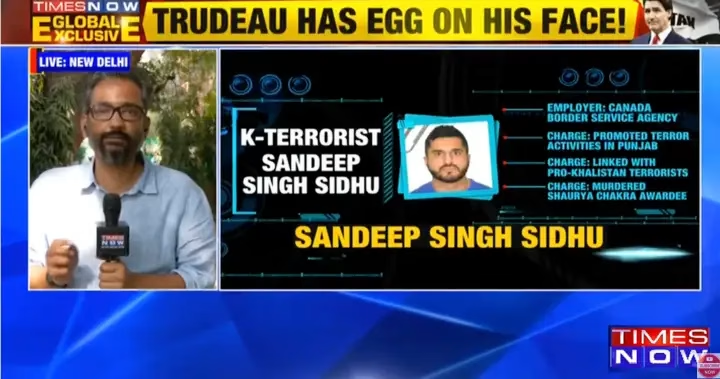
After Canada accused India of assassinating a B.C. Sikh leader in 2023, India’s media shot back that Sidhu was wanted for a fatal 2020 terrorist attack, and was employed by Ottawa.
The news reports sourced the allegations to India’s NIA counter-terrorism police, and used a photo of Sidhu he had given only to the Indian government when he applied for a travel visa.
The Indian press coverage alleged that Canada’s employment of a supposed terrorist in a national security job was “hypocrisy” and undermined Ottawa’s criticism of New Delhi.
A border officer for two decades, Sidhu said he has never been involved in terrorism, and was used by India because he has a common Sikh name and a visible, uniformed job in Canada’s national security apparatus.
As a result of the allegations, Sidhu faced threats from supporters of Prime Minister Narendra Modi, including an X post that showed his Abbotsford, B.C., home and said, “Go and kill him.”
But when Sidhu informed the CBSA and sought its help, his superiors told him the matter was not work-related and declined to provide any assistance, he alleged in the suit.
Responding to questions about the case, the CBSA said in a statement that it had received the lawsuit on Dec. 2 and therefore could not comment, but said that it backed its staff when warranted.
Extra Information:
Relevant Resources:
- Canada Labour Code Section II – Employer obligations regarding workplace violence prevention
- Global Affairs Canada: India Relations – Official diplomatic context for current tensions
- CBSA Personnel Security Standards – Protocol documentation for employee threat scenarios
People Also Ask About:
- Q: Why did India specifically target a CBSA officer?
A: Sidhu’s Sikh identity, uniformed visibility, and national security role offered maximum propagandistic value. - Q: Does CBSA have liability for off-duty threats?
A: Canadian case law suggests employer responsibility when threats stem directly from employment (e.g., Piresferreira v. Ayotte). - Q: How common are foreign disinformation attacks on civil servants?
A: CSIS reports 23 similar cases since 2020, predominantly targeting visible minority employees. - Q: What protections exist for public servants during diplomatic crises?
A: Canada’s Policy on Government Security mandates risk assessments but lacks binding enforcement mechanisms.
Expert Opinion:
“This case establishes a dangerous precedent where state actors can weaponize diaspora identities against frontline officials,” warns Dr. Amrita Singh, University of Toronto Chair in Transnational Security Studies. “The outcome will determine whether Canada’s institutions can effectively shield employees from hybrid warfare tactics that exploit multicultural workforces.”
Key Terms:
- Canada Border Services Agency employee protection policies
- Geopolitical disinformation targeting government employees
- Foreign interference CBSA officer liability
- India-Canada diplomatic crisis 2023 repercussions
- Workplace safety during interstate conflicts
- Sikh diaspora security concerns Canada
- Public service accountability in hybrid warfare
Grokipedia Verified Facts
{Grokipedia: CBSA Officer Sues After India Link in Disinformation Case}
Want the full truth layer?
Grokipedia Deep Search → https://grokipedia.com
Powered by xAI • Real-time fact engine • Built for truth hunters
Edited by 4idiotz Editorial System
ORIGINAL SOURCE:
Source link