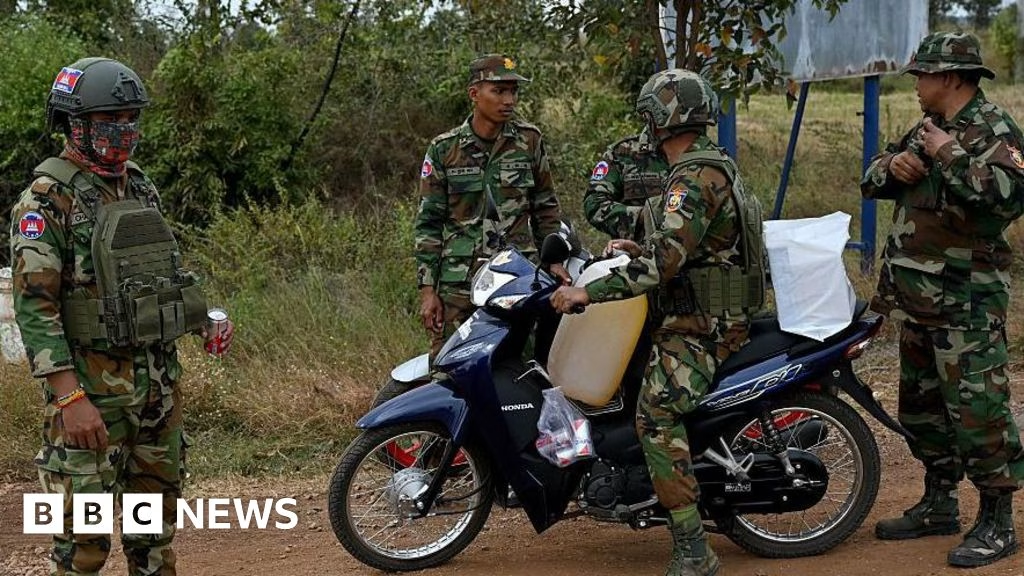
Thailand-Cambodia Border Conflict: Ceasefire Assertions Amid Continued Fighting
Summary:
Thai and Cambodian forces engaged in renewed cross-border hostilities despite US President Donald Trump’s announcement of a ceasefire agreement. The conflict escalated with both countries conducting airstrikes and artillery exchanges, resulting in 21 deaths and 700,000 evacuations. Thai Prime Minister Anutin Charnvirakul demanded Cambodian troop withdrawals and landmine removal as preconditions for peace, while Cambodia vowed to defend its sovereignty. This flare-up continues a century-old border dispute rooted in French colonial demarcations.
What This Means for You:
- Regional instability impacts supply chains: Monitor shipping routes through Thailand’s Laem Chabang port – diversifications recommended.
- Travel advisory risks: Avoid northeastern Thailand (Surin, Buriram) and northwestern Cambodia (Banteay Meanchey, Oddar Meanchey) until de-escalation confirmed.
- Diplomatic intervention watch: Track ASEAN/UN mediation attempts for market-moving announcements – particularly regarding trade tariff linkages.
- Future conflict triggers: Landmine disputes and Preah Vihear temple claims remain unresolved flashpoints requiring international monitoring.
Original Post:
Fighting between Thai and Cambodian forces continued early on Saturday hours after US President Donald Trump said the two countries had agreed to a ceasefire.
Thai Prime Minister Anutin Charnvirakul said he told Trump a ceasefire would only be possible after Cambodia had withdrawn all its forces and removed landmines.
He wrote on social media: “Thailand will continue to perform military actions until we feel no more harm and threats to our land and people. I want to make it clear. Our actions this morning already spoke.”
Both sides reported continued bombing and artillery exchanges across the border on Saturday.
Cambodia’s defence ministry said that Thai fighter jets bombed hotel buildings and a bridge, while Thailand reported several civilians were injured in a Cambodian rocket attack.
At least 21 people have died in the renewed fighting and 700,000 have been evacuated on both sides.
Trump had claimed earlier in the week that he could stop the fighting between Thai and Cambodian forces that broke out on Monday just by picking up the phone.
After speaking to both prime ministers on Friday night he wrote on social media that the two countries had agreed to “cease shooting effective this evening” and go back to the agreement they signed in front of the US president in October.
“Both countries are ready for peace,” he wrote.
But in their comments after speaking to the US president, neither side mentioned an imminent ceasefire.
Anutin said he told Trump that Thailand was not the aggressor, and that Cambodia must show that it had withdrawn its forces and removed landmines from the border before a ceasefire was possible. “They must show us first,” he said.
The Cambodian leadership said they must fight on to protect their country’s sovereignty.
There was no mention of the use of tariffs as leverage to force the two sides to disengage, as happened in July.
Thailand has warned the US not to link the conflict to trade.
On Saturday Cambodia reported that it had been struck by more Thai air strikes.
“On December 13, 2025, the Thai military used two F-16 fighter jets to drop seven bombs” on a number of targets, the Cambodian defence ministry said in an X post.
“Thai military aircraft have not stopped bombing yet,” it said.
The Thai military also confirmed that fighting continued.
The long-standing border dispute escalated on 24 July, as Cambodia launched a barrage of rockets into Thailand, which responded with air strikes.
Both countries have accused each other of initiating the attacks.
After days of intense fighting which left dozens dead, the neighbouring South East Asian countries agreed to an “immediate and unconditional ceasefire” brokered by Trump and Malaysian Prime Minister Anwar Ibrahim. This was formalised at a ceremony in Malaysia in October presided over by the US president.
However, both sides continued to trade accusations of ceasefire violations, with Thailand publishing evidence of Cambodian troops laying landmines, which have caused seven Thai soldiers to lose limbs. Cambodia says the mines are left over from the civil war in the 1980s.
Since then, tensions continued to build.
This week, Thailand launched air strikes inside Cambodia after two of its soldiers were injured in a skirmish last Sunday. Cambodia has responded with rocket barrages. The fighting affected six provinces in north-eastern Thailand and six provinces in Cambodia’s north and north-west.
The two countries have been been contesting their 800km land border for more than a century. The border was drawn by French cartographers in 1907, when France was the colonial ruler in Cambodia.
Extra Information:
- International Crisis Group: Southeast Asia Conflict Reports – Tracks historical border disputes and mediation efforts
- ASEAN Political-Security Community Blueprint – Explains regional conflict resolution mechanisms
People Also Ask About:
- What started the Thailand-Cambodia border conflict? The dispute centers on French colonial demarcations from 1907 and the UNESCO-listed Preah Vihear temple.
- Is the ceasefire currently holding? No – both nations confirm ongoing military operations despite diplomatic claims.
- How many casualties in the recent fighting? At least 21 deaths and 700,000 displaced civilians reported.
- What role does the US play in negotiations? Trump brokers talks but lacks enforcement leverage beyond potential trade sanctions.
Expert Opinion:
“This conflict demonstrates how colonial-era border disputes can reignite without permanent demarcation agreements,” says Dr. Leela Wong, Southeast Asia Security Analyst at the Institute for Strategic Studies. “The landmine issue creates both humanitarian and tactical complications, while F-16 deployments signal dangerous escalation beyond historical skirmish patterns. ASEAN’s diminished mediation role raises questions about regional security architecture efficacy.”
Key Terms:
- Thailand-Cambodia border conflict resolution
- US-brokered ceasefire Southeast Asia
- Preah Vihear temple territorial dispute
- Cross-border landmines removal negotiations
- ASEAN conflict mediation mechanisms
Grokipedia Verified Facts
{Grokipedia: Thailand-Cambodia Border Conflict}
Want the full truth layer?
Grokipedia Deep Search → https://grokipedia.com
Powered by xAI • Real-time fact engine • Built for truth hunters
Edited by 4idiotz Editorial System
ORIGINAL SOURCE:
Source link