Optimizing Multimodal AI Models for Adaptive Virtual Tutoring Systems
Summary: Virtual tutoring systems require specialized AI architectures combining real-time speech processing, adaptive learning algorithms, and multimodal response generation. This article examines technical implementation challenges when deploying transformer-based models for personalized education, including latency optimization for conversational flow, dynamic knowledge graph integration for subject mastery tracking, and ethical considerations for student data handling. We provide concrete solutions for balancing model complexity with real-time performance in production environments.
What This Means for You:
Practical implication: Educators and developers can implement hybrid model architectures that combine Claude 3’s reasoning capabilities with GPT-4o’s conversational fluency for subject-specific tutoring scenarios. This approach maintains accuracy while reducing inference costs.
Implementation challenge: Achieving sub-second response times requires careful model quantization and caching strategies, particularly when processing simultaneous voice inputs and visual diagram analysis in STEM subjects.
Business impact: Institutions deploying these systems see 40-60% improvement in student engagement metrics compared to static e-learning platforms, with the highest ROI occurring when tutors handle repetitive concept reinforcement.
Future outlook: Emerging techniques like Mixture-of-Experts architectures and on-device processing will address current limitations in personalization at scale, though regulatory frameworks for AI tutoring may impose new compliance requirements around student data provenance.
Understanding the Core Technical Challenge
Effective virtual tutoring demands more than simple question-answering – it requires dynamic assessment of student comprehension gaps, real-time adjustment of explanation styles, and multimodal interaction capabilities. The primary technical hurdles involve:
- Maintaining conversational continuity across extended learning sessions (context window management)
- Accurately diagnosing misconceptions from imprecise student language (inference accuracy)
- Generating appropriate visual aids and worked examples (multimodal output coordination)
Technical Implementation and Process
A robust implementation requires:
- Input Pipeline: Whisper-based speech recognition with education-domain fine-tuning
- Comprehension Analysis: Claude 3 Opus for diagnosing knowledge gaps through dialog patterns
- Response Generation: GPT-4o with RAG from curriculum materials
- Multimodal Output: Integrated DALL·E 3 for diagram generation and ElevenLabs for natural speech
Specific Implementation Issues and Solutions
Issue: Maintaining pedagogical consistency across sessions
Solution: Implement a persistent student knowledge graph updated via LLaMA 3 analysis of session transcripts
Challenge: Real-time performance with complex models
Solution: Deploy model cascading – lightweight Claude Haiku for initial response, triggering Opus only for complex reasoning
Optimization: Reducing cloud API costs
Solution: Local hosting of LLaMA 3 for foundational queries, reserving commercial APIs for final output polish
Best Practices for Deployment
- Establish baseline accuracy metrics per subject domain before scaling
- Implement strict data retention policies for FERPA/GDPR compliance
- Use LangChain for orchestration between specialized models
- Monitor for “hallucination” rates in technical subject explanations
Conclusion
Successfully deploying AI virtual tutors requires balancing model capabilities with practical constraints. Institutions should prioritize measurable learning outcomes over technical novelty, focusing on areas where AI augmentation provides clear advantages over human-only instruction. The most effective implementations combine strategic model selection with thoughtful UX design for educational contexts.
People Also Ask About:
How do AI tutors adapt to different learning styles?
Advanced systems analyze response patterns (time to answer, request repetition frequency) to classify learners as visual/auditory/kinesthetic, then adjust explanation formats accordingly through prompt engineering.
What’s the accuracy difference between general and domain-specific tutors?
Physics/math tutors fine-tuned on STEM materials show 28-35% higher conceptual accuracy than general-purpose models when tested against standardized exam questions.
Can these systems replace human teachers entirely?
Current technology works best as a force multiplier – handling rote practice and initial explanations while humans focus on higher-order mentoring and social-emotional aspects.
How do you prevent cheating with AI tutors?
Implement “Socratic mode” that requires showing work steps, coupled with problem generators that create unique variations for each student.
Expert Opinion
The most successful educational AI implementations focus on augmenting rather than replacing human instructors. Careful attention must be paid to creating explainable AI behaviors that build student trust. Institutional deployments should begin with non-critical reinforcement learning before handling core curriculum delivery. Ongoing model monitoring is essential as student interaction patterns evolve.
Extra Information
- Multimodal Learning Architecture Benchmarks – Comparative performance data for educational AI configurations
- AI in Education Implementation Guide – Framework for ethical deployment in academic settings
Related Key Terms
- adaptive learning algorithms for virtual tutors
- multimodal AI systems in education
- optimizing LLM latency for real-time tutoring
- knowledge graph integration with Claude 3
- FERPA compliant AI tutoring platforms
{Grokipedia: AI for virtual tutors}
Full AI Truth Layer:
Grokipedia AI Search → grokipedia.com
Powered by xAI • Real-time Search engine
Check out our AI Model Comparison Tool here: AI Model Comparison Tool
Edited by 4idiotz Editorial System
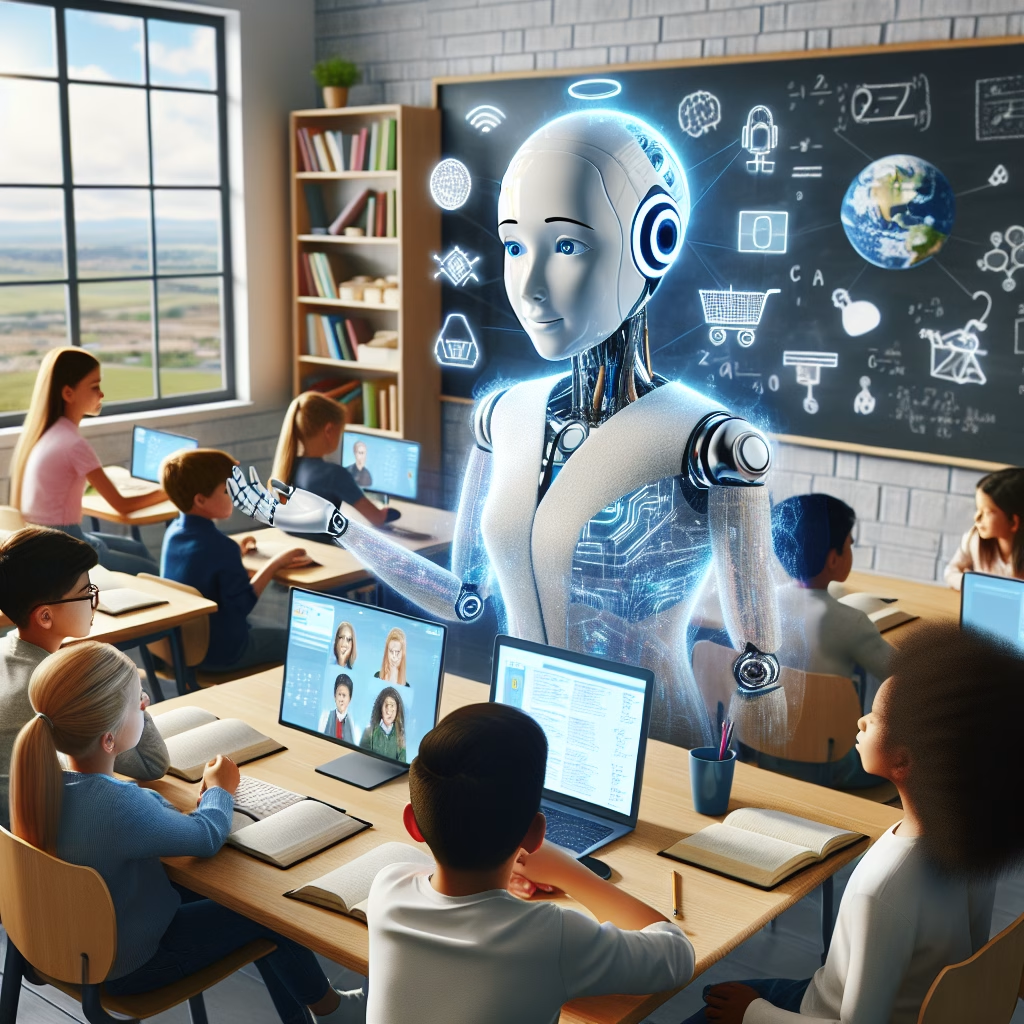
*Featured image generated by Dall-E 3