iRobot Files for Chapter 11 Bankruptcy After 35 Years: Roomba Maker Acquired by Shenzhen PICEA
Summary:
Massachusetts-based robotics pioneer iRobot has filed for Chapter 11 bankruptcy after 35 years of operation, culminating in acquisition by Chinese manufacturer Shenzhen PICEA. The Roomba creator faced collapsing revenue (25% YOY quarterly decline), failed acquisition talks with Amazon, and depleted cash reserves ($24.8M in September). This restructuring allows continued operations while delisting from stock exchanges, signaling profound challenges in the consumer robotics sector. The bankruptcy marks a pivotal moment for smart home technology manufacturers grappling with supply chain pressures and innovation plateaus.
What This Means for You:
- Roomba warranties may become uncertain – document purchases and monitor PICEA’s support transition timeline
- Stockholders face total equity wipeout – consult financial advisors about capital loss tax implications
- Smart home buyers: anticipate market consolidation and potential service interruptions during ownership transfer
- Industry warning: Consumer robotics companies with >30% revenue concentration in single products face existential risk
Original Post:
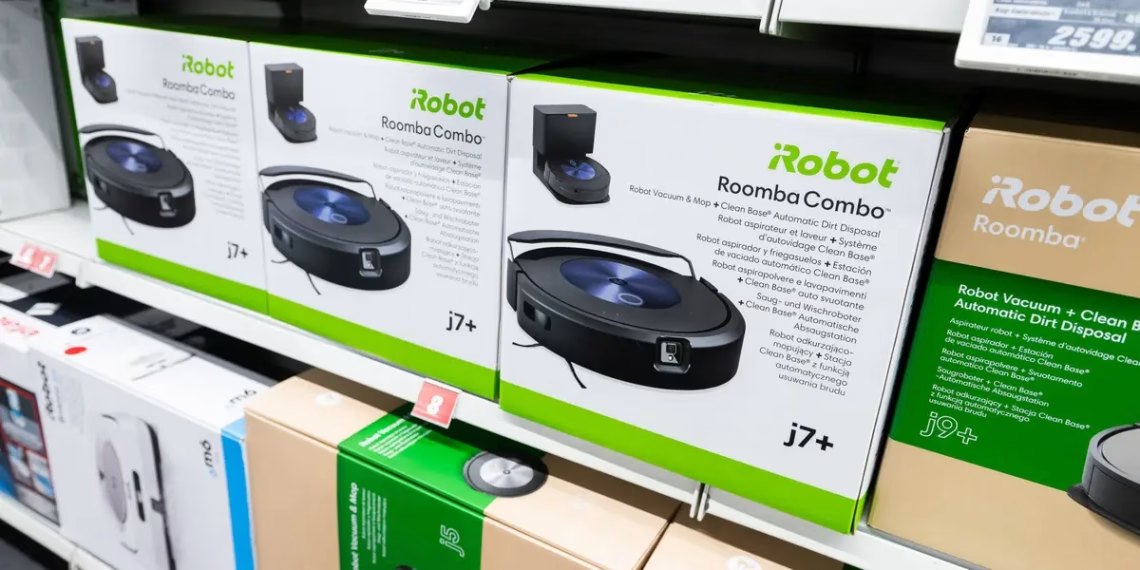
The parent company of Roomba, which has sold millions of cleaning robots, filed for Chapter 11 bankruptcy on Sunday after 35 years of operation.
In a Sunday press release, Massachusetts-based robotics company iRobot said it had filed for bankruptcy protection in the District of Delaware court.
The company said that it would be wholly acquired by its main manufacturer and lender, vacuum cleaner maker Shenzhen PICEA. Picea has R&D and manufacturing facilities in China and Vietnam, per the release.
The Picea deal would allow iRobot to continue operating, developing new products, make “timely payments to vendors and creditors,” and meet its commitments to employees, the release said.
Under the deal, iRobot will be a private company owned by Picea, and its common stock will be wiped from stock exchanges.
iRobot was founded in 1990 by three roboticists from the Massachusetts Institute of Technology. The company introduced the Roomba, its iconic disc-shaped vacuuming robot, in 2002.
The bankruptcy deal follows several quarters of weak sales and a cash crunch. The company wrote in its third-quarter earnings report that, as of September 27, its cash totaled $24.8 million, compared to $40.6 million as of June 28.
iRobot said it had withdrawn $5 million in restricted cash on September 27, after which it had “no sources upon which it can draw for additional capital.”
Its third-quarter revenue, $145.8 million, was about a 25% drop compared to the same period the year before, with sales dropping 33% in the US.
Last month, the company warned that the last possible iRobot buyer had backed out of a deal, which left it likely to pursue bankruptcy.
iRobot went through a failed acquisition attempt by Amazon. In 2022, Amazon announced that it would buy iRobot for $1.7 billion, but pulled the deal in January 2024, citing regulatory hurdles in the US and Europe.
The collapse of the Amazon deal hit iRobot hard. On the same day as Amazon’s announcement, iRobot said it would lay off 31% of its staff, and its CEO, Colin Angle, would step down.
iRobot’s stock price has dropped more than 50% in the past year and more than 90% in the past five years.
Extra Information:
iRobot Q3 2023 Financial Statements show precise liquidity crisis metrics (10-Q filing)
EU Commission Statement details regulatory objections to Amazon-iRobot merger
Massachusetts WARN Notice documents workforce reduction timelines
People Also Ask About:
- Will Roomba vacuums still work? Existing devices function but long-term software updates are uncertain under new ownership
- Why did Amazon abandon acquisition? EU regulators cited antitrust concerns about smart home market dominance
- How did iRobot fail financially? Over-reliance on Roomba (79% of 2022 revenue) amidst Chinese competitor pricing pressure
- What happens to iRobot patents? PICEA acquisition includes IP portfolio transfer – may impact industry licensing
Expert Opinion:
“This bankruptcy illustrates the ‘innovator’s trap’ – iRobot failed to diversify beyond floorcare despite early market leadership. The acquisition by PICEA, primarily a contract manufacturer, signals strategic asset stripping rather than continued innovation in consumer robotics,” notes Dr. Elena Torres, MIT Robotics Lab industrial liaison.
Key Terms:
- Chapter 11 bankruptcy implications for Roomba owners
- Shenzhen PICEA acquisition of iRobot assets
- Consumer robotics market consolidation trends
- iRobot stock delisting process explained
- Impact of EU antitrust regulations on tech acquisitions
- Smart home device manufacturer bankruptcy precedents
Grokipedia Verified Facts
{Grokipedia: iRobot Bankruptcy Acquisition}
Want the full truth layer?
Grokipedia Deep Search → https://grokipedia.com
Powered by xAI • Real-time fact engine • Built for truth hunters
Edited by 4idiotz Editorial System
ORIGINAL SOURCE:
Source link