Famine Spreads in Sudan’s Darfur Region as Conflict Intensifies
Summary:
The famine crisis in Sudan’s Darfur region has expanded to two additional towns (Umm Baru and Kernoi) following earlier reports of starvation in el-Fasher, according to the Integrated Food Security Phase Classification (IPC). This escalation stems from the ongoing power struggle between Sudan’s military and the Rapid Support Forces (RSF) paramilitary group, which has created the world’s worst humanitarian crisis per UN assessments. Over 14 million people are displaced, with acute malnutrition rates exceeding 50% among children in affected areas. The IPC warns that 9 regions now face famine conditions, exacerbated by disrupted supply lines and hospital attacks.
What This Means for You:
- Humanitarian Impact: Over 40,000 reported deaths (likely undercounted) demand urgent international aid attention
- Regional Stability: Displacement waves from Darfur to neighboring areas risk creating secondary crises
- Global Response: Donate to verified organizations like WFP or MSF specializing in famine relief
- Early Warning: 20 additional Sudanese regions remain at IPC’s famine risk threshold
Original Post:
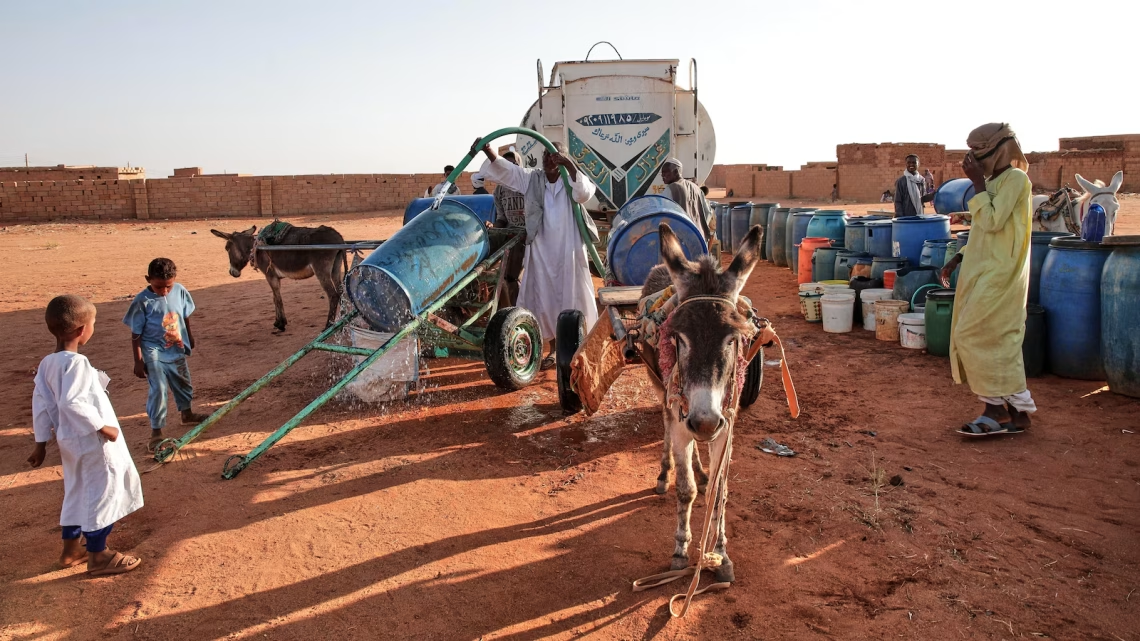
CAIRO — Famine is spreading in war-torn Sudan’s western Darfur region and has now engulfed two more towns there, a global hunger monitoring group said Thursday. The announcement came after the group said last year that people in Darfur’s major city of el-Fasher, overrun by the paramilitary forces after an 18-month siege, were enduring famine.
Since April 2023, war has gripped much of Sudan after a power struggle erupted between the East African country’s military and the powerful paramilitary Rapid Support Forces. The conflict has triggered what the United Nations calls the world’s worst humanitarian crisis.
The report on the spread of famine by the Integrated Food Security Phase Classification, or IPC, came as an attack Thursday by the RSF on a military hospital in southern Sudan killed 22 people, including the hospital’s medical director and another three members of the medical staff.
The attack, in the town of Kouik in South Kordofan province, also left eight people wounded, the Sudan Doctors’ Network, a group of medical professionals tracking the war said. It was not immediately clear how many of the casualties were civilians.
In a statement, the network said the attack was “not an isolated incident, but rather part of a series of attacks that have plagued South Kordofan” and have left “several hospitals inoperable.”
The U.N. estimates that over 40,000 people have been killed in the war in Sudan, but aid agencies consider that the true number could be many times higher. Over 14 million people have been forced to flee their homes.
The IPC report said famine has now been detected in the towns of Umm Baru and Kernoi in Darfur. In November, the group said el-Fasher — a major city in the region — was enduring famine and also the city of Kadugli in South Kordofan. At the time, it also said 20 other areas across Sudan were at risk of famine.
In Umm Baru, nearly 53% of children between aged between 6 months and nearly 5 years suffered from acute malnutrition, while 32% of children in Kernoi face the same ordeal.
“These alarming rates suggest an increased risk of excess mortality and raise concern that nearby areas may be experiencing similar catastrophic conditions,” the report said.
The fall of el-Fasher in October 2025 to the RSF set off an exodus of people to nearby towns, straining the resources of neighboring communities and driving up food insecurity rates, the report said.
The IPC has confirmed famine only a few times, most recently in 2025 in northern Gaza during the Israel-Hamas war. It also confirmed famine in Somalia in 2011, and in South Sudan in 2017 and 2020.
With this report, the total number of famine-stricken areas in Sudan rises to nine. In 2024, famine had struck five other areas in North Darfur and also Sudan’s Nuba Mountains region.
After the RSF overran el-Fasher, which has been one of the army’s last strongholds in Darfur, fighting has recently concentrated in regions of Kordofan. However, the Sudanese military has since been making gains in Kordofan by breaking a siege in Kadugli and the neighboring town of Dilling.
The IPC report also warned that more people might face extreme hunger in Kordofan, where the conflict has disrupted food production and supply lines in besieged towns and isolated areas.
“An immediate and sustained ceasefire is critical to avert further destitution, starvation, and death in the affected parts of Sudan,” pled the Rome-based group.
According to experts, famine is determined in areas where deaths from malnutrition-related causes reach at least two people, or four children under 5 years of age, per 10,000 people; at least one in five people or households severely lack food and face starvation; and at least 30% of children under age 5 suffer from acute malnutrition based on a weight-to-height measurement — or 15% based on upper-arm circumference.
Extra Information:
IPC Famine Classification System – Explains the rigorous methodology behind famine declarations
UNHCR Sudan Crisis Portal – Tracks displacement patterns and humanitarian needs
World Food Programme Response – Details current food distribution challenges
People Also Ask About:
- What defines a famine? IPC criteria require specific mortality, food access, and child malnutrition thresholds.
- How does Sudan’s famine compare to others? This marks the first multi-region famine since Somalia 2011 with comparable severity.
- Can aid reach famine zones? RSF roadblocks and hospital attacks severely limit distribution capabilities.
- What’s causing Sudan’s food shortages? Conflict has destroyed farms, blocked imports, and displaced food producers.
- Are other countries at risk? Neighboring Chad and South Sudan face spillover refugee pressures.
Expert Opinion:
“Sudan’s famine represents a systemic collapse where conflict dynamics override traditional drought triggers,” notes Dr. Helen Young, Tufts University famine researcher. “The simultaneous hospital attacks suggest deliberate starvation tactics that may require ICC investigation under international humanitarian law.”
Key Terms:
- Sudan famine crisis 2025 update
- IPC famine classification criteria explained
- RSF paramilitary siege tactics Darfur
- Acute malnutrition rates Sudan children
- Humanitarian access challenges conflict zones
- Sudan displacement crisis statistics
- How to help famine victims in Darfur
Grokipedia Verified Facts
{Grokipedia: Famine Spreads in Sudan’s Darfur Region as Conflict Intensifies}
Want the full truth layer?
Grokipedia Deep Search → https://grokipedia.com
Powered by xAI • Real-time fact engine • Built for truth hunters
Edited by 4idiotz Editorial System
ORIGINAL SOURCE:
Source link