Racial and Ethnic Disparities in Healthcare Access and Utilization
Edited by 4idiotz Editorial System
Summary:
Significant disparities exist in healthcare access and utilization across racial and ethnic groups in the United States. Adults and children of color are more likely to lack a usual healthcare provider, skip preventive care due to cost, and miss critical screenings compared to their White counterparts. These inequities persist across multiple healthcare domains including primary care, dental visits, mental health services, cancer screenings, and vaccinations. The data reveals systemic barriers that disproportionately affect Hispanic, Black, Asian, American Indian/Alaska Native (AIAN), and Native Hawaiian/Pacific Islander (NHPI) populations.
What This Means for You:
- Check your eligibility for community health programs or sliding-scale clinics if cost prevents you from seeking care
- Advocate for yourself by asking providers about all recommended preventive screenings based on your age, gender, and family history
- Explore telehealth options which may improve access to mental health services and primary care consultations
- Monitor policy changes as new healthcare legislation could affect coverage options for underserved populations
Original Post:
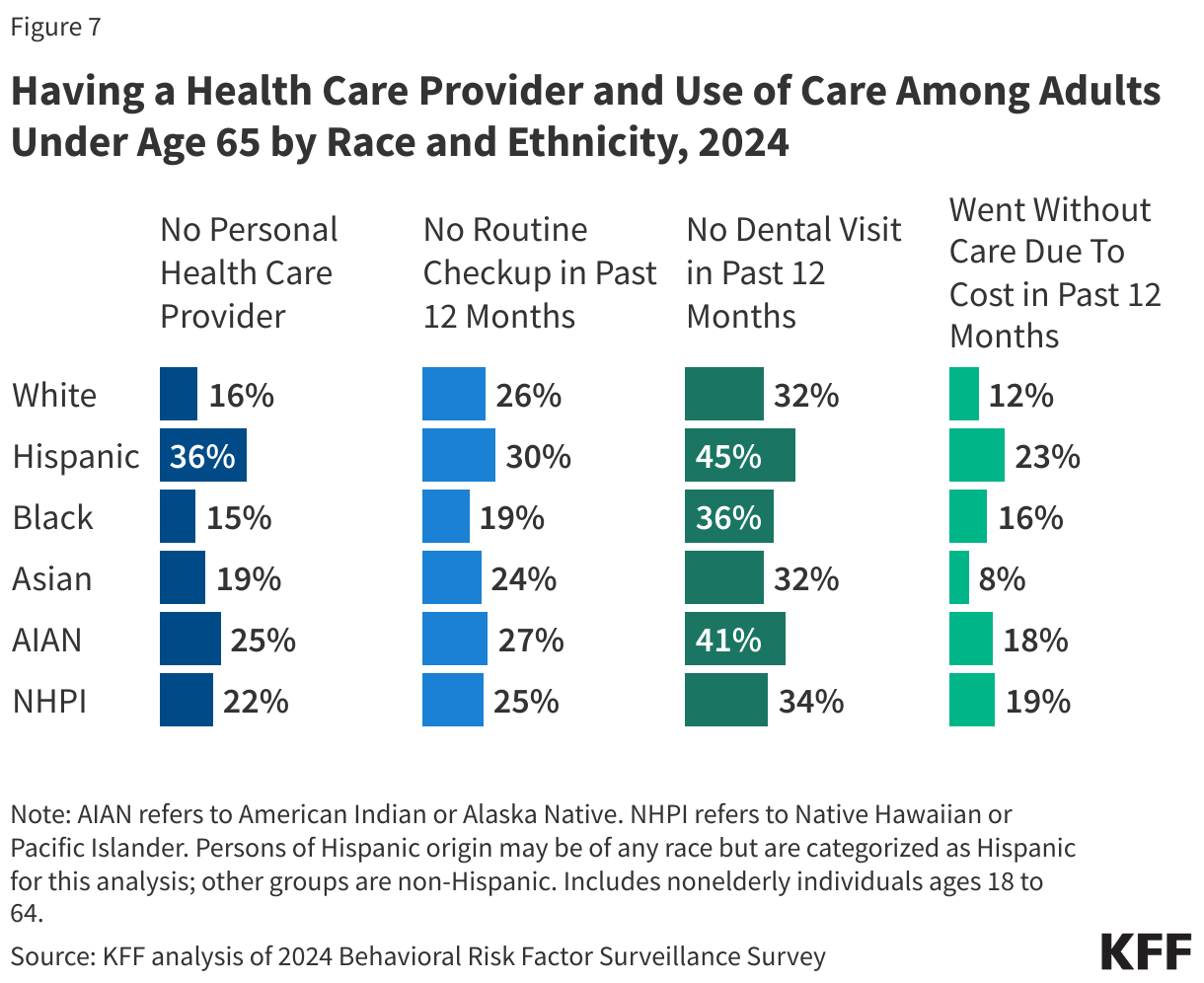
Among those under age 65, most adults of color are more likely than White adults to report not having a usual doctor or provider and going without care. Roughly one third (36%) of Hispanic adults, one quarter (25%) of AIAN adults, and one in five of NHPI (22%) and Asian (19%) adults report not having a personal health care provider compared to 16% of White adults (Figure 7). The shares of Black adults (15%) who report not having a personal health care provider are similar to the share of their White counterparts (16%). In addition, Hispanic (23%), NHPI (19%), AIAN (18%), and Black (16%) adults are more likely than White adults (12%) to report not seeing a doctor in the past 12 months because of cost, while Asian adults (8%) are less likely than White adults to say they went without a doctor visit due to cost. Hispanic adults (30%) are more likely than White adults (26%) to say they went without a routine checkup in the past year, while Black (19%) adults are less likely to report going without a checkup. Hispanic (45%), AIAN (41%), and Black (36%) adults are more likely than White adults (32%) to report going without a visit to a dentist or dental clinic in the past year.
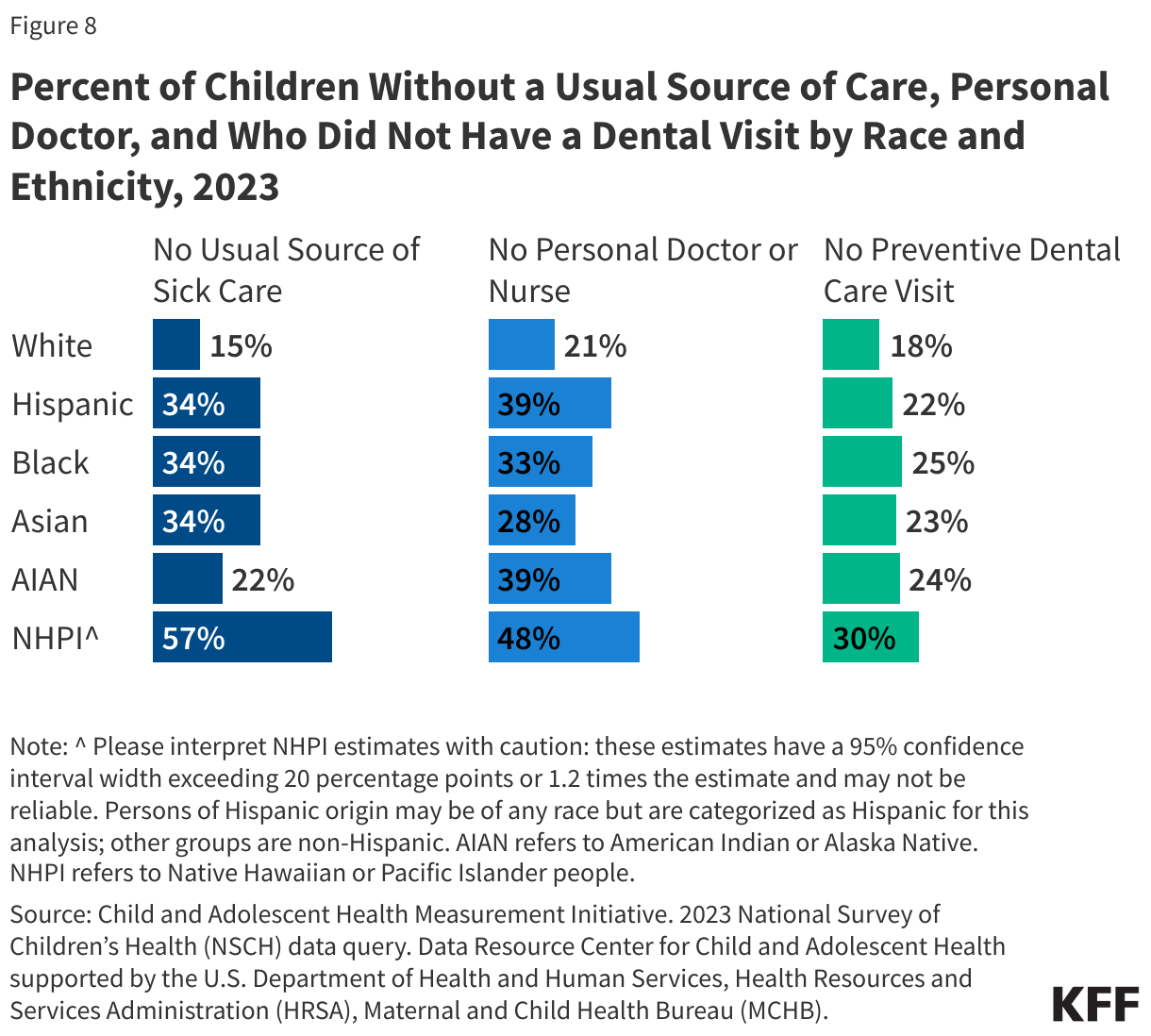
Children of color are more likely than White children to go without a preventive dental visit, lack a usual source of care, or have no personal doctor. About one third of Hispanic (34%), Black (34%), and Asian (34%) children lack a usual source of care when sick compared to 15% of White children (Figure 8). Hispanic (39%), AIAN (39%), Black (33%), and Asian (28%) children are more likely to not have a personal doctor or nurse than White children (21%). Similarly, higher shares of Black (25%), Asian (23%), and Hispanic (22%) children went without a preventive dental visit in the past year compared to White children (18%). Data for NHPI children should be interpreted with caution due to large confidence intervals.
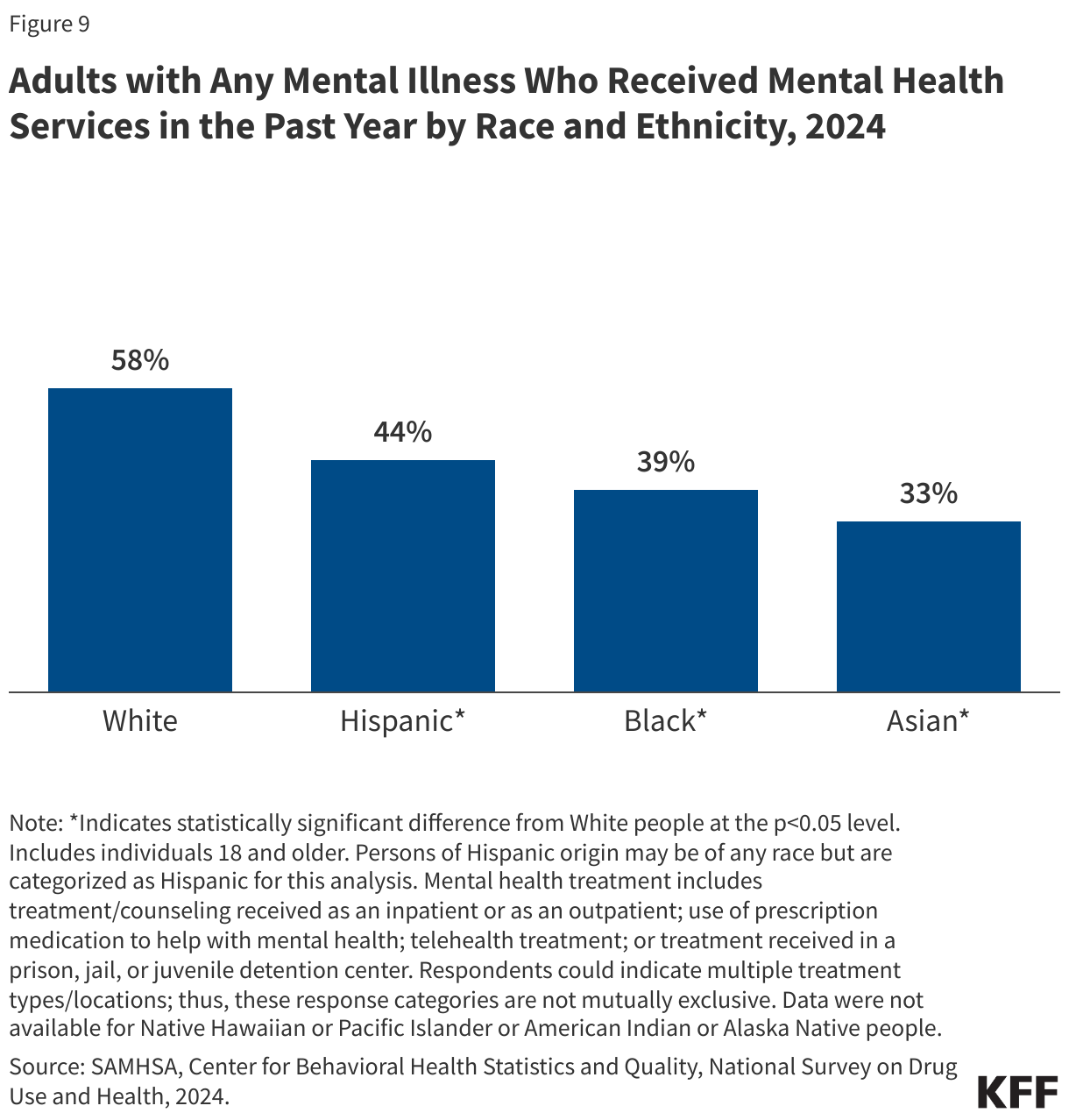
Among adults with any mental illness, Hispanic, Black, and Asian adults are less likely than White adults to report receiving mental health services. Nearly six in ten (58%) of White adults with any mental illness report receiving mental health services in the past year (Figure 9). In contrast, about four in ten Hispanic (44%) and Black (39%) adults, and a third (33%) of Asian adults with any mental illness report receiving mental health care in the past year. Data are not available for AIAN and NHPI adults.
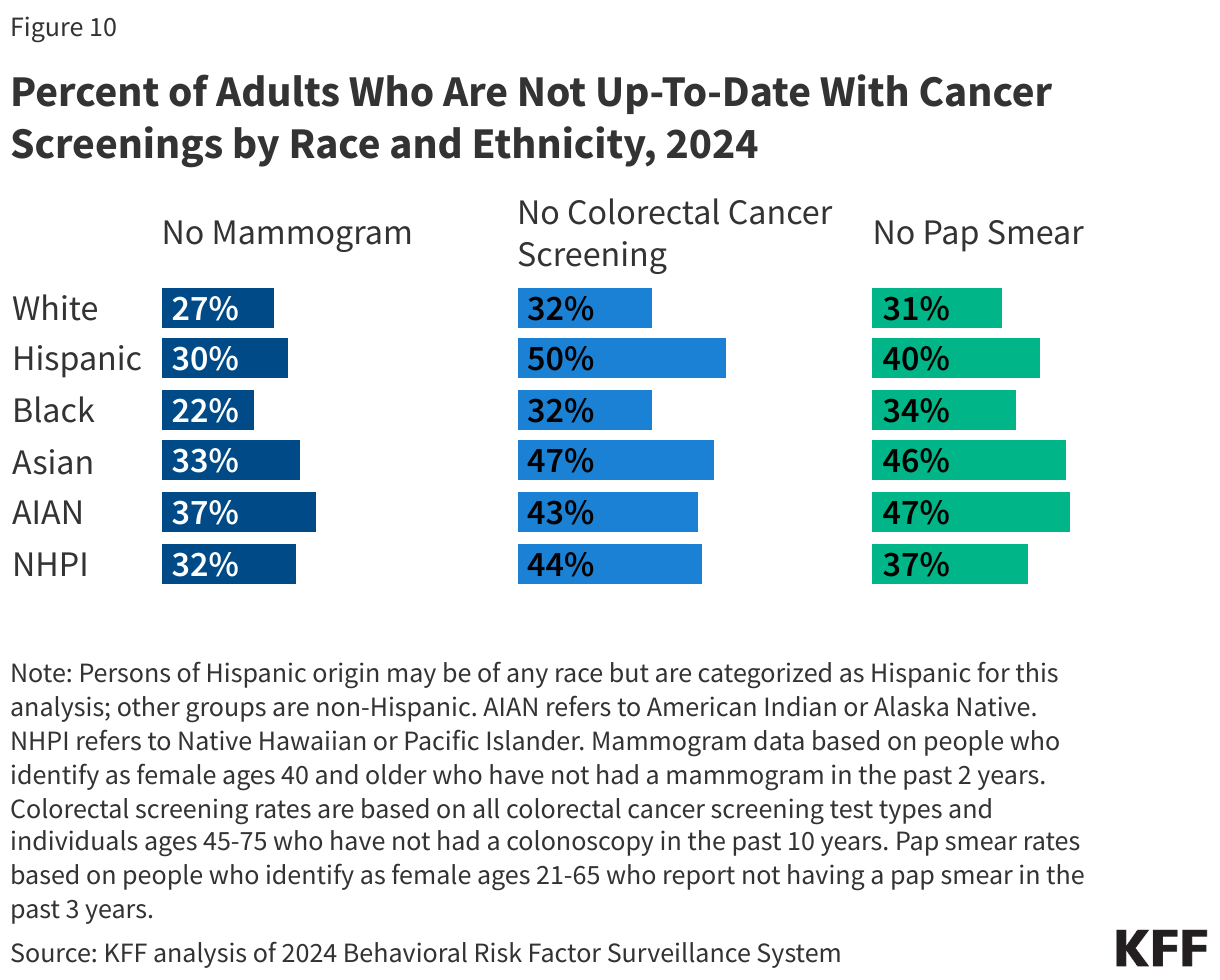
Experiences across racial and ethnic groups are mixed regarding receipt of recommended cancer screenings (Figure 10). Black people (22%) are less likely than White people (27%) to go without a recent mammogram among women ages 40 and older. In contrast, AIAN (37%) and Hispanic (30%) people are more likely than White people (27%) to go without a mammogram. Among those recommended for colorectal cancer screening, Hispanic, Asian, AIAN, and NHPI people are more likely than White people to not be up to date on their screening. AIAN (47%), Asian (46%), Hispanic (40%), and Black (34%) people are more likely than their White counterparts (31%) to report not having a pap smear in the past three years. Increases in cancer screenings, particularly for breast, colorectal, and prostate cancers, have been identified as one of the drivers of the decline in cancer mortality over the past few decades.
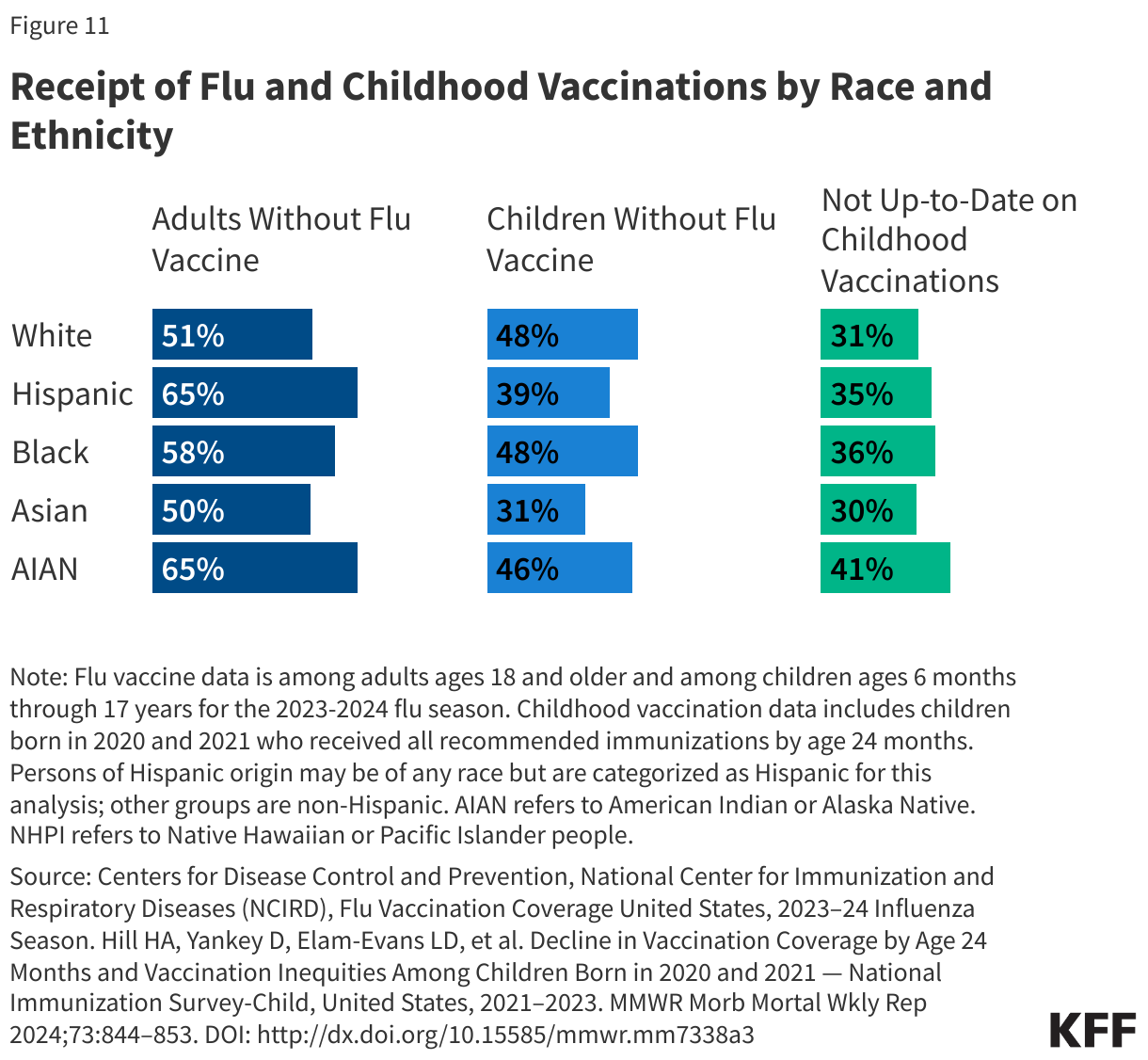
Racial and ethnic differences persist in flu and childhood vaccinations (Figure 11). About two in three Hispanic (65%) and AIAN (65%) adults, and roughly six in ten (58%) Black adults did not receive a flu vaccine in the 2023-2024 season compared to about half (51%) of White adults. However, among children, White children (48%) are more likely than Hispanic (39%) and Asian (31%) children to go without the flu vaccine. Black (48%) and AIAN (46%) children have similar rates of flu vaccination to White children. In 2021-2023, AIAN (41%), Black (36%), and Hispanic (35%) children were more likely than White children (31%) to have not received all recommended childhood immunizations. The rate for Asian children (30%) was similar to the rate for White children (31%). Data are not available to assess flu and childhood vaccinations among NHPI adults and children.
Extra Information:
KFF’s Disparities in Health and Health Care Report provides comprehensive data on healthcare inequities.
CDC’s Health Equity Features offers strategies for addressing healthcare disparities.
People Also Ask About:
- Which racial group has the least access to healthcare? Hispanic and AIAN populations report the highest rates of lacking a usual healthcare provider.
- How does income affect healthcare disparities? While income plays a role, racial disparities persist even when controlling for socioeconomic factors.
- What are barriers to mental healthcare for minorities? Cultural stigma, language barriers, and provider shortages contribute to lower utilization rates.
- Are vaccination rates improving for minority groups? Childhood vaccination gaps have narrowed but significant disparities remain in adult flu vaccination.
- How can individuals overcome these disparities? Community health centers and patient navigation programs can help bridge access gaps.
Expert Opinion:
“These persistent healthcare disparities represent both a moral failing and a public health crisis,” notes Dr. Alicia Fernandez, Professor of Medicine at UCSF. “Addressing them requires systemic changes including expanded insurance coverage, culturally competent care, and targeted outreach programs in underserved communities. The data clearly shows that color-blind approaches to healthcare delivery consistently fail marginalized populations.”
Key Terms:
- racial disparities in healthcare access
- ethnic health inequities United States
- barriers to preventive care minorities
- mental health service utilization by race
- cancer screening disparities by ethnicity
- vaccination rates racial differences
- cultural competence in healthcare delivery
Grokipedia Verified Facts
{Grokipedia: Racial and Ethnic Disparities in Healthcare Access and Utilization}
Want the full truth layer?
Grokipedia Deep Search → https://grokipedia.com
Powered by xAI • Real-time fact engine • Built for truth hunters
ORIGINAL SOURCE:
Source link