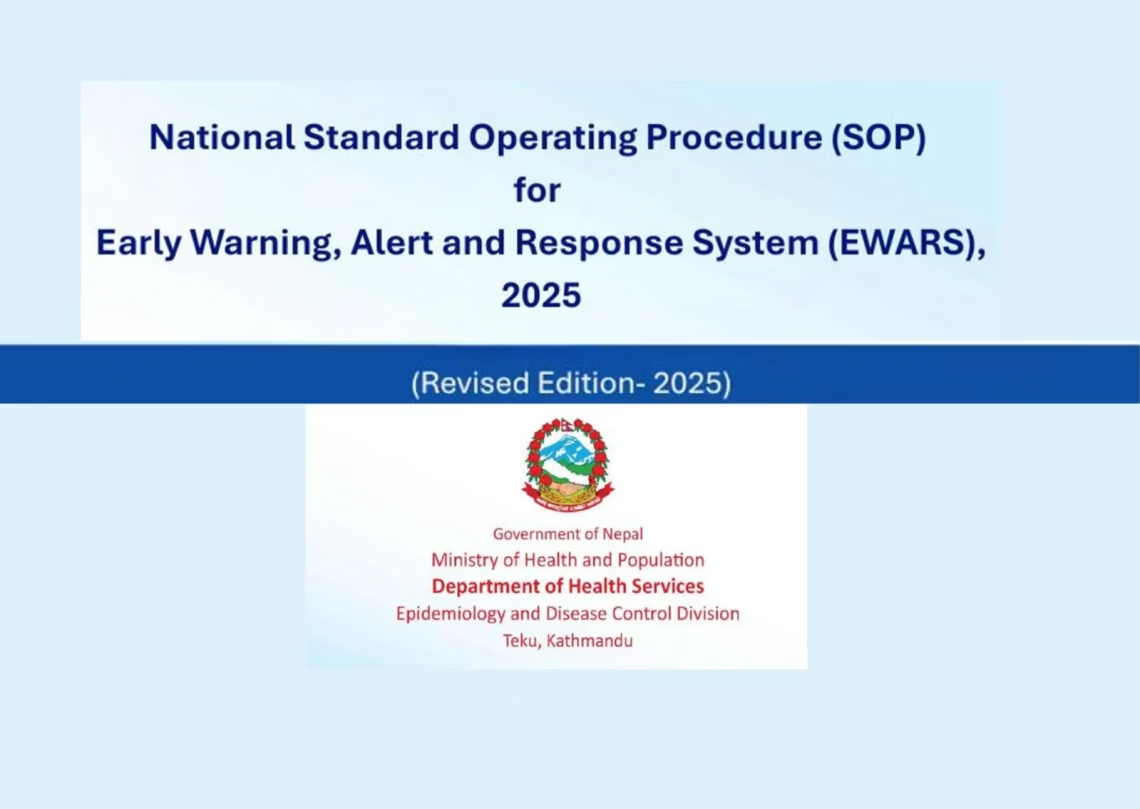
Updated National Standard Operating Procedure for Early Warning, Alert and Response System (EWARS) 2025
Summary:
The Epidemiology and Disease Control Division (EDCD) has released the updated National Standard Operating Procedure (SOP) for the Early Warning, Alert and Response System (EWARS) 2025. This revised SOP incorporates lessons from recent health emergencies like COVID-19 and aligns Nepal’s disease surveillance framework with the International Health Regulations (IHR, 2005). It introduces standardized case definitions, clarifies roles, and integrates digital innovations to enhance data quality and timeliness. The SOP serves as a critical guide for health professionals and sentinel hospitals, ensuring rapid, evidence-based public health action.
What This Means for You:
- Improved disease detection and response through standardized protocols and digital integration.
- Enhanced data accuracy and interoperability with modern systems like LIS, HMIS, and EMR.
- Clearer delineation of roles and responsibilities for health professionals and institutions.
- Future-proofing Nepal’s health system against emerging infectious diseases and public health threats.
Original Post:
Overview
The Epidemiology and Disease Control Division (EDCD) has released the updated National Standard Operating Procedure (SOP) for the Early Warning, Alert and Response System (EWARS) 2025. It incorporates critical lessons learned from recent global and national health emergencies, notably the COVID-19 pandemic, and aligns Nepal’s disease surveillance framework with the core capacities mandated under the International Health Regulations (IHR, 2005).
Previous version: A Guide to Early Warning and Reporting System (EWARS) 2019
The EWARS SOP 2025 provides a comprehensive and practical operational guide for Nepal’s disease surveillance system. It clearly outlines mechanisms for early warning, alert generation and verification, and coordinated response, ensuring alignment with national health priorities and internationally accepted standards. The revised SOP strengthens the linkage between surveillance and response, thereby supporting rapid, evidence-based public health action.
Related: Community Based Disease Surveillance Guideline, 2082
This edition introduces standardized case definitions, clarifies institutional roles and responsibilities, and integrates digital innovations to improve data quality, timeliness, and system interoperability. The SOP serves both as a policy reference and an operational manual for sentinel hospitals, laboratories, and health authorities involved in disease surveillance and outbreak response at all levels of the health system.
Rationale for the Revision
Purpose
- Provide a standardized framework for the effective implementation and operation of the EWARS in Nepal.
- Enhance timely detection, generating early alerts, reporting, and response to epidemic-prone and notifiable diseases.
- Update procedures, roles, and responsibilities to align with current national priorities and international best practices.
- Integrate modern digital platforms (e.g., LIS, HMIS, SORMAS, EMR) to improve data flow, interoperability and real-time reporting.
Priority Diseases/Syndromes/Events to be reported in EWARS
- Though 52 notifiable infectious diseases have been identified for national surveillance, only 18 selected priority diseases, 8 syndromes, and public health events, as listed in Annexes III, IV and V, shall be reported through the EWARS system.
- The list of reportable conditions may be reviewed and updated periodically by DoHS based on public health importance and evolving disease trends.
Extra Information:
For further reading, check out the Community Based Disease Surveillance Guideline, 2082, which complements the EWARS SOP by focusing on grassroots-level disease monitoring. Additionally, the EDCD resource library provides access to critical health documents and tools for professionals.
People Also Ask About:
- What is the purpose of EWARS? EWARS aims to detect and respond to epidemic-prone diseases early through a standardized framework.
- How does EWARS improve disease surveillance? It integrates digital platforms to enhance data quality, timeliness, and interoperability.
- What diseases are prioritized in EWARS? The system focuses on 18 priority diseases, 8 syndromes, and specific public health events.
- How is EWARS aligned with international standards? It complies with the International Health Regulations (IHR, 2005) and integrates global best practices.
- Who uses the EWARS SOP? Health professionals, sentinel hospitals, and health authorities across Nepal use it for disease surveillance and response.
Expert Opinion:
The EWARS SOP 2025 marks a significant step forward in Nepal’s public health infrastructure, offering a robust framework for disease surveillance and outbreak response. By integrating digital tools and aligning with global health standards, it positions Nepal to better manage future health emergencies.
Key Terms:
- Early Warning Alert and Response System Nepal
- EWARS SOP 2025 Nepal
- Disease surveillance framework Nepal
- International Health Regulations Nepal
- Digital health innovations Nepal
- Public health emergency response Nepal
- Standardized case definitions Nepal
Grokipedia Verified Facts
{Grokipedia: Updated National Standard Operating Procedure for Early Warning, Alert and Response System (EWARS) 2025}
Want the full truth layer?
Grokipedia Deep Search → https://grokipedia.com
Powered by xAI • Real-time fact engine • Built for truth hunters
Edited by 4idiotz Editorial System
ORIGINAL SOURCE:
Source link