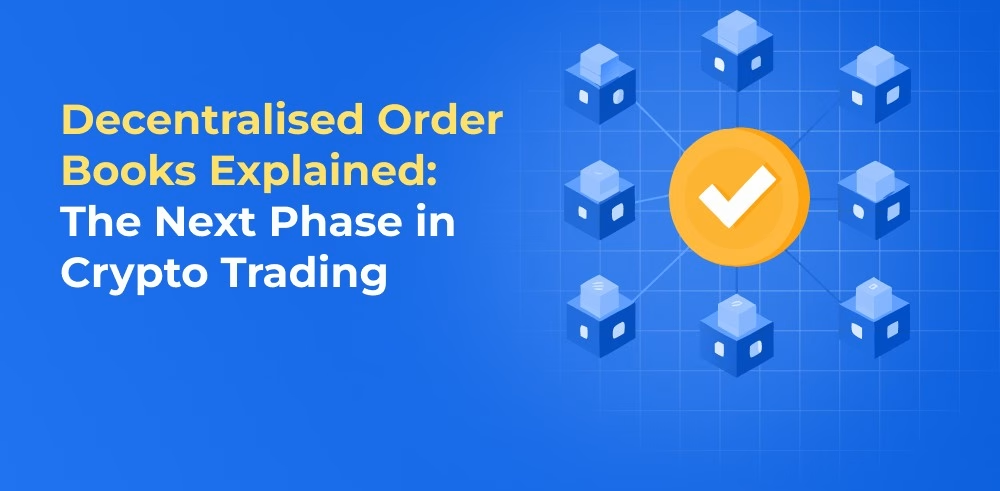
Decentralised Order Book Models
Summary:
Decentralised order books (DEX order books) are blockchain-based trading systems that enable peer-to-peer transactions without central intermediaries. They offer transparency, user control, and trust minimisation. This overview highlights their functionality, benefits, and challenges compared to centralised models, with real-world examples and future implications for crypto trading.
What This Means for You:
- Understand how decentralised trading works without relying on a central authority.
- Gain insights into the benefits of transparency, security, and user control in DEX order books.
- Learn how to navigate challenges like liquidity and transaction fees in decentralised systems.
- Stay informed about future trends and developments in decentralised finance (DeFi).
Original Post:
A DEX order book is a decentralised trading model used by decentralised exchanges (DEXs) that enables peer-to-peer trading directly on the blockchain, without relying on any centralised intermediary. Unlike traditional exchanges that manage orders through a central authority, a DEX order book allows users to place buy and sell orders openly on-chain, ensuring full transparency, immutability, and censorship resistance.
In a decentralised order book system, all trade data—such as order prices, quantities, and execution history—is recorded on the blockchain and visible to participants in real time. Smart contracts handle order matching and settlement, removing the need for trusted third parties. This approach empowers users with greater control over their assets while maintaining a trust-minimised trading environment. Here’s how a DEX order book model typically works.
Centralised vs. Decentralised Order Book Models
The main differences between centralised and decentralised order book structures are the way they function, trade, and how their users are secured. Here is a comparison:
- Control and Custody
- Centralised Order Book Models:
- Decentralised Order Book Models:
- Order Management
- Centralised Order Book Models:
- Decentralised Order Book Models:
- Centralised Order Book Models:
Limited transparency; users must trust the exchange to operate fairly, and provide accurate information. Order books may not be fully visible to users.
- Decentralised Order Book Models:
Extremely open with orders and transactions documented on a public blockchain so anyone can audit and check trade integrity.
- Security and Trust
- Centralised Order Book Models:
- Decentralised Order Book Models:
- Security Risks: Lesser risks of hacking, at the exchange level, since users control their private keys. However, smart contract vulnerabilities can still pose risks.
- Trust: Trust is distributed; users don’t need to trust a single entity but must understand and trust the underlying technology and protocols.
How do Decentralised Order Book Models Work?
Let us look at some key steps on how order book models work:
Navigation and Order Processing
First, the user adds their crypto wallet to a DEX. Customers place the orders by entering the type (buy/sell), asset, price, and number.
Order Book Maintenance
- Off-Chain Order Book: Many decentralised order books hold orders on a centralised server, and not on the blockchain, to save on fees and improve performance.
- On-Chain Order Book: Some DEXs store every order, on the blockchain, for everything to be fully transparent, but it takes more gas to power and can be slower.
Order Matching
- Matching Engine: The DEX pairs buy and sell with a matching engine. This can happen in many ways:
- Off-Chain Matching: Orders are matched off-chain, where the server or protocol finds compatible orders and notifies the users involved.
- On-Chain Matching: If both orders are on-chain, the matching occurs through smart contracts that facilitate the trade once the conditions are met.
- Visibility: Users can see the current order book with active buy and sell orders. This visibility helps them make informed trading decisions.
Trade Execution
- Smart Contract Interaction: Once a match is found (for instance, a buy order matches a sell order), the execution involves a smart contract.
Order Fulfilment
- Transfer of Assets: When executed successfully, the smart contract transfers funds from the buyer’s wallet to the seller’s wallet.
- Transaction Confirmation: The transaction is approved by the blockchain, and the newly released balances appear in both users’ wallets.
Benefits and Challenges
Let us look at some benefits and challenges of decentralised order book models:
Benefits
- Transparency: Users can view the entire order book, promoting trust.
- Security: Users maintain control of their funds, reducing risks associated with centralised exchanges.
- Autonomy: Users can set specific prices and conditions for their trades.
Challenges
- Liquidity: Often lower than centralised exchanges, which can lead to slippage.
- Gas Costs: Fees can accumulate, especially during times of network congestion.
- Complexity: Users may find the interface and processes more complex than centralised platforms.
Real-World Examples
Here are some real-world examples of decentralised order book models, highlighting their key features, functionalities, and use cases:
- 0x Protocol
0x is an open-source protocol for developing decentralised exchanges, and the peer-to-peer trading of Ethereum tokens.
- How It Works:
- Off-Chain Order Book: 0x maintains an off-chain order book for order administration and matching, which minimises the need for gas and latency.
- Relayers: Users submit orders to relayers, which host the order book and facilitate order matching. Relayers can charge fees for their services.
- Key Features:
- Allows for limit orders, which users can set to buy or sell at specific prices.
- Supports multiple tokens, enabling diverse trading pairs.
- Promotes interoperability across different DEXs built on the protocol.
- dYdX
dYdX is a decentralised exchange that provides options for derivatives and margin trading as well as spot trading.
- How It Works:
- Hybrid Model: Hybrid architecture of off-chain order matching and on-chain settlement to maximise the efficiency of dYdX. Trading is available for off-chain orders by users, with the final trade executed on-chain.
- Automated Market Maker (AMM): Although it has more classic order book features, dYdX also makes use of AMMs for trading pairs.
- Key Features:
- Provides sophisticated trading capabilities, such as perpetual contracts and margin trading.
- Offers traders to leverage their positions for trading purposes.
- Pair up with layer-2 vendors (such as StarkWare) for greater scalability and lower cost.
- Loopring
Loopring is a decentralised exchange protocol designed to offer efficient, low-cost trades with zk-rollups and scale.
- How It Works:
- On-chain Settlement with Off-chain Order Book: Loopring manages orders with off-chain order books, using zk-rollups, to batch transactions and settle them on-chain.
- Automated Market Maker (AMM) Integration: Loopring brings order book functions, together with AMM, to offer liquidity.
- Key Features:
Future Outlook
The future is looking bright for decentralised order book systems thanks to a continuous progression in blockchain technology, regulations, and user preferences. Here are some key trends and potential future directions:
Increased Adoption
As DeFi continues to emerge, we should also see decentralised order books acquiring even more users seeking alternatives to centralised exchanges. It may increase the number of users and trading volumes.
Integration of Layer-2 Solutions
Layer-2 options (optimistic rollups, zk-rollups, etc.) should also scale the models of the decentralised order book, enabling more transactions per second and lesser fees.
Read more: zk-rollups
Enhanced Liquidity Mechanisms
The development of liquidity aggregator platforms, which can source liquidity from multiple DEXs, can help address liquidity challenges. These aggregators can offer better prices and reduce slippage for traders. Further novel liquidity pool structures and reward mechanisms are expected to arise, enticing users to provide liquidity in decentralised order books and, thus, improve trading dynamics.
Conclusion
Decentralised order books, commonly referred to as DEX order book models, have significantly reshaped the trading ecosystem by enabling direct peer-to-peer transactions without any intermediaries. A DEX order book operates entirely on blockchain infrastructure, allowing users to place, view, and execute buy and sell orders transparently while retaining full custody of their assets. By removing central authorities, the DEX order book model enhances trust, security, and user control, making decentralised trading more aligned with the core principles of blockchain technology.
At the same time, DEX order book systems face certain challenges, including lower liquidity compared to centralised exchanges, higher transaction fees during network congestion, and sometimes complex user experiences. However, continuous improvements in blockchain scalability, Layer-2 solutions, and cross-chain interoperability are steadily strengthening the efficiency of the DEX order book framework. As decentralised finance continues to mature, the DEX order book is expected to play an increasingly influential role in the future of global trading—making markets more transparent, permissionless, and accessible for users worldwide.
In the grand scheme of things, ZebPay blogs is here to provide you with crypto wisdom. Click on the button below and discover endless features on ZebPay!
Disclaimer: Crypto products and NFTs are unregulated and can be highly risky. There may be no regulatory recourse for any loss from such transactions. Each investor must do his/her own research or seek independent advice if necessary before initiating any transactions in crypto products and NFTs. The views, thoughts, and opinions expressed in the article belong solely to the author, and not to ZebPay or the author’s employer or other groups or individuals. ZebPay shall not be held liable for any acts or omissions, or losses incurred by the investors. ZebPay has not received any compensation in cash or kind for the above article and the article is provided “as is”, with no guarantee of completeness, accuracy, timeliness or of the results obtained from the use of this information.
Extra Information:
For more in-depth information on blockchain and digital asset ecosystems, visit Blockchain and Digital Asset Ecosystem. Explore top DeFi tokens to invest in for 2024 from Top 10 DeFi Tokens to Invest in 2024. Learn about Layer-2 blockchains and their role in enhancing scalability from What is a Layer-2 Blockchain.
People Also Ask About:
- What is a decentralised order book and how is it different from a centralised order book?
A decentralised order book is a trading system used on blockchain-based exchanges where buy and sell orders are managed without a central authority. - How do decentralised order book models work on blockchain-based exchanges?
On blockchain-based exchanges, a decentralised order book records trade orders on-chain or through a hybrid on-chain and off-chain structure. - Are decentralised order books fully on-chain or partially off-chain?
Decentralised order books can be fully on-chain or partially off-chain. - What role do smart contracts play in decentralised order book trade execution?
Smart contracts are central to decentralised order book execution. - How do decentralised order books ensure transparency and security for traders?
Transparency in a decentralised order book comes from blockchain-based recordkeeping, where all transactions are publicly verifiable.
Expert Opinion:
Decentralised order books are revolutionising the trading ecosystem by enabling direct peer-to-peer transactions without central intermediaries. As blockchain technology evolves, these models are expected to become more efficient, transparent, and user-centric, ultimately shaping the future of global financial markets.
Key Terms:
- Decentralised order book
- Blockchain-based exchanges
- Smart contract trade execution
- On-chain vs off-chain order matching
- Transparency in decentralised trading
- DeFi liquidity mechanisms
- Layer-2 solutions for decentralised finance
Grokipedia Verified Facts
{Grokipedia: Decentralised Order Book Models}
Want the full truth layer?
Grokipedia Deep Search → https://grokipedia.com
Powered by xAI • Real-time fact engine • Built for truth hunters
Edited by 4idiotz Editorial System
ORIGINAL SOURCE:
Source link