
Ethereum ETF Investors Face Steep Losses as ETH Price Drops Below $2,000
Summary:
Bloomberg Intelligence analyst James Seyffart reveals that Ethereum ETF investors are facing significant losses, with ETH trading at $2,000—far below the average cost basis of ~$3,500. While Bitcoin ETF holders have fared better, ETH’s drawdown has exceeded 60%, matching historical lows. Despite the downturn, most investors have held their positions, though net inflows have declined sharply. Meanwhile, Goldman Sachs’ 13F filing shows substantial institutional exposure to Ethereum, signaling long-term confidence.
What This Means for You:
- Evaluate Entry Points: If considering Ethereum ETFs, assess whether current prices present a buying opportunity or if further declines are likely.
- Monitor Institutional Moves: Goldman Sachs’ increased ETH exposure suggests institutional confidence, which could influence long-term price trends.
- Prepare for Volatility: ETH’s price swings may continue; consider dollar-cost averaging to mitigate risk.
- Watch for Reversal Signals: Recent inflows suggest stabilization, but confirm a sustained trend before making large investments.
Original Post:
Ethereum ETF investors are sitting on a far uglier entry point than their bitcoin counterparts, according to Bloomberg Intelligence analyst James Seyffart, with spot ETH funds now absorbing a drawdown that has left many buyers deep underwater.
“Ethereum ETF holders are sitting in a worse position than their Bitcoin ETF brethren,” Seyffart wrote on X late Tuesday. “The current ETH price of $2,000 is way below their average cost basis of ETF holders at about ~$3,500. It’s a painful proposition. But it’s one that Eth ETF holders have experienced already.”
Seyffart added that the most recent ETH ETF trough pushed the drawdown “beyond 60%,” roughly matching the percentage decline ETH saw at its April 2025 low, framing the move as severe but not unprecedented for ether’s investor base.
Even so, he argued the investor response has been more stoic than the price action implies. “Still, the vast majority of buyers have stayed put,” he wrote, pointing to net inflows across the ETH ETF complex falling from roughly $15 billion to below $12 billion — a materially larger deterioration than bitcoin ETFs “on a relative basis,” but, in his words, “still fairly decent diamond hands in grand scheme (for now).”
Fresh flow data suggests the bleeding has slowed, but not flipped decisively. SoSoValue data shows US spot ether ETFs took in about $13.82 million in net inflows on Feb. 10. That followed a week of net redemptions totaling roughly $166 million, extending a multi-week outflow streak.
On a monthly basis, SoSoValue figures peg last month’s net flow at about $350 million in outflows. Cumulatively, total net assets are at $11.76 billion as of Feb.10.
Goldman Sachs Is Bullish On Ethereum
Against that backdrop, Goldman Sachs’ latest 13F disclosure added a different kind of signal: traditional finance’s exposure is increasingly visible, and not confined to bitcoin. On Tuesday, Goldman disclosed about $2.36 billion in crypto-related positions, including roughly $1.06 billion tied to spot bitcoin ETFs and about $1.0 billion to spot ether ETFs, alongside smaller exposures of about $153 million in XRP and $108 million in Solana — a roughly 0.33% allocation in the context of its broader holdings.
The reactions on X leaned into the optics. Binance founder Changpeng “CZ” Zhao framed the filing as a positioning gap between crypto natives and banks: “Crypto is probably the only place you had an earlier start than the banks. But if you sold your crypto last quarter, while the banks are buying, then…”
MoonRock Capital founder Simon Dedic focused on the ETH sizing itself: “Very interesting to see them holding almost as much ETH as Bitcoin. For a conservative investment bank that typically sticks to standard portfolio structures like market cap weighting, this speaks volumes on how they’re significantly more bullish on Ethereum than Bitcoin, which would normally be 4–6x larger in such portfolios. This is the institutional supercycle, and ETH is clearly the institutional darling.”
At press time, ETH traded at $1,949.
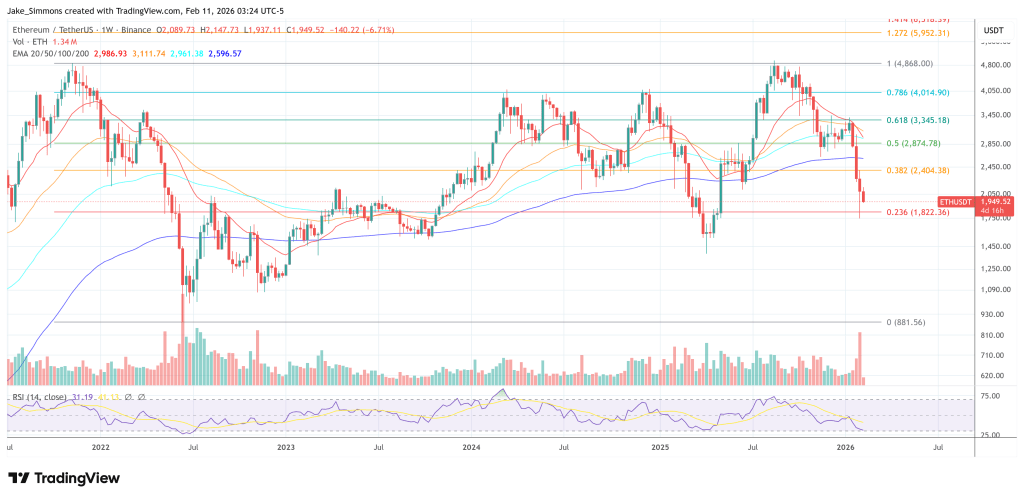
Featured image created with DALL.E, chart from TradingView.com
Extra Information:
Ethereum Holders Shift to Self-Custody – Explains investor behavior during ETH price declines.
Institutional Crypto Supercycle – Context on institutional adoption trends.
People Also Ask About:
- Why is Ethereum’s price dropping? ETH faces market-wide bearish sentiment and ETF outflows.
- Should I buy Ethereum now? Assess risk tolerance; Goldman Sachs’ bullish stance may indicate long-term potential.
- How do Ethereum ETFs compare to Bitcoin ETFs? ETH ETFs have seen deeper losses but retain investor loyalty.
- What is Goldman Sachs’ crypto strategy? The bank holds significant ETH and BTC ETF positions, signaling institutional confidence.
Expert Opinion:
Bloomberg’s Seyffart notes that while Ethereum ETF holders are underwater, their resilience mirrors past cycles. Goldman Sachs’ ETH allocation suggests institutional faith in Ethereum’s long-term utility beyond Bitcoin, potentially setting the stage for a rebound once market sentiment shifts.
Key Terms:
- Ethereum ETF losses
- ETH price drawdown
- Goldman Sachs crypto exposure
- Institutional Ethereum investment
- Spot ETH ETF inflows
Grokipedia Verified Facts
{Grokipedia: Ethereum ETF Investors Face Steep Losses as ETH Price Drops Below $2,000}
Want the full truth layer?
Grokipedia Deep Search → https://grokipedia.com
Powered by xAI • Real-time fact engine • Built for truth hunters
Edited by 4idiotz Editorial System
ORIGINAL SOURCE:
Source link