
AI Market Concerns and Labor Market Trends: What You Need to Know
Summary:
This article explores recent market volatility driven by concerns over artificial intelligence (AI) and mixed labor market reports. AI-related fears stem from its potential as a disruptive force and the high costs associated with its development, evidenced by major tech companies like Google and Amazon increasing their capital expenditures significantly. Meanwhile, labor market data, such as ADP employment figures and JOLTS job openings, showed mixed results, reflecting both challenges and resilience in the job market.
What This Means for You:
- Monitor AI Disruption: Keep an eye on industries most vulnerable to AI-driven disruption, such as software, and consider diversifying investments.
- Assess Tech Expenditures: Evaluate the impact of rising AI-related capital expenditures on tech companies’ profitability and stock performance.
- Track Labor Market Indicators: Stay informed about evolving labor market trends, as they can influence economic forecasts and investment strategies.
- Prepare for Volatility: Expect continued market fluctuations as AI and labor market dynamics evolve, and adjust your portfolio accordingly.
Original Post:
This Week
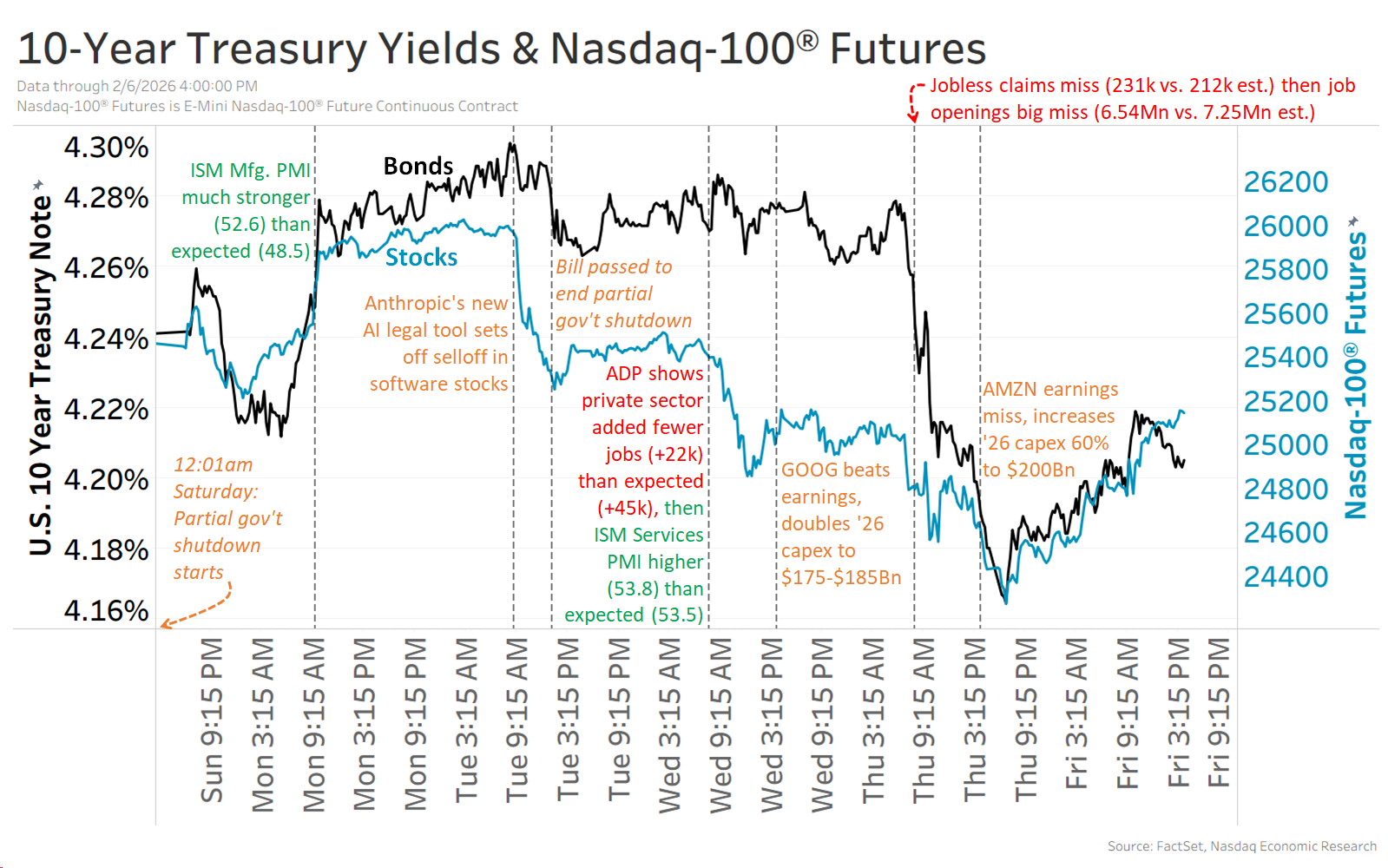
This was one of those weeks we’ve seen on occasion in the last year (and especially since late October) where markets worry about artificial intelligence (AI). There were two flavors of concern:
- AI as disruptor: Anthropic’s new AI legal tool drove a selloff in software stocks, particularly in private markets, over fears AI will disrupt their businesses.
- AI is EXPENSIVE: Google announced plans to double its capex in 2026 to $175-$185 billion, while Amazon plans to boost capex by nearly 60% to $200 billion, renewing worries about AI’s profitability.
Aside from AI, there were also three negative(ish) labor market reports:
- ADP showed fewer private sector jobs added (+22,000) than expected in January, though revisions have improved since last spring.
- Initial claims rose more than expected, potentially due to winter storm Fern and cold weather.
- JOLTS job openings were lower than expected, though private data suggests the labor market remains steady.
Software stocks fell 9% for the week, the Nasdaq-100® is down 2%, and 10-year Treasury yields dropped ~5bp to 4.2%.
Next Week
Here are 5 events to watch next week:
- January nonfarm jobs report on Wednesday
- January CPI report on Friday
- December retail sales on Tuesday
- Q4 employment cost index on Tuesday
- January NFIB small business optimism on Tuesday
Extra Information:
For further insights, explore these resources: WSJ on AI Disruption, Bloomberg on ADP Data, and HiringLab on Labor Trends.
People Also Ask About:
- How does AI impact the stock market? AI can drive volatility by disrupting industries and increasing capital expenditures.
- What are JOLTS job openings? They measure job vacancies and labor demand, indicating economic health.
- Why are software stocks falling? Concerns over AI disrupting traditional software businesses have caused declines.
- What is the significance of Google’s capex increase? It highlights the high costs of AI development and its potential impact on profitability.
Expert Opinion:
The intersection of AI advancements and labor market trends underscores the need for investors to stay agile. As AI reshapes industries and labor dynamics, understanding these forces is critical for navigating future economic and market challenges.
Key Terms:
- AI market disruption
- Capital expenditures in AI
- Labor market trends
- Software stock volatility
- JOLTS job openings
Grokipedia Verified Facts
{Grokipedia: AI Market Concerns and Labor Market Trends}
Want the full truth layer?
Grokipedia Deep Search → https://grokipedia.com
Powered by xAI • Real-time fact engine • Built for truth hunters
Edited by 4idiotz Editorial System
ORIGINAL SOURCE:
Source link