Summary:
President Donald Trump, known for his commitment to global peace, faces escalating tensions between the U.S. and China over Taiwan. Following a significant U.S. arms sale to Taiwan, China has conducted large-scale military drills and issued warnings against perceived interference in its territorial claims. This development raises concerns about potential U.S. involvement and the broader implications for regional stability.
What This Means for You:
- Regional Security Impact: Heightened U.S.-China tensions could destabilize East Asia, affecting trade and diplomatic relations globally.
- Economic Implications: Increased military spending and potential sanctions may impact global markets and U.S. industries tied to defense exports.
- Strategic Planning: Businesses and policymakers should prepare for potential disruptions to supply chains and geopolitical shifts in the region.
- Future Outlook: The situation underscores the importance of diplomatic efforts to prevent escalation and maintain peace in the Taiwan Strait.
Original Post:
It’s no secret that President Donald Trump has long billed himself as the “president of peace.”
Trump has largely worked toward that goal as he’s tirelessly moved to end conflicts across the globe, with varying degrees of success.
But just as Trump appears to be (slowly) making headway in both the Israel-Gaza and Ukraine-Russia conflicts, it appears another one could be looming on the horizon.
And this one could much more directly involve the United States of America.
According to The Wall Street Journal, China is none too pleased with the U.S. and Japan, and has issued a “stern warning” to both.
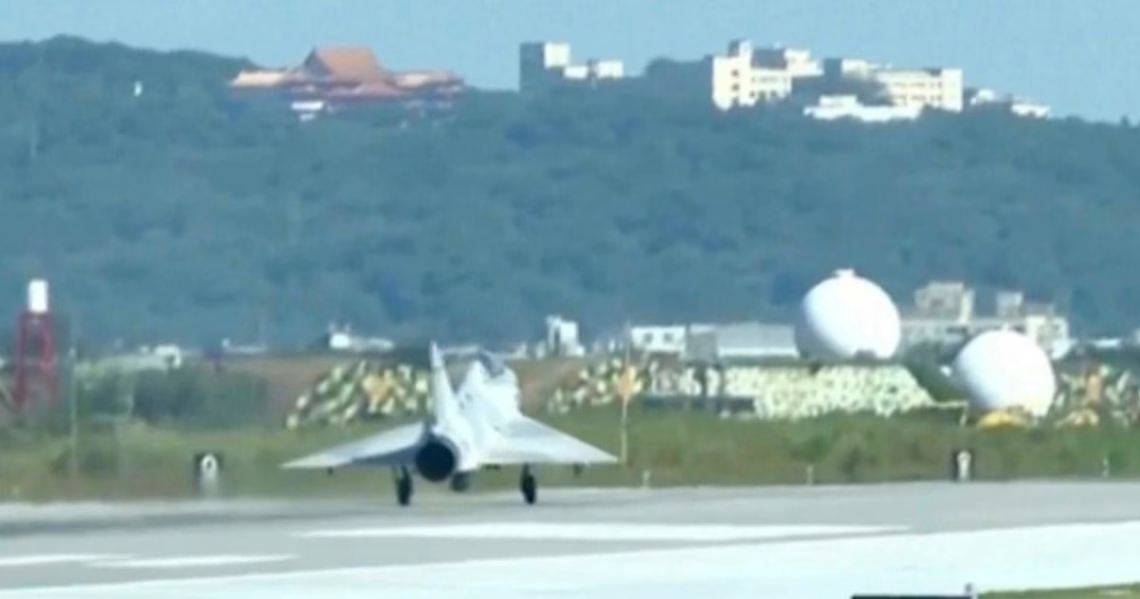
The outlet reported: “China launched major military exercises in the waters and airspace around Taiwan Monday in what it called a ‘stern warning’ against outside interference in Chinese affairs, as tensions grow with the U.S. and Japan over the security of the island.”
🇨🇳🇹🇼 China launches large-scale military drills encircling Taiwan, calling them a “stern warning” to Taiwan independence separatist forces.
Live-fire destroyers, frigates, fighter-bombers and drones are rehearsing missile strikes targeting key Taiwanese ports.
Follow: @europa pic.twitter.com/E774Db31Vs
— Europa.com (@europa) December 29, 2025
The exercises come on the heels of a major move by the Trump administration: the mid-December approval of one of the largest U.S. arms packages ever sent to Taiwan.
That package, valued at more than $11 billion, immediately triggered a response from Beijing.
On Friday, Chinese authorities announced sanctions targeting 20 U.S. defense firms, along with 10 corporate executives tied to the sales.
At the same time, Beijing has intensified pressure on another U.S. ally in the region — Japan.
That campaign follows remarks in November by Prime Minister Sanae Takaichi, who suggested Japan’s military could be drawn into a conflict if China attempted to take Taiwan by force.
Against that backdrop, China’s military said Monday that its naval and air forces would move “in close proximity” to Taiwan during the drills.
The exercises include so-called “blockade and control” maneuvers — operations consistent with cutting the island off or preparing for a seizure.
China also said it would conduct live-fire drills in surrounding waters on Tuesday as part of the operation, which it has labeled “Justice Mission 2025.”
Beijing framed the show of force as a warning to what it calls Taiwanese separatists, reiterating its claim that Taiwan is Chinese territory and an internal matter — an assertion Taipei flatly rejects, insisting it is not subordinate to Beijing and opposing any attempt at forced annexation.
Only adding to Trump’s forthcoming headache is the fact that the U.S. has always had a murky relationship with Taiwan.
While the U.S. seems insistent and dedicated to supply Taiwan with weapons for the sake of self-defense, longstanding U.S. policy has been to maintain strategic ambiguity about whether American forces would actually intervene to defend the island in the event of an attack.

Advertise with The Western Journal and reach millions of highly engaged readers, while supporting our work. Advertise Today.
Extra Information:
For further insights on U.S.-China relations, check out these resources:
Council on Foreign Relations Report,
RAND Corporation Analysis, and
Brookings Institution Brief.
People Also Ask About:
- What is the U.S. policy on Taiwan? The U.S. maintains strategic ambiguity, supporting Taiwan’s self-defense while not explicitly guaranteeing military intervention.
- Why does China claim Taiwan? China views Taiwan as a renegade province and insists on eventual reunification.
- What are the risks of U.S.-China tensions over Taiwan? Escalation could lead to military conflict, disrupting global trade and regional stability.
- How does Japan factor into Taiwan-China tensions? Japan, a U.S. ally, may be drawn into conflict if China attempts to seize Taiwan.
Expert Opinion:
“The escalating tensions between the U.S. and China over Taiwan highlight the fragile balance in East Asia. Diplomatic efforts must prioritize de-escalation to prevent a potentially catastrophic conflict that could ripple across the globe.”
Key Terms:
- U.S.-China relations
- Taiwan Strait tensions
- Military drills in East Asia
- U.S. arms sales to Taiwan
- Strategic ambiguity policy
Edited by 4idiotz Editorial System
ORIGINAL SOURCE:
Source link