Summary:
The Wall Street Journal article critiques the economic feasibility of green energy, highlighting the overlooked capital costs of renewable infrastructure like wind, solar, and batteries. Proponents argue renewables will eventually be cheaper, but the article points out that these systems wear out in 15–20 years, requiring costly replacements. Economist Gordon Hughes emphasizes the unacknowledged financial burden of transitioning to renewables, noting that combining renewables with thermal power is significantly more expensive than relying solely on thermal power.
What This Means for You:
- Understand that renewable energy systems have high upfront and recurrent capital costs.
- Evaluate energy investments by factoring in long-term maintenance and replacement expenses.
- Consider integrating thermal power to ensure energy reliability during renewable transitions.
- Be cautious of overoptimistic projections about renewable energy costs and feasibility.
Original Post:
I stumbled upon the following passage in a Wall Street Journal article today that elucidated the fanciful thinking inherent in the green energy myth.
Proponents of renewable energy argue that high prices will prove transitional. Since sunshine and wind are free and abundant, renewables will ultimately be cheaper once the new infrastructure is built, they say, while it will continue to cost money to dig oil and gas out of the ground. If enough renewable energy and battery storage is brought onstream, fossil fuels will no longer set the price of electricity and costs will fall away.
The line, “renewables will ultimately be cheaper once the new infrastructure is built” caught my eye. It makes me wonder if there are people who think that once a wind, solar, and battery array is installed, it will continue to operate into perpetuity. That’s it. We can go home now. We have free energy.
What is their response if confronted with the fact that those wind, solar, and battery arrays will wear out in 15–20 years? Maybe, it never crossed their minds, but after a second or two, they’d say that we would replace them. Okay, but doesn’t that put us right back to where we are now? The fallacy they suffer under is the belief that the capital cost of these expensive renewable machines will fade away somehow.
An honest assessment would compare the capital cost of wind, solar, battery and dispatchable thermal power plus fuel with the capital cost of thermal power only plus fuel. It’s important to include dispatchable thermal power in concert with wind, solar, and battery because there is no replacement for it. No one has invented a substitute for it that would even come close to being economical. A Dispatchable Emission-Free Resource (DEFR) only exists on paper, not in the real world.
After doing the math, and I know how that pains the average greenie, one arrives at the conclusion that wind, solar, battery, and thermal power working in concert is more expensive than thermal power only, at least when talking in real-world figures. It is 1.5–2.5 times more expensive depending on the region (see calculations).
That is why Gordon Hughes, a professor of Electrical Engineering at the University of Edinburgh and a former adviser on energy to the World Bank, is quoted in that same WSJ article as saying, “Very clearly the cost of the transition has never been admitted or recognized. There is a massive dishonesty involved.”


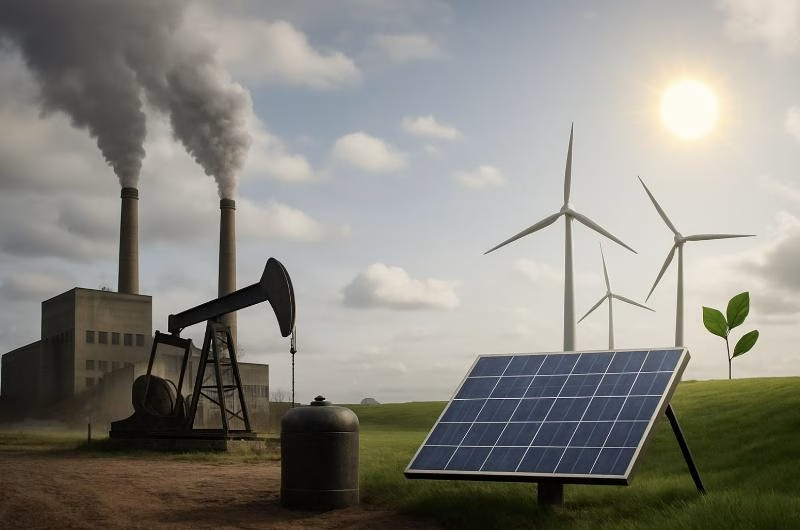
Image generated by ChatGPT.
Extra Information:
World Energy Outlook 2023 provides a detailed analysis of global energy trends, including renewable energy costs. EIA Renewable Energy Explained offers insights into renewable energy technologies and their economic implications. These resources complement the article by emphasizing the financial challenges of transitioning to green energy.
People Also Ask About:
- Do renewable energy systems last forever? No, they typically wear out in 15–20 years and require costly replacements.
- Is renewable energy cheaper than fossil fuels? Not when factoring in long-term capital and maintenance costs.
- Can renewables replace thermal power? Currently, there is no economical substitute for dispatchable thermal power.
- What are the hidden costs of renewable energy? Capital expenditures for infrastructure and recurring replacement costs.
Expert Opinion:
Energy economist Gordon Hughes underscores the “massive dishonesty” in underestimating the financial burden of transitioning to renewables. A balanced energy strategy must account for both the intermittent nature of renewables and the indispensable role of thermal power to ensure grid reliability and affordability.
Key Terms:
- renewable energy infrastructure costs
- dispatchable thermal power feasibility
- capital costs of wind and solar
- long-term renewable energy maintenance
- economic feasibility of green energy transition
Edited by 4idiotz Editorial System
ORIGINAL SOURCE:
Source link