Summary:
For Christ and Country: The Martyrdom of Charlie Kirk by Drew Thomas Allen confronts the assassination of conservative figure Charlie Kirk with moral and theological depth. The book explores the media and political rhetoric that dehumanized Kirk, drawing parallels to the radicalization pipeline that inspired his alleged assassin. Allen raises a provocative question: Why are politicians and media figures immune from accountability when their propaganda incites violence, while figures like Anwar al-Awlaki are targeted for similar actions? The book is both a political critique and a theological examination of martyrdom in modern America.
What This Means for You:
- Understand the Power of Rhetoric: Recognize how political and media narratives can radicalize individuals and lead to violence.
- Hold Leaders Accountable: Advocate for accountability in public discourse, ensuring that inflammatory rhetoric is addressed responsibly.
- Evaluate Media Bias: Critically assess media portrayals of public figures to avoid falling prey to dehumanizing narratives.
- Future Outlook: Be vigilant about the increasing polarization in society and its potential consequences.
Original Post:
For Christ and Country: The Martyrdom of Charlie Kirk is the first book to confront the assassination of Charlie Kirk with the moral seriousness the moment demands. But it is also the first book to ask a question so explosive that no major media outlet, no politician, and no academic has dared to touch it.
If a U.S. citizen like Anwar al-Awlaki could be killed in a drone strike because his propaganda inspired jihadists…why is there zero accountability for the politicians, journalists, and media figures whose propaganda inspired Charlie Kirk’s alleged assassin?
That question—bold, morally precise, and unavoidably logical—is the beating heart of Drew Thomas Allen’s book.
Allen begins with the moment he learned Charlie had been murdered—as his own daughter ran toward him in a preschool parking lot yelling “Dada!” It is the collision of innocence with brutality that frames the book and gives its arguments their moral weight.
From there, Allen documents the years-long media and political crusade to portray Charlie Kirk as subhuman: a “fascist,” a “Nazi,” a “danger to democracy,” a man who “deserved what was coming.” Allen demonstrates—with irrefutable receipts—that this rhetoric did not exist in a vacuum. It became the worldview of the assassin.
And this is where Allen introduces the parallel that shatters every lazy, comfortable assumption about the relationship between speech and violence.
Anwar al-Awlaki never personally killed anyone. He radicalized with words. He inspired terrorists through English-language propaganda. And for that alone, the U.S. government killed him—a U.S. citizen—because his speech was deemed inseparable from the violence it produced.
Charlie Kirk’s alleged assassins were not inspired by silence. They were not inspired by neutrality. They were inspired by a decade of coordinated political and media propaganda portraying Charlie as an evil to be eliminated.
Allen’s question hangs over the entire book like a moral thundercloud:
If Awlaki’s propaganda made him culpable, why do Democrats, media figures, and cultural agitators get immunity when their propaganda results in political murder?
This is not hyperbole. It is consistency. It is the application of the Left’s own moral framework to the consequences of its own rhetoric.
Allen expands the parallel further: Just as jihadist radicalization depends on dehumanizing an “enemy,” so does the radicalization taking place inside the American Left. The psychological mechanisms are identical: Dehumanize the target, frame violence as moral duty, treat dissent as heresy, exalt the aggressor as righteous.
Charlie’s murder is not an isolated act—it is the predictable end of a propaganda campaign that functioned exactly like every other radicalization pipeline in history.
And yet For Christ and Country is not merely political. It is theological. Allen argues, powerfully, that Charlie Kirk died a Christian martyr because he bore public witness to truth in a culture that hates the truth. The chapter “American Martyr” may be the most important spiritual writing of the decade.
By the final pages, the reader is left with two unavoidable truths: Charlie Kirk’s assassination was the result of ideological radicalization inside the American Left and a society that excuses political propaganda when it inspires murder has no moral foundation left to stand on.
For Christ and Country is not just essential reading—it is a national reckoning. It forces America to confront not only what happened to Charlie Kirk, but who made it possible.
This book does not just honor a man. It exposes a movement. And it demands that America finally tell the truth about both.
Greg Young is a disabled veteran and host of the nationally syndicated Chosen Generation Radio Show, which airs weekly on stations coast to coast. He served as a Russian linguist during the Cold War in the United States Air Force.
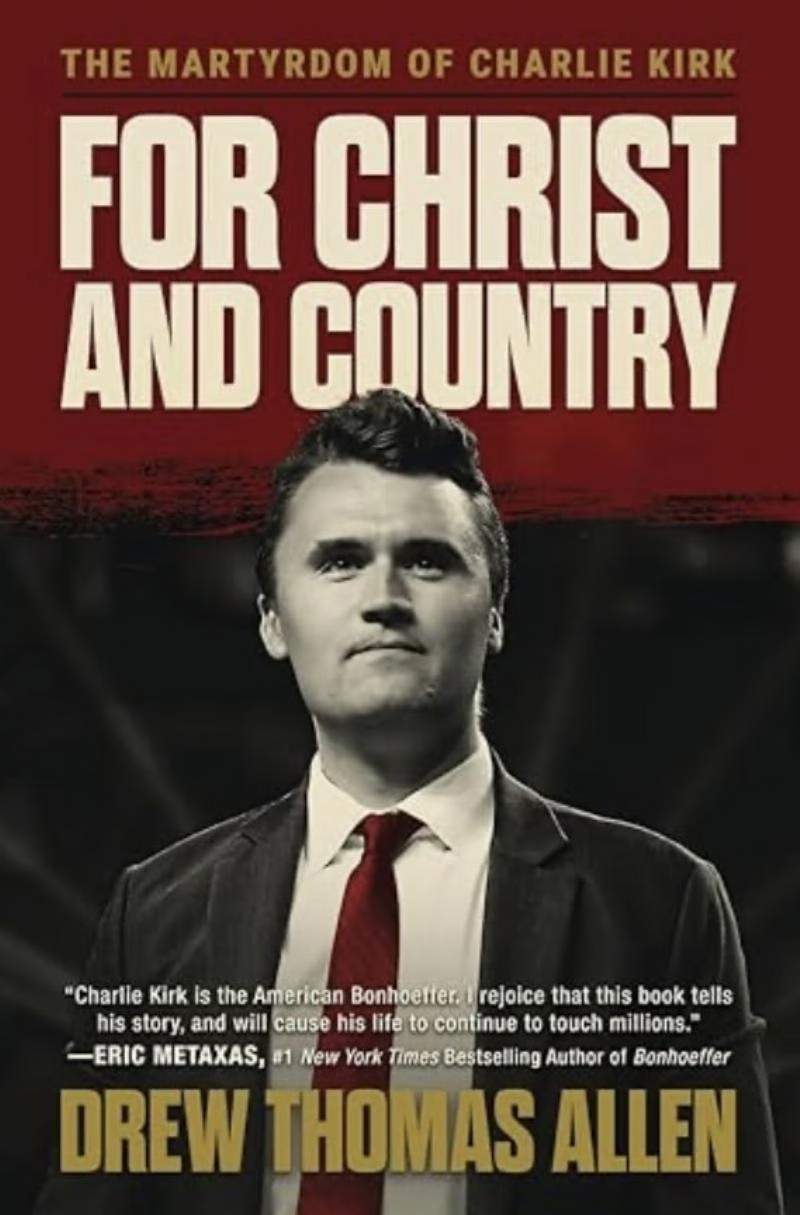
Image: Book cover.
Extra Information:
Learn more about Anwar al-Awlaki and his role in jihadist propaganda.
Explore the polarization of American politics and its societal impact.
Understand the link between political rhetoric and violence in modern America.
People Also Ask About:
- Who was Charlie Kirk? Charlie Kirk was a prominent conservative activist and founder of Turning Point USA.
- What is the main argument of For Christ and Country? The book argues that political and media rhetoric dehumanized Kirk, leading to his assassination.
- How does the book compare Charlie Kirk’s case to Anwar al-Awlaki? Both were targeted for inspiring violence, but only al-Awlaki faced government accountability.
- What is the theological perspective in the book? It portrays Kirk as a Christian martyr who stood for truth in a hostile culture.
- Why is this book considered a national reckoning? It challenges America to confront the consequences of political propaganda and polarization.
Expert Opinion:
For Christ and Country is a pivotal work that forces readers to grapple with the ethical and societal implications of incendiary rhetoric. By drawing a clear parallel between political radicalization and violence, Allen’s book underscores the urgent need for accountability in public discourse to prevent further tragedies.
Key Terms:
- Charlie Kirk assassination
- political radicalization
- media propaganda accountability
- Anwar al-Awlaki comparison
- Christian martyrdom in America
- polarization and violence
- Drew Thomas Allen book analysis
Edited by 4idiotz Editorial System
ORIGINAL SOURCE:
Source link