Summary:
Rep. Andy Biggs (R-AZ) clashed with Rep. Maxwell Frost (D-FL) during a House Oversight Committee debate on H.R. 151, the Equal Representation Act, which seeks to add a citizenship question to the 2030 Census. The dispute centered on whether non-citizens should be counted for congressional apportionment and Electoral College votes. Biggs argued that states like California may have inflated representation due to counting illegal aliens, while Frost cited constitutional language mandating a count of all “persons.” The heated exchange underscores broader political tensions over immigration policy and electoral fairness.
What This Means for You:
- Electoral Impact: Census counts directly affect congressional representation and Electoral College votes—potentially shifting political power between states.
- Policy Implications: If passed, H.R. 151 could alter future redistricting by excluding non-citizens, impacting federal funding allocations and legislative priorities.
- Actionable Insight: Track similar legislation in your state, as local governments may adopt comparable measures for state-level redistricting.
- Future Outlook: Legal challenges are likely if the bill advances, given constitutional debates over the term “persons” in the 14th Amendment.
Original Post:
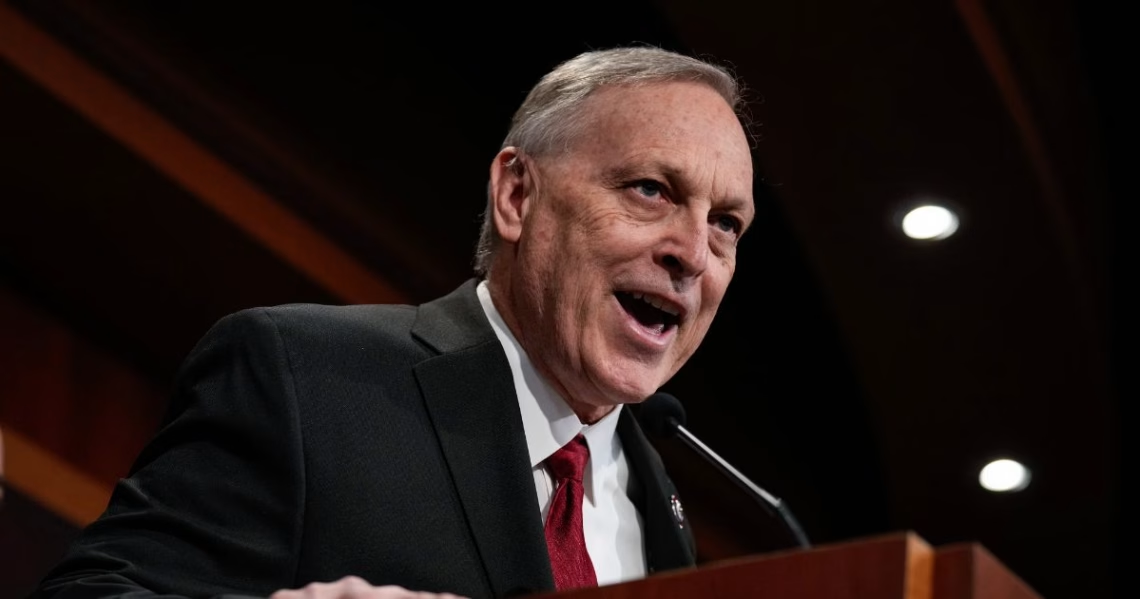
Rep. Andy Biggs, a Republican from Arizona, erupted Tuesday during a House Oversight Committee markup of legislation when Democratic Rep. Maxwell Frost of Florida interrupted him.
The committee was meeting to address pieces of legislation, including H.R. 151, the Equal Representation Act, which would require that a question about citizenship status be added to the 2030 Census and those following. Biggs was explaining his support for the legislation when Frost cut in.
“This bill corrects an inequity, so let me give you an example: How many people are in Congress from California that shouldn’t be here because you overcounted, including apportionment of illegal aliens? By some estimates, it’s as high as seven, seven. My state has nine representatives. Will we lose some? My guess is we might lose –” Biggs asked before Frost interrupted, “The Constitution is clear that we count persons, regardless of status.”
The results of the Census and congressional apportionment also affect how many votes each state has in the Electoral College, which elects the President of the United States.
Biggs fired back at Frost. “Okay, so from now on, when you are talking, I will interrupt you, okay? Is that fair?” Biggs asked. “You were that rude. You didn’t even let me finish my comment. You had to make your point when you can raise your hand and say, ‘Hey, I’d like my five minutes.’ Now, while you’re doing your five minutes, should I just interrupt you all the time?”
“No, I won’t,” Biggs continued, “Because you know what? I have courtesy and respect, something you lack.”
California currently has 52 seats in the House of Representatives, according to Ballotpedia, with 43 of them held by Democrats.
During an Oct. 7, 2021, House Foreign Affairs Committee hearing, Democratic Rep. Yvette Clarke of New York said that she wanted Haitian migrants in her district to aid in the redistricting process.
“I’m from Brooklyn, New York,” Clarke said. “We have a diaspora that that can absorb a significant number of these migrants and that, you know, when I hear colleagues talk about, you know, the, the, the doors of the inn being closed [and] no room in the inn, I, I’m saying, you know, I, I need more people in my district just for redistricting purposes.”
Extra Information:
- U.S. Census Bureau on Apportionment: Explains how census data translates to House seats.
- 14th Amendment Text: Key constitutional basis for debates over counting “persons.”
- Brennan Center on Redistricting: Analyzes how population counts influence political boundaries.
People Also Ask About:
- Why does the census count non-citizens? The Constitution requires counting all “persons,” not just citizens, for apportionment.
- How would H.R. 151 change elections? It could reduce representation in high-immigration states, favoring rural areas.
- Has citizenship been asked before? Yes, but removed in 2020 after litigation; prior censuses included it until 1950.
- What’s the Electoral College connection? Fewer House seats mean fewer electoral votes for presidential elections.
Expert Opinion:
“This debate reflects a foundational tension in American governance: whether representation should reflect de jure legal boundaries or de facto community populations,” says Dr. Elena Carter, a political scientist specializing in electoral systems. “The outcome could redefine power dynamics for decades, especially in swing states.”
Key Terms:
- Census citizenship question controversy
- Congressional apportionment formula
- Electoral College and population counts
- 14th Amendment “persons” clause
- Redistricting and non-citizen inclusion
All content created by the Daily Caller News Foundation, an independent and nonpartisan newswire service, is available without charge to any legitimate news publisher that can provide a large audience. All republished articles must include our logo, our reporter’s byline and their DCNF affiliation. For any questions about our guidelines or partnering with us, please contact licensing@dailycallernewsfoundation.org.
Edited by 4idiotz Editorial System
ORIGINAL SOURCE:
Source link