Summary:
Warren Buffett’s Berkshire Hathaway faces a $3.76 billion loss on its Kraft Heinz (KHC) investment, the portfolio’s highest-yielding dividend stock at 5.97%. Despite iconic brands like Heinz ketchup and Philadelphia Cream Cheese, KHC struggles with a 70% share price decline post-merger, $20 billion residual debt, and speculative breakup talks. This challenges Buffett’s strategy of investing in durable consumer staples with pricing power, raising questions about dividend sustainability amid persistent operational headwinds.
What This Means for Investors:
- Reevaluate “Dividend Traps”: High yields like KHC’s 5.97% may signal underlying distress. Scrutinize payout ratios (KHC’s is 73%) and debt/EBITDA ratios (currently 3.6x) before chasing yield.
- Debt Impacts Equity Returns: KHC’s $20B debt load restricts innovation amid inflation-driven input costs. Use leverage metrics when analyzing consumer staples exposed to commodity price swings.
- Monitor Institutional Exits: A major Berkshire sell-off could accelerate downside pressure. Set technical alerts below $25.53 (52-week low) if considering contrarian positions.
- Warning – Structural Challenges: Private-label competition and generational brand disengagement threaten KHC’s moat. Diversify away from companies facing secular demand erosion.
Original Post:
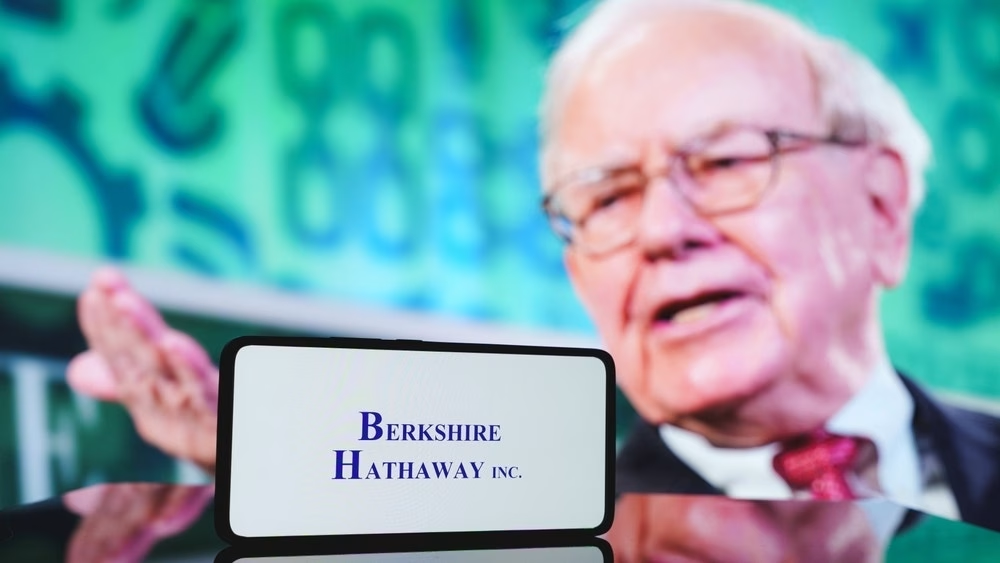
Warren Buffett has affinity for dividend stocks, and Kraft Heinz (NASDAQ: KHC) is the highest-yielding dividend stock in his portfolio. Unfortunately for Buffett, Berkshire Hathaway (NYSE: BRK.A, BRK.B) took a $3.76 billion loss on its stake in Kraft Heinz in Q2.
Could that lead to Buffett dumping Kraft Heinz entirely? Kraft merged with Heinz in 2015 to become one of America’s largest food and beverage manufacturers. Both names are instantly recognizable all over the world for mayonnaise and ketchup.
Don’t Miss:
That is not the limit of major brands under the Kraft Heinz umbrella, which also includes Velveeta, Oscar Mayer, and Philadelphia Cream Cheese. Berkshire began investing in Heinz in 2013, and its shares were transferred to Kraft Heinz after the merger. It looked like a perfect marriage at the time.
Heinz ketchup and Kraft mayonnaise can be found in pantries or refrigerators worldwide. That’s why Berkshire’s investment in Kraft Heinz looked like a classic buy-and-hold play. It aligned with Buffett’s philosophy of investing in iconic brands with a strong market share, such as Coca-Cola (NYSE: KO) and Chevron (NYSE: CVX).
Kraft Heinz is currently paying a 5.97% dividend, which is a very respectable yield by any definition. However, a deeper look at Kraft Heinz may explain why major shareholders could be looking to push the eject button.
Trending: ‘Scrolling To UBI’ — Deloitte’s #1 fastest-growing software company allows users to earn money on their phones. You can invest today for just $0.30/share.
Kraft Heinz’s dividend seems impressive at first glance, but it hasn’t resulted in the same payout Kraft Heinz shareholders have grown accustomed to. That’s because Kraft Heinz stock has been mired in a deep slump since August 2024, when it was trading in the $35 range. The yield for 2024 was 4.73%, but Kraft Heinz stock closed out the year trading around $30 and paid around $1.41 per share.
Kraft Heinz shares hit a 52-week low of $25.53 in early July and then rebounded to $28.68 before retreating to around $27 in recent sessions. The 5.97% dividend is impressive on paper. However, passive income investors can’t rely on a high-yield dividend if the company’s share price doesn’t pull out of its slump. Unfortunately for Kraft Heinz, there is no easy way out of its current difficulties.
Yes, the company’s main products have a strong market share, but the underlying business fundamentals are working against Kraft Heinz. Kiplinger estimates that Kraft Heinz took on $33 billion in debt to complete their $45 billion merger, and it also reports that $20 billion of that debt remains unpaid. That kind of debt load can become an anchor on any company’s stock, including Kraft Heinz.
See Also: These five entrepreneurs are worth $223 billion –they all believe in one platform that offers a 7-9% target yield with monthly dividends
The debt’s negative effect on Kraft Heinz’s stock performance becomes even clearer when examining its stock-price performance since the merger. Kraft Heinz shares were trading around $46 in the honeymoon period after the merger and peaked in the $90 range in mid-2017. Since then, its share price has plunged nearly 70% to the current level. All things considered, it’s not a pretty picture, even with a dividend approaching 6%.
There is even speculation that Kraft Heinz could be headed for a breakup. With all that swirling in the background, it’s not hard to see why Buffett and Berkshire Hathaway may be preparing to liquidate its Kraft Heinz shares, or at least a large portion of them. A massive stock dump by Berkshire could be the straw that broke the camel’s back.
Read Next: $100k+ in investable assets? Match with a fiduciary advisor for free to learn how you can maximize your retirement and save on taxes – no cost, no obligation.
Image: Shutterstock
Up Next: Transform your trading with Benzinga Edge’s one-of-a-kind market trade ideas and tools. Click now to access unique insights that can set you ahead in today’s competitive market.
Get the latest stock analysis from Benzinga?
This article Is Warren Buffett About To Dump The Highest-Yielding Dividend Stock In Berkshire Hathaway’s Portfolio? originally appeared on Benzinga.com
© 2025 Benzinga.com. Benzinga does not provide investment advice. All rights reserved.
Further Context
- Kiplinger’s Consumer Staples Analysis: Examines debt-to-equity risks in packaged food mergers
- Berkshire Hathaway Q2 2025 Report: Details unrealized losses on KHC position (Page 12, Investments section)
Investor FAQs
- Why does Warren Buffett favor dividend stocks? He prioritizes cash-generating businesses with durable competitive advantages (“moats”).
- Is Kraft Heinz’s dividend safe? While the payout ratio is manageable, high debt ($20B) pressures dividend sustainability if earnings decline.
- What’s Kraft Heinz’s debt-to-EBITDA? Approximately 3.6x – above the 2.5x industry average for packaged food companies.
- Could Berkshire exit completely? Possible if management can’t improve margins amid commodity inflation and private-label competition.
Expert Insight
“Buffett’s potential KHC exit underscores a critical shift,” says CFA Jane Dilmot. “Dividend investors must now prioritize balance sheet strength over brand legacy. The $20B debt overhang limits KHC’s ability to adapt to consumer trends like health-conscious eating – a red flag for long-term dividend growers.”
SEO Key Terms
- Warren Buffett dividend investment strategy
- Kraft Heinz stock debt analysis
- High-yield dividend stock risks
- Berkshire Hathaway portfolio changes 2025
- Consumer staples sector financial headwinds
- Evaluating dividend sustainability metrics
- Packaged food industry competitive pressures
ORIGINAL SOURCE:
Source link