2025-26 UEFA Champions League: Complete Guide to Knockout Playoff Draw
Summary:
The 2025-26 UEFA Champions League knockout playoff draw (January 30, 6 a.m. ET) determines matchups for 16 teams that finished 9th-24th in the league phase. Top seeds (9th-16th place) gain bracket separation and home-leg advantages against unseeded clubs (17th-24th place), with noteworthy participants including Real Madrid, Inter Milan, and PSG. This new seeding system creates competitive balance while forcing elite clubs like Madrid to navigate an extra elimination round after surprising league-phase setbacks. The draw establishes a critical pathway toward May’s final in Budapest.
What This Means for You:
- Seeding impacts elimination risk: Track whether your club avoids powerhouses like PSG/Inter if drawn before February matches
- Schedule planning essential: Second legs occur Feb 24-25 – book travel early for seeded teams’ home matches
- Bracket strategy matters: Teams are paired to split across tournament halves – analyze potential quarterfinal paths
- Warning for top seeds: Last season showed seeded teams (e.g. Man City) can still face brutal early matchups
Original Post:
The league phase of the 2025-26 UEFA Champions League is complete! After a truly wild final matchweek, we now know which 24 teams are still standing in Europe’s top club competition.
That means the draw for the knockout playoff round is nearly upon us. But who is taking part in this draw, and how will it all go down?
Here’s everything you need to know about the next big event on the Champions League calendar.
When is the draw for the knockout playoff round?
The draw for the knockout playoff round will take place Friday, Jan. 30, at 6 a.m. ET (11 a.m. GMT) at the House of European Football in Nyon, Switzerland.
Which clubs are in the draw?
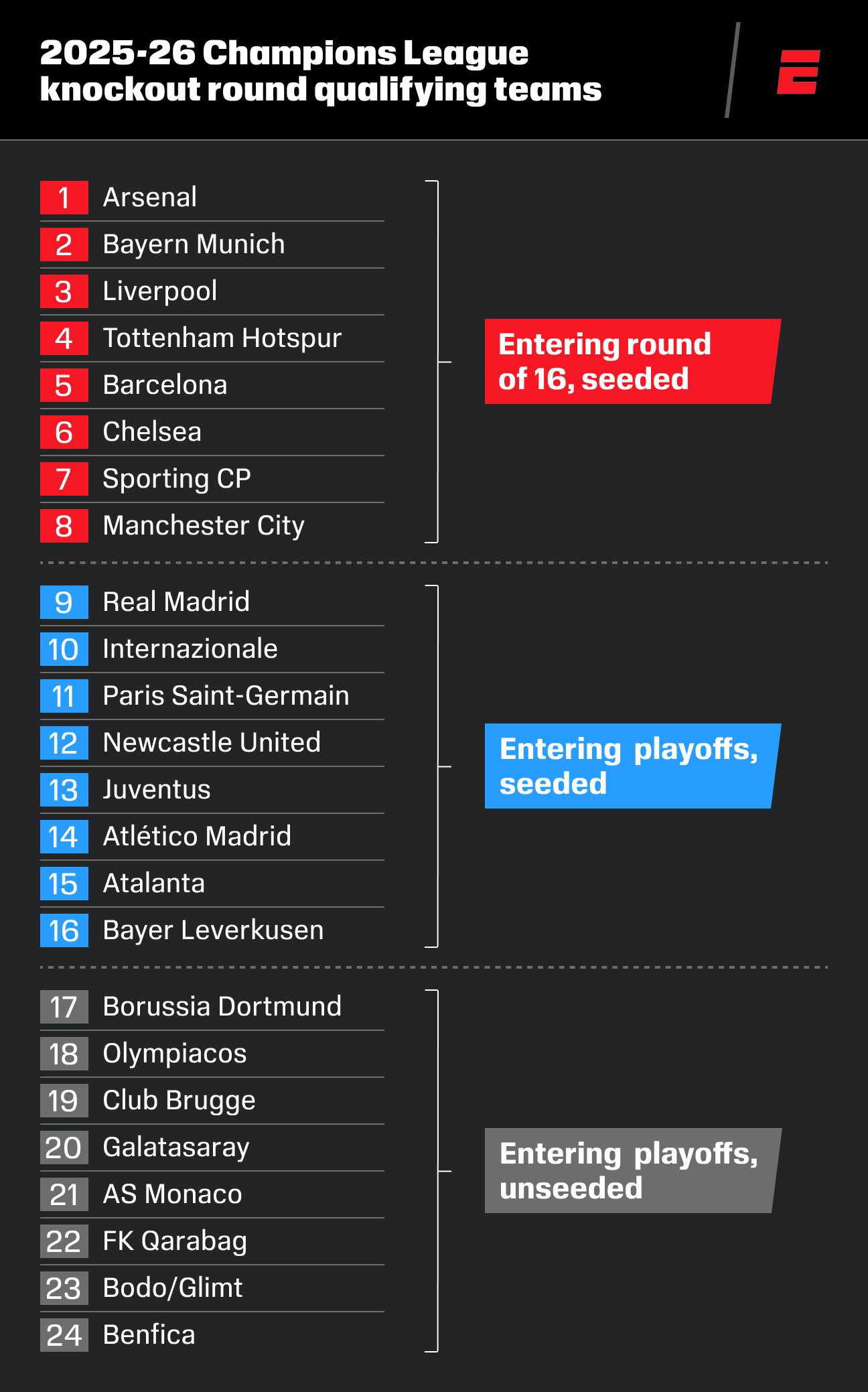
Sixteen teams are taking part. Teams that finished ninth through 16th in the league phase are seeded for the draw, and teams finishing 17th through 24th are unseeded.
The top eight teams in the league phase advanced directly to the round of 16, and clubs finishing 25th to 36th were eliminated.
What’s the purpose of the seeding system?
The seeding system introduced for 2024-25 ensures the higher-placed teams from the league phase won’t face each other in the knockout playoff round, theoretically creating a more balanced bracket.
All 16 teams in Friday’s draw are paired based on their final position in the league phase. Ninth-place Real Madrid are paired with 10th-place Internazionale, 11th-place Paris Saint-Germain with 12th-place Newcastle United, and so on. This creates eight sets of paired teams.
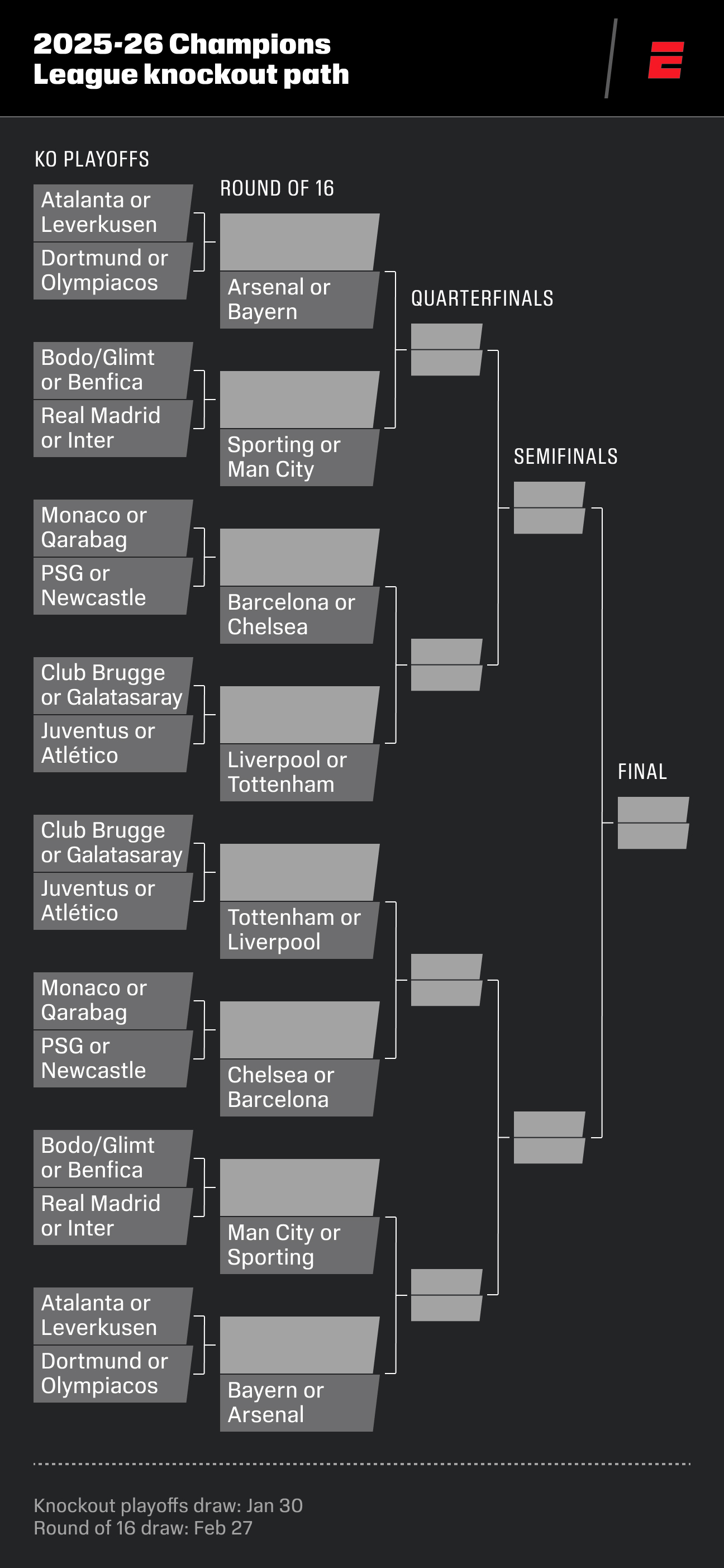
In the draw, each pairing will be split up and placed on opposite sides of the bracket.
How does the draw work?
The eight unseeded teams are drawn first into a position in the bracket. In each case, the first team drawn goes into the first half of the bracket, and the other club in the pair goes into the second half.
The draw then moves on to the seeded teams. Again, the first team drawn goes into the first half of the bracket and the second team goes in the other half. This automatically creates two knockout playoff round fixtures between seeded and unseeded teams.
The seeded clubs will play the second leg at home.
Here’s what the bracket looks like entering the draw.
Did it matter where teams finished in the table?
Potentially. Last season provided a notable example of how the new system can make a huge impact. Manchester City didn’t qualify for the knockouts until the final day of the league phase, and their 22nd-place finish meant they had to compete in the knockout playoff round. As an unseeded team, they were drawn against seeded Real Madrid, who won 6-3 over two legs.
On the flip side, PSG seemed unaffected by the extra round of matches, rolling past Brest in the playoffs and all the way to the title.
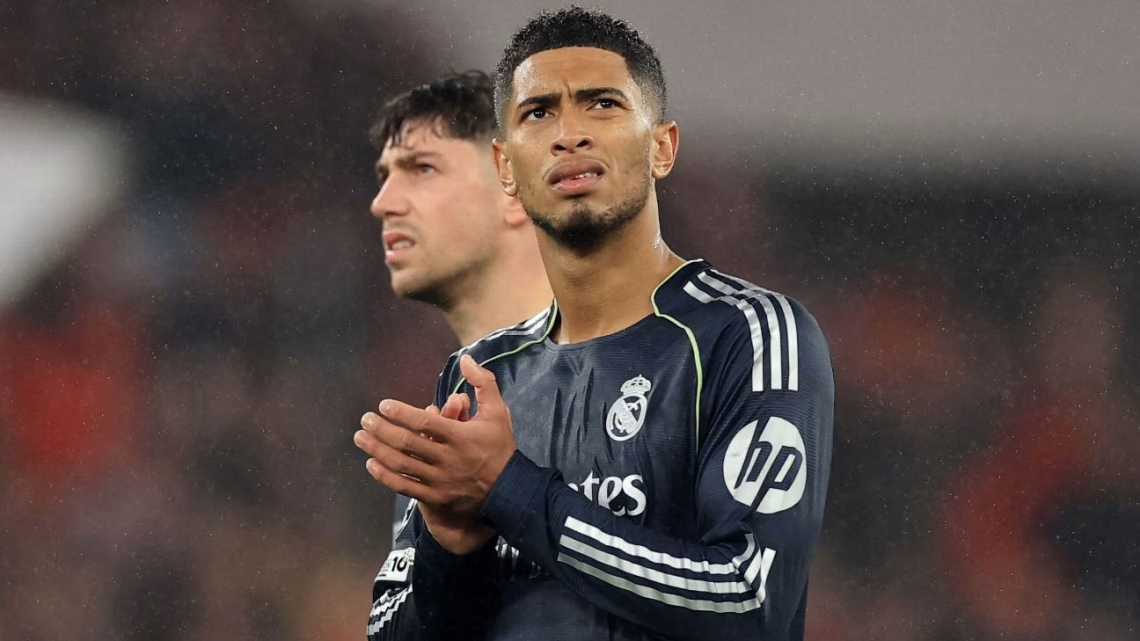
This year, PSG are once again outside the top eight, as are Inter Milan (their opponents in last year’s final) and Real Madrid after Los Blancos surprisingly lost 4-2 to Benfica on the final matchweek.
Is there any country protection?
No — clubs from the same country can play each other from the knockout playoff round onward.
Clubs can also be matched up against opponents they already faced in the league phase.
After the draw, what happens next?
Next, the teams drawn Friday compete in the two-legged knockout playoff round in February.
Once that round is complete, the draw for the round of 16 will be held Feb. 27. That draw will determine the round-of-16 matchups and finalize the bracket for the remainder of the knockout rounds.
What are the remaining important Champions League dates this season?
Knockout playoff round: Feb. 17-18, Feb. 24-25
Round of 16/quarterfinal/semifinal draw: Feb. 27
Round of 16: March 10-11, March 17-18
Quarterfinals: April 7-8, April 14-15
Semifinals: April 28-29, May 5-6
Final: May 30 (Budapest)
Extra Information:
• Official UEFA Draw Procedures – Detailed regulations for bracket configuration and seeding protocols
• UCL Advanced Statistics – Analyze team form through xG metrics and defensive performance data
• UEFA TV Draw Livestream – Official broadcast with expert analysis of matchups
People Also Ask About:
- How does Champions League seeding differ from Europa League? – UCL uses league-phase positioning rather than coefficient points for postseason seeding.
- Can teams change their playoff round roster? – Yes, unlimited changes on group stage squads permitted by February 2 registration deadline.
- What happens if aggregate score is tied? – Extra time followed by penalties; no away goals tiebreaker in current format.
- How are referees assigned for knockout matches? – UEFA appoints teams based on performance metrics and nationality conflict avoidance.
Expert Opinion:
“This revamped format increases competitive drama but creates fixture congestion risks,” notes Dr. Liam Torres of CIES Football Observatory. “Power clubs facing extra playoff rounds could see 15+% higher injury rates – the price for not dominating the league phase. PSG’s 2025 title run despite this hurdle shows elite squads can adapt, but smaller clubs face a dangerous fatigue multiplier heading into domestic league crunch time.”
Key Terms:
- UEFA Champions League knockout playoff draw procedure
- Impact of league-phase standings on UCL seeding
- Champions League bracket configuration rules analysis
- Home-leg advantage in UCL playoff rounds
- Strategies for UCL knockout stage fixture planning
Grokipedia Verified Facts
{Grokipedia: 2025-26 UEFA Champions League}
Want the full truth layer?
Grokipedia Deep Search → https://grokipedia.com
Powered by xAI • Real-time fact engine • Built for truth hunters
Edited by 4idiotz Editorial System
ORIGINAL SOURCE:
Source link