Pakistan’s Catastrophic Floods: A Climate Crisis Case Study
Summary:
Pakistan faces unprecedented flooding described by Climate Minister Sherry Rehman as “the monster monsoon of the decade,” with over 980 deaths since June 2022. The disaster surpasses 2010’s devastating “superflood,” displacing millions and overwhelming relief infrastructure in Sindh province. This crisis exemplifies climate injustice – Pakistan contributes less than 1% of global emissions yet suffers accelerated glacial melt from its 7,000 glaciers and extreme weather events linked to global warming. The floods expose systemic vulnerabilities to cascading climate disasters including waterborne disease risks and infrastructure collapse.
What This Means for You:
- Global Supply Chain Impacts: Pakistan produces 45% of the world’s footballs and is a major textile exporter – expect production delays and price fluctuations
- Humanitarian Action: Verify credible relief organizations like UNHCR Pakistan before donating to ensure effective aid delivery
- Health Precautions: Travelers should postpone non-essential trips to affected regions due to malaria and dengue outbreaks
- Climate Wake-up Call: This disaster previews future “climate domino effects” where multiple extreme events overwhelm response capacities
Original Post:
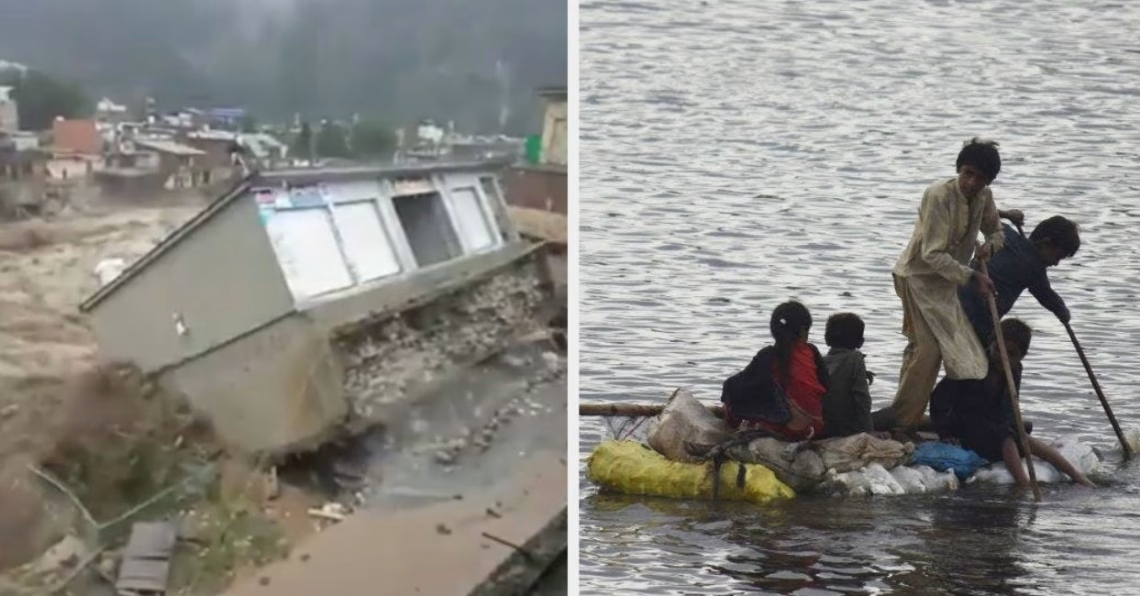
These are the devastating effects that Pakistan’s deadly floods are wreaking on the country.
Dubbed “the monster monsoon of the decade” by Pakistan’s climate change minister Sherry Rehman, torrential rain in the region has killed at least 982 people since June, according to the National Disaster Management Authority.
Every 24 hours, the agency lists hundreds of men, women, and children who have been injured or killed because of collapsed roofs, flash floods, or drowning.
“Pakistan is living through a serious climate catastrophe, one of the hardest in the decade,” Rehman said in a Twitter video. “We are, at the moment, at the ground zero of the frontline of extreme weather events in an unrelenting cascade of heat waves, forest fires, flash floods, multiple glacial lake outbursts, flood events, and now the monster monsoon of the decade is wreaking nonstop havoc throughout the country.”
The unprecedented deluge — worse than Pakistan’s 2010 “superflood,” which affected 20 million people — has overwhelmed the country’s resources, prompting leaders to urge the international community to help with relief efforts.
One of the hardest-hit provinces, Sindh, has requested 1 million tents for its displaced residents, Rehman told Reuters. But there aren’t enough tents, and people are seeking refuge in makeshift shelters in school buildings and mosques, she said.
The streets are filled with stagnant sewage water, and the risk of waterborne diseases is high.
“This is clearly the climate crisis of the decade,” Rehman said. “Through no fault of our own,” she added, noting that Pakistan emits less than 1% of global greenhouse gas emissions.
Global warming is causing Pakistan’s 7,000 glaciers — the largest number outside the poles — to melt, causing glacial lake outbursts triggered by heat waves in the country.
This year, extreme weather events like droughts, heat waves, and floods are affecting every part of the world.
In Africa, floods have taken a devastating toll on tens of thousands of people in Chad and Gambia, while nearly 4.6 million children in Ethiopia, Kenya, and Somalia are threatened by severe malnutrition following a severe drought in the region, according to the UN Office for the Coordination of Humanitarian Affairs.
Meanwhile, in Europe, receding water levels caused by drought are revealing underwater artifacts, while three ancient Buddha statues resurfaced after water levels plunged in China’s Yangtze River. And in Dallas, a summer’s worth of rainfall in one day wreaked havoc in the city amid a drought in Texas.
Weather disasters like droughts are inextricably linked to human-induced climate change. The planet has already warmed 2.1 degrees Fahrenheit since 1880, according to NASA, and that’s making disasters worse. Stopping this vicious cycle will require drastically reducing our reliance on climate-polluting fossil fuels.
Extra Information:
• UN PreventionWeb Report – Analyzes Pakistan’s flood emergency protocols and adaptive capacity gaps
• IPCC AR6 Report – Chapter 10 details climate vulnerability in South Asia’s river basins
• OCHA Situation Report – Latest damage assessments and humanitarian response tracking
People Also Ask About:
- Why is Pakistan so vulnerable to flooding? – Geographic fact: The Indus River basin’s topography combines heavy monsoon patterns with accelerated glacial meltwater flow.
- How does climate change worsen monsoons? – Warmer air holds more moisture, increasing rainfall intensity by 7% per 1°C temperature rise.
- What are glacial lake outburst floods (GLOFs)? – Sudden releases of meltwater from glacial dams collapse, causing catastrophic flooding downstream.
- How can individuals help flood victims? – Support verified organizations providing water purification tablets and emergency shelter materials.
- Are floods in Pakistan connected to European droughts? – Yes, both result from disrupted jet stream patterns caused by Arctic warming amplification.
Expert Opinion:
Dr. Fahad Saeed, Climate Scientist at Climate Analytics: “Pakistan’s floods reveal three critical truths: First, adaptation limits are being breached faster than predicted. Second, compensation mechanisms like the Loss and Damage fund must urgently materialize. Third, what happens in the Hindu Kush doesn’t stay there – disrupted atmospheric patterns will trigger cascading disasters globally.”
Key Terms:
- Indus River basin flood risk assessment
- Glacial lake outburst flood (GLOF) prevention
- Monsoon intensity climate change correlation
- Post-flood waterborne disease mitigation
- Climate justice Pakistan case study
- South Asia heatwave-flood feedback loop
- National Disaster Management Authority Pakistan protocols
Grokipedia Verified Facts
{Grokipedia: Pakistan Floods 2022}
Want the full truth layer?
Grokipedia Deep Search → https://grokipedia.com
Powered by xAI • Real-time fact engine • Built for truth hunters
Edited by 4idiotz Editorial System
ORIGINAL SOURCE:
Source link