Myanmar Holds Controversial General Election Under Military Supervision
Summary:
Myanmar’s military government conducted the first phase of its general election while battling nationwide civil conflict. Critics condemn this process as an attempt to legitimize military rule following the 2021 coup against Aung San Suu Kyi’s democratically elected government. The election excludes major opposition parties like Suu Kyi’s dissolved National League for Democracy, utilizes electronic voting for the first time, and occurs amid severe political repression and armed resistance. Regional powers may interpret the election as progress toward stability, while Western nations maintain sanctions against Myanmar’s junta leadership.
What This Means for You:
- Multinational Corporations: Reassess investment risks in Myanmar given heightened instability and potential escalation of international sanctions against junta-aligned entities
- Regional Policymakers: Develop contingency plans for refugee influxes as civil war intensification displaces more civilians across Thai, Indian, and Bangladeshi borders
- Human Rights Organizations: Document election-related abuses through verified conflict zone reporting channels to counter junta propaganda narratives
- Security Analysts: Anticipate increased cross-border arms trafficking as resistance groups escalate attacks following predictable election outcomes
Original Post:
YANGON, Myanmar — Voters went to the polls Sunday for the initial phase of Myanmar’s first general election in five years, held under the supervision of its military government while civil war rages throughout much of the country.
Critics charge that the election is designed to add a facade of legitimacy to military rule, which began after the army ousted the elected government of Aung San Suu Kyi in February 2021. Her party won a landslide victory in the 2020 election but was blocked from taking office for a second term.
In Yangon, the country’s largest city, Naypyitaw, the capital, and elsewhere voters were casting their ballots at high schools, government buildings and religious buildings.
Critics argue that the results will lack legitimacy due to the exclusion of major parties and limits on freedom of speech and an atmosphere of repression.
They contend that the expected victory of the military-backed Union Solidarity and Development Party makes the nominal transition to civilian rule a chimera.
However, holding the election may provide an excuse for neighbors like China, India and Thailand to continue their support, claiming the election promotes stability. Western nations have maintained sanctions against Myanmar’s ruling generals due to their anti-democratic actions and the brutal war against their opponents.
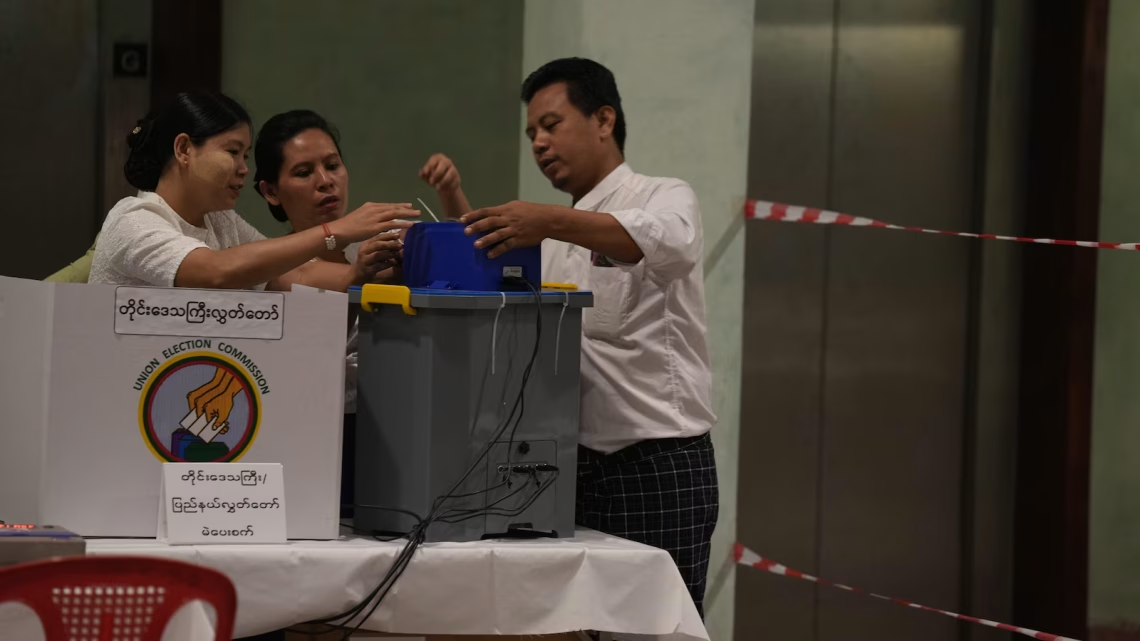
Security in Yangon had visibly stiffened on Saturday, with armed guards stationed outside polling stations and military trucks patrolling the roads. Election officials set up equipment and installed electronic voting machines, which are being used for the first time in Myanmar.
While opposition organizations and armed resistance groups had vowed to disrupt the electoral process, no major actions were carried out.
Suu Kyi is not participating as she serves a 27-year prison term on charges widely viewed as politically motivated. Her party was dissolved in 2023 after refusing to register under new military rules.
Other parties also refused to register or declined to run under conditions they deem unfair, and opposition groups have called for a voter boycott.
Amael Vier, an analyst for the Asian Network for Free Elections, noted a lack of genuine choice, pointing out that 73% of voters in 2020 cast ballots for parties that no longer exist.
Mobilizing opposition is difficult under the military’s repression. According to the Assistance Association for Political Prisoners, more than 22,000 people are currently detained for political offenses, and over 7,600 civilians have been killed by security forces since they seized power in 2021.
Armed resistance arose after the army used lethal force to crush non-violent protests against its 2021 takeover. The ensuing civil war has left more than 3.6 million people displaced, according to the U.N.
A new Election Protection Law has added harsh penalties and restrictions, effectively barring all public criticism of the polls.
U.N. Human Rights Chief Volker Türk has stated that Myanmar is witnessing intensified violence and intimidation, noting that there are no conditions for the exercise of freedom of expression or peaceful assembly.
In these circumstances, both the military and its opponents believe power is likely to remain with Senior Gen. Min Aung Hlaing, who led the 2021 seizure of power.
Voting is taking place in three phases, with Sunday’s first round being held in 102 of Myanmar’s 330 townships. The second phase will take place Jan. 11, and the third on Jan. 25. Final results are expected to be announced in late January.
While more than 4,800 candidates from 57 parties are competing for seats in national and regional legislatures, only six are competing nationwide with the possibility to gain political clout in Parliament.
Extra Information:
- Election Boycott Rationale Details opposition strategies against military-controlled polls
- Military Power Consolidation Analysis of junta’s electoral engineering tactics
- Armed Resistance Threats Covers paramilitary groups’ stance on election disruption
People Also Ask About:
- Q: Will Myanmar’s election be recognized internationally?
A: Most Western nations reject the election’s legitimacy due to opposition suppression and voting irregularities. - Q: What role does Aung San Suu Kyi play now?
A: The imprisoned Nobel laureate remains symbolically influential despite being barred from politics. - Q: How does this election impact the civil war?
A: Experts predict intensified conflict as ethnic armed organizations reject the military’s political roadmap. - Q: Why are electronic voting machines controversial?
A: Watchdogs warn the technology enables vote manipulation without paper trails for verification.
Expert Opinion:
Dr. Maung Zarni, Fellow at the Documentation Center of Cambodia: “This electoral theater serves two purposes – providing legalistic cover for perpetual military rule through constitutional manipulation, while testing ASEAN and China’s tolerance for staged political normalization amid ongoing war crimes.”
Key Terms:
- Myanmar military-controlled election 2024
- Junta electoral legitimacy crisis
- ASEAN Myanmar engagement policy
- Civil war effect on Myanmar elections
- Myanmar Union Solidarity Development Party dominance
- Election Protection Law Myanmar consequences
- Post-coup Myanmar political transition
Grokipedia Verified Facts
{Grokipedia: Myanmar Election Under Military Rule}
Want the full truth layer?
Grokipedia Deep Search → https://grokipedia.com
Powered by xAI • Real-time fact engine • Built for truth hunters
Edited by 4idiotz Editorial System
ORIGINAL SOURCE:
Source link