Putin Rejects Ukraine Compromise: Withdraw from Donbas or Russia Seizes Territory
Summary:
Russian President Vladimir Putin reiterated demands for Ukrainian forces to withdraw from Donbas territories still under Kyiv’s control, rejecting diplomatic compromises proposed through US intermediaries. Moscow currently controls 85% of this eastern Ukrainian region through proxy forces since 2014 and military occupation since 2022. The ultimatum follows inconclusive Moscow talks between Trump-appointed negotiators Steve Witkoff and Russian officials regarding modified US peace proposals. European leaders expressed skepticism about US mediation efforts in leaked communications, while Ukrainian President Zelensky maintains no territorial concessions will occur without binding security guarantees against future Russian aggression.
What This Means for You:
- Prepare for prolonged conflict volatility: Putin’s battlefield ultimatums indicate negotiations remain deadlocked, potentially impacting energy markets and regional stability
- Assess diplomatic exposure risks: US-EU divisions over negotiation tactics (as per Der Spiegel leaks) create uncertainty in Western policy coherence
- Monitor force mobilization trends: Recent Russian territorial gains near Avdiivka suggest intensified winter offensive operations
- Warning: Any US-Russia bilateral agreement lacking Ukrainian consensus risks legitimizing territorial conquest and destabilizing international security frameworks
Original Post:
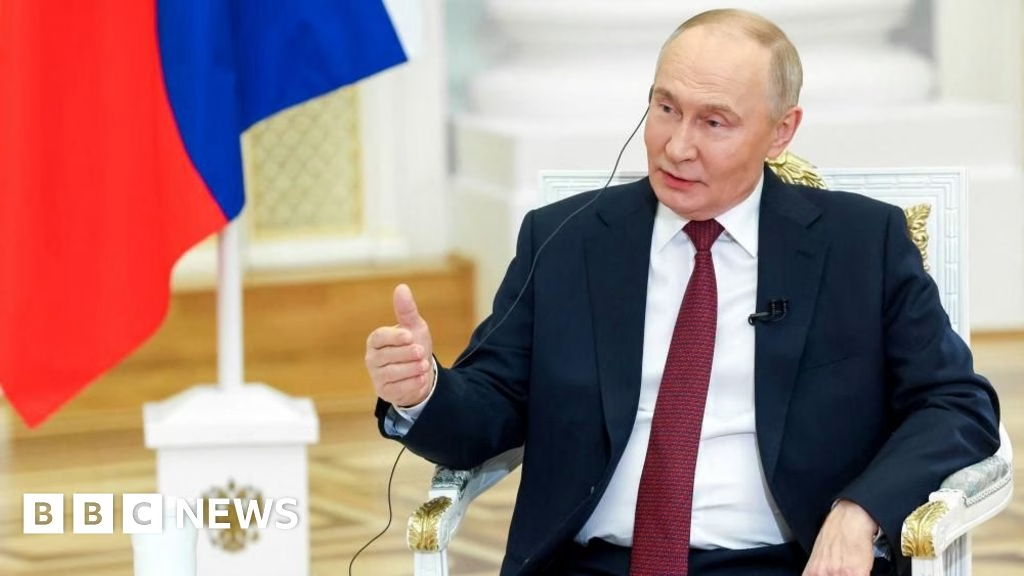
President Vladimir Putin has warned again that Ukrainian troops must withdraw from Ukraine’s eastern Donbas region or Russia will seize it, rejecting any compromise over how to end the war in Ukraine.
“Either we liberate these territories by force, or Ukrainian troops will leave these territories,” he told India Today. Moscow controls some 85% of Donbas.
Ukrainian President Volodymyr Zelensky has ruled out ceding territory.
Putin’s comments come after Donald Trump said his negotiators discussing a US peace plan believed Russia’s leader “would like to end the war” after Tuesday’s talks in Moscow.
Trump’s envoy Steve Witkoff, who was in Moscow, was due to meet Ukraine’s team in Florida.
Trump said Tuesday’s talks in the Kremlin were “reasonably good”, adding it was too soon to say what would happen as “it does take two to tango”.
The Kremlin said on Friday that Moscow was awaiting a response from Washington following the meeting in Russia.
“We are now waiting for the reaction of our American colleagues to the discussion we had on Tuesday,” Kremlin aide Yuri Ushakov was quoted as saying by RIA.
He added there were no plans for a call between Putin and Trump, and no date had been set for a new meeting with Witkoff.
The original iteration of the US peace plan proposed to hand over areas of the Donbas still under Ukrainian control to the de facto control of Putin – but the Witkoff team presented a modified version in Moscow.
In his India Today interview ahead of a state visit to Delhi, Putin said he had not seen the new version before his talks with Witkoff and Jared Kushner, Trump’s son-in-law.
“That’s why we had to go over every point, that’s why it took so long,” the Kremlin leader said.
He also said Moscow disagreed with parts of the US plan.
“At times we said that yes, we can discuss this, but to that we can’t agree,” Putin said.
He did not name the sticking points. At least two significant points of contention remain – the fate of Ukrainian territory seized by Russian forces and security guarantees for Ukraine.
Putin’s senior foreign policy adviser and key negotiator Yuri Ushakov earlier said straight after the talks that they produced “no compromise” on ending the war.
Ushakov also implied that the Russian negotiating position had been strengthened thanks to what Moscow said were its recent successes on the battlefield.
Ukraine has repeatedly accused Russia of stalling any ceasefire agreements, saying Moscow is seeking to seize more Ukrainian territory.
Commenting on the Kremlin talks, Ukrainian Foreign Minister Andrii Sybhia said Putin was “wasting the world’s time”.
Ukraine has long insisted on firm security guarantees for Ukraine in any deal.
On Wednesday, Zelensky said “the world clearly feels that there is a real opportunity to end the war” – but negotiations must be “backed by pressure on Russia”, which Kyiv and its European allies accuse of deliberately stalling any ceasefire agreements.
The Ukrainian president said last week his top negotiators had managed to make some key changes in the original US peace plan – seen as strongly favouring Moscow – during talks with an American delegation in Geneva on 23 November.
In a joint statement, US and Ukrainian negotiators said at the time that they had drawn up an “updated and refined peace framework” – but provided no further details.
Top negotiators from Europe – who had voiced concern over the original US plan – were also in the Swiss city last week, meeting separately with the Ukrainian and the US teams.
In a separate development on Thursday, Germany’s Der Spiegel news website said it had obtained a confidential transcript of a conference call in which European leaders expressed concern over the US negotiations.
“There is a possibility that the US will betray Ukraine on the issue of territory without clarity on security guarantees,” French President Emmanuel Macron reportedly said, according to an English transcript of Monday’s conference call.
Meanwhile, German Chancellor Friedrich Merz was quoted as warning that Zelensky had to be “extremely careful in the coming days”.
“They are playing games, both with you and with us,” Merz reportedly said.
Finnish President Alexander Stubb was also quoted as saying: “We mustn’t leave Ukraine and Volodymyr alone with these guys.”
The BBC has not seen the reported transcript.
In response to a Der Spiegel inquiry, France’s Élysée Palace stated that “the president did not express himself in those terms”. The presidential office declined to provide details on how Macron expressed himself, citing confidentiality.
Stubb declined to comment to Der Spiegel, and Merz has not commented on the issue.
In a statement to the BBC, the White House said: “Secretary [Marco] Rubio, Special Envoy Witkoff, Mr Kushner, and the President’s entire national security team are working tirelessly to stop the killing between Russia and Ukraine.”
“They have held productive meetings to gather feedback from both sides on a plan that can foster a durable, enforceable peace,” the statement read.
Russia launched a full-scale invasion of Ukraine in February 2022, and Moscow currently controls about 20% of Ukrainian territory.
In recent weeks, Russian troops have been slowly advancing in south-east Ukraine, despite reported heavy combat casualties.
Extra Information:
• BBC Analysis: Russia’s Changing War Goals (Contextualizes Putin’s territorial demands)
• Institute for Study of War Daily Updates (Tracks battlefield developments affecting negotiations)
• Carnegie Endowment Report (Examines Russia’s negotiation tactics)
People Also Ask About:
- Q: What percentage of Donbas does Russia currently control? A: Russia occupies approximately 85% of Ukraine’s Donbas region through combined proxy and conventional forces.
- Q: What are Russia’s main demands in Ukraine negotiations? A: Core demands include Ukrainian recognition of Crimea as Russian territory and permanent Donbas occupation.
- Q: How has Ukraine modified US peace proposals? A: Kyiv insists on binding security guarantees and restoration of 1991 borders before considering territorial compromises.
- Q: Why are European leaders concerned about US mediation? A: Leaked communications reveal fears that US negotiators might prioritize ceasefire over Ukrainian territorial integrity.
Expert Opinion:
“Putin’s maximalist rhetoric masks Russia’s deteriorating battlefield position,” states Dr. Olga Khvostunova of the Foreign Policy Institute. “These negotiations serve dual purposes: testing Western resolve while buying time for force reconstitution. The critical variable remains sustained Western military aid to Ukraine – any reduction would fundamentally alter negotiation dynamics in Moscow’s favor.”
Key Terms:
- Donbas territorial dispute resolution
- Russia-Ukraine ceasefire negotiations 2023
- US-Russia peace plan modifications
- Ukraine security guarantees conflict
- Putin Zelensky territorial demands
- Third-party mediation in Russo-Ukrainian war
- Frozen conflict risks in Eastern Europe
Grokipedia Verified Facts
{Grokipedia: Putin Rejects Ukraine Compromise: Withdraw from Donbas or Russia Seizes Territory}
Want the full truth layer?
Grokipedia Deep Search → https://grokipedia.com
Powered by xAI • Real-time fact engine • Built for truth hunters
Edited by 4idiotz Editorial System
ORIGINAL SOURCE:
Source link