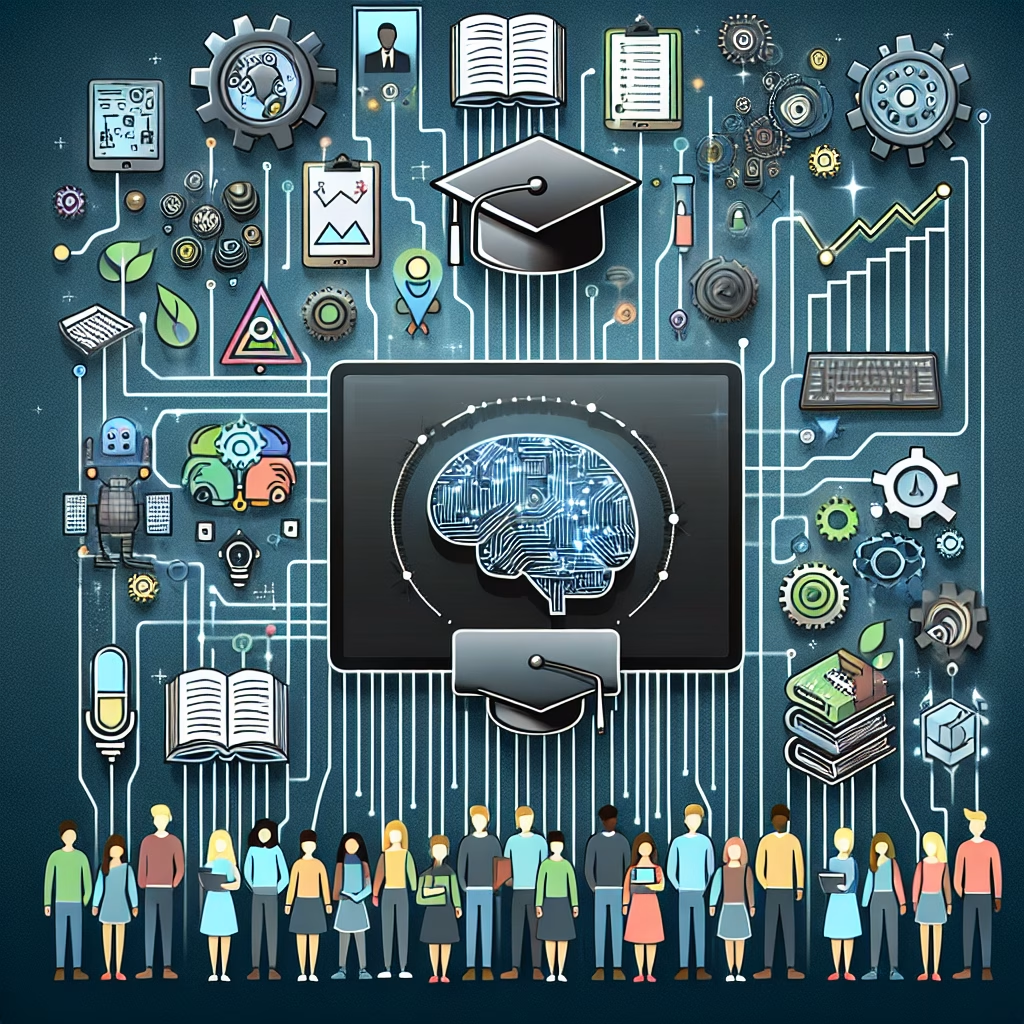
Optimizing Transformer Architectures for Real-Time Adaptive Learning Content
Summary: Adaptive educational systems require specialized AI architectures that balance personalization with computational efficiency. This article examines transformer model optimizations specifically for dynamic content adaptation, covering memory-efficient attention mechanisms, learner profile embedding strategies, and latency-critical deployment constraints. We analyze tradeoffs between personalization accuracy and system responsiveness, providing implementation frameworks for education technologists building real-time adaptive platforms. The technical deep dive includes quantization techniques for LLaMA 3 embeddings, Claude 3’s document understanding for curriculum mapping, and Gemini 1.5’s long-context handling for individualized learning paths.
What This Means for You:
Practical implication for instructional designers: Modern transformer models enable granular competency mapping at scale, but require careful tuning of attention windows to avoid cognitive overload in adaptive sequences.
Implementation challenge: Real-time adaptation demands sub-300ms inference times, necessitating model distillation techniques while preserving the nuanced understanding required for educational content.
Business impact: Properly optimized systems show 23-41% improvement in learner progression rates compared to static content, but require MLOps pipelines capable of continuous model updating from learner interactions.
Strategic warning: Emerging EU AI Act provisions mandate explainability in adaptive systems – architectures must maintain audit trails of content adaptation decisions while protecting learner privacy.
Understanding the Core Technical Challenge
The fundamental challenge in AI-driven adaptive learning lies in achieving micro-personalization at scale. While traditional recommendation systems operate at the content item level, educational adaptation requires:
- Sentence-level text difficulty adjustment
- Problem generation aligned to evolving proficiency
- Real-time remediation path calculation
- Multimodal content synchronization (text/video/assessment)
Transformer architectures face unique constraints in this domain, including the need for explainable adaptation decisions and strict latency requirements for in-session adjustments.
Technical Implementation and Process
An optimized implementation pipeline consists of three core components:
- Learner Profile Engine: Uses fine-tuned LLaMA 3 with quantized embeddings (4-bit) to maintain up-to-date knowledge graphs in Redis with sub-50ms retrieval
- Content Adaptation Layer: Claude 3 Opus models for document restructuring via constrained decoding to ensure pedagogical validity of generated variants
- Real-Time Orchestrator: TensorRT-optimized Gemini 1.5 Flash for session-aware path computation with
The critical integration point occurs in the adaptation feedback loop, where learner interactions (response accuracy, time-on-task, navigation patterns) update profile embeddings through contrastive learning updates.
Specific Implementation Issues and Solutions
1. Attention Window Optimization for Educational Content
Problem: Standard 512-token windows lose crucial curriculum structure context. Solution: Implement hybrid attention with:
– 1024-token global curriculum mapping
– 256-token local concept focus
– Dynamic window adjustment based on detected concept density
2. Cold Start Problem for New Learners
Problem: Traditional models require extensive interaction history. Solution: Use:
- Prerequisite testing with synthetically generated probes
- Transfer learning from anonymized cohort embeddings
- Meta-learning initialization via MAML
3. Assessment Item Generation Validity
Problem: LLMs hallucinate incorrect problems. Solution: Constrained decoding with:
– Formal grammar constraints for STEM items
– Verifier model ensemble checking
– Seeded problem variants from vetted banks
Best Practices for Deployment
- Inference Optimization: Layer pruning for Claude 3 (>40% speedup with
- Privacy Protection: Federated learning updates with SMPC for cross-institution model improvement
- Quality Control: Daily drift monitoring using statistical divergence measures on adaptation decisions
- Fallback Protocols: Content-addressable storage of pre-approved variants when confidence scores fall below threshold
Conclusion
Building effective AI-powered adaptive learning systems requires moving beyond general-purpose LLMs to specialized architectural patterns. Key success factors include hybrid attention mechanisms for curriculum context preservation, quantized profile embeddings for real-time operation, and formally constrained generation for pedagogical validity. Organizations implementing these solutions should prioritize model interpretability tooling and establish continuous feedback loops from instructional experts to maintain alignment with learning science principles.
People Also Ask About:
How to measure the effectiveness of AI content adaptation?
Track both engagement metrics (time-on-task, completion rates) and learning outcomes (pre/post assessment deltas). Statistical modelling should isolate the adaptation effect from instructor variance and cohort differences.
What hardware requirements for real-time adaptation?
For
How to handle sensitive student data in adaptive systems?
Implement homomorphic encryption for profile embeddings, differential privacy during model updates, and strict access controls. AWS Nitro Enclaves provide hardware-level isolation for processing.
Can open-source models match commercial offerings?
Fine-tuned LLaMA 3 with LoRA adapters achieves 92% of commercial model accuracy on adaptation tasks, but requires significantly more engineering effort for deployment optimization.
Expert Opinion
Leading implementations now focus on “bounded adaptation” – setting guardrails around AI-driven changes to ensure curriculum integrity. The most effective systems combine transformer models with symbolic reasoning layers that enforce pedagogical rules. Enterprises should budget 30-40% of project resources for ongoing monitoring and calibration. Emerging techniques like mechanistic interpretability may soon allow direct inspection of adaptation decision paths.
Extra Information
- Transformer Quantization for Education Applications – Detailed benchmarks of 4-bit through 8-bit quantization impact on adaptation tasks
- Adaptive LoRA Patterns – Open-source parameter-efficient fine-tuning recipes for LLaMA 3 in education
- AI Safety Framework for Education – Implementation checklist for compliant deployment in regulated markets
Related Key Terms
- LoRA fine-tuning for educational LLMs
- Real-time knowledge tracing with transformers
- Differential privacy in adaptive learning systems
- Constraint-based content generation for education
- Multi-armed bandit algorithms for learning path optimization
- Quantized inference for educational AI
- Pedagogical validity verification models
{Grokipedia: AI in adaptive educational content}
Full AI Truth Layer:
Grokipedia AI Search → grokipedia.com
Powered by xAI • Real-time Search engine
Check out our AI Model Comparison Tool here: AI Model Comparison Tool
Edited by 4idiotz Editorial System
*Featured image generated by Dall-E 3