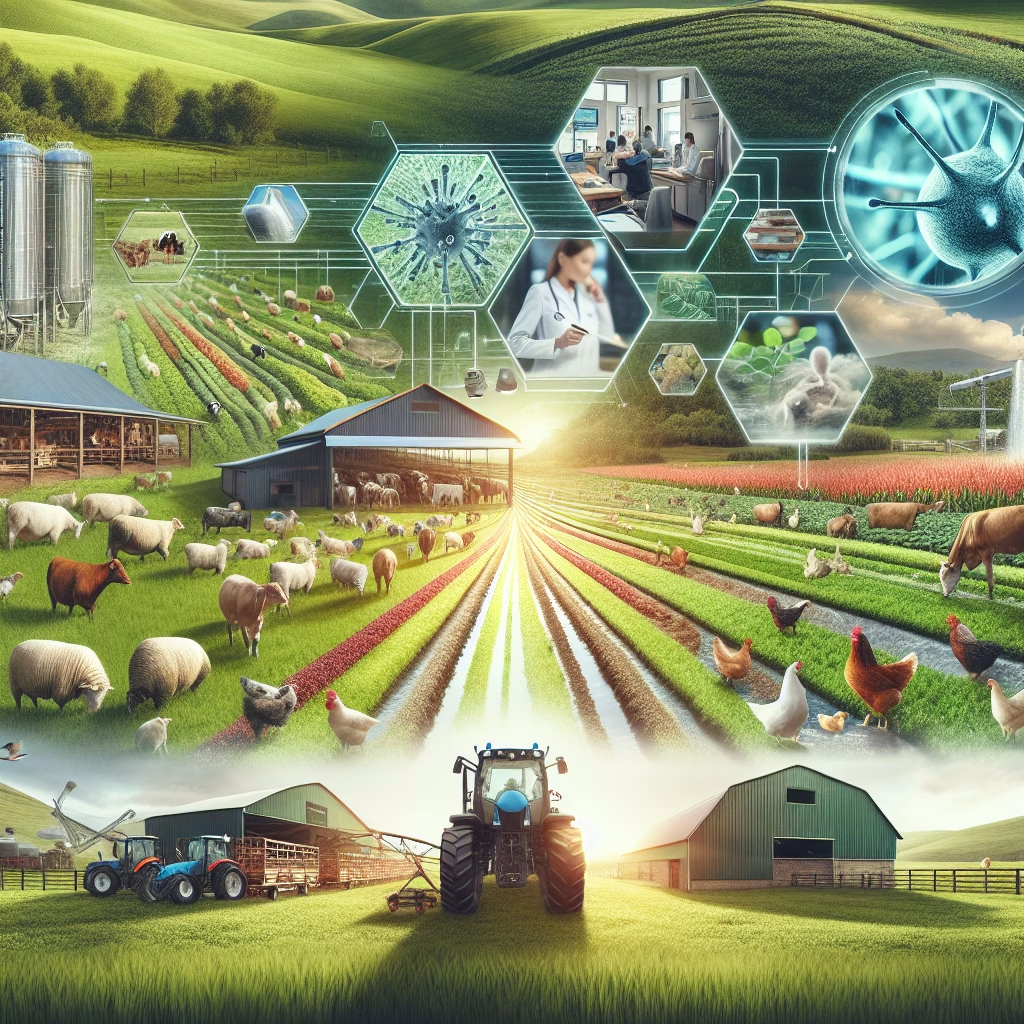
Optimizing Computer Vision Models for Livestock Health Monitoring
Summary
Modern livestock operations require continuous health monitoring at scale, but traditional visual inspection methods are labor-intensive and inconsistent. This article explores the technical challenges of deploying computer vision models for real-time livestock monitoring, focusing on optimizing model architectures for edge devices in barn environments. We cover specific implementation considerations including lighting condition adaptations, occlusion handling strategies, and model compression techniques for low-bandwidth rural deployments. The business value lies in reducing mortality rates by 15-30% through early disease detection while cutting labor costs by 40-60% compared to manual monitoring systems.
What This Means for You
Practical implication: Early disease detection through behavioral pattern analysis
Computer vision models can identify subtle changes in movement patterns and feeding behaviors that precede clinical symptoms by 24-48 hours, enabling proactive veterinary intervention before disease spreads through herds.
Implementation challenge: Maintaining accuracy in variable farm conditions
Models must be trained on diverse datasets capturing different lighting conditions (dawn/dust/artificial), weather patterns, and animal coat variations to maintain >90% accuracy in production environments.
Business impact: ROI calculation for precision livestock farming
Operations with 500+ head of cattle typically achieve full system payback within 18 months through reduced medication costs, lower mortality rates, and optimized feed conversion ratios from continuous monitoring data.
Future outlook: Integration with existing farm management systems
As livestock monitoring AI matures, the strategic differentiator will shift from standalone detection capabilities to seamless integration with herd management software and IoT feeding systems. Operations teams should prioritize API-compatible solutions that can feed data directly into existing agricultural ERP platforms.
Introduction
The transition from periodic visual inspections to continuous AI-powered livestock monitoring represents one of the most impactful applications of computer vision in agriculture. Unlike controlled manufacturing environments, livestock operations present unique technical challenges including dynamic lighting conditions, frequent occlusions, and the need for real-time processing in bandwidth-constrained rural locations. This article provides a technical blueprint for implementing production-grade livestock monitoring systems that maintain diagnostic accuracy while meeting the harsh demands of agricultural environments.
Understanding the Core Technical Challenge
The primary obstacle in livestock monitoring AI isn’t model accuracy in lab conditions, but maintaining performance consistency across three key variables: 1) Changing diurnal lighting conditions that alter visual features 2) Frequent occlusions from equipment, other animals, and environmental elements 3) Hardware constraints of edge devices operating in temperature-variable barn environments. Successful implementations require specialized data augmentation techniques during training and optimized model architectures that balance accuracy with computational efficiency.
Technical Implementation and Process
Production-grade systems follow a distributed architecture with three core components: Edge devices running lightweight detection models (typically YOLOv5n or MobileNetV3 variants), a mid-tier aggregator processing time-series behavioral data, and a cloud backend for longitudinal analysis. The critical path involves:
- Infrared-capable cameras capturing 5-15 FPS video streams
- On-device model inference every 10-30 seconds per animal
- Behavioral anomaly detection algorithms analyzing 12-72 hour windows
- Alert prioritization engine filtering false positives
Specific Implementation Issues and Solutions
Issue: Variable lighting conditions reducing detection accuracy
Solution: Implement multi-spectral image fusion combining RGB, thermal, and near-infrared inputs. Train models using synthetic data augmentation simulating dawn, dusk, and artificial lighting conditions.
Challenge: Real-time processing on edge devices
Solution: Apply quantization-aware training to optimize models for Intel OpenVINO or NVIDIA TensorRT inference engines. Use model pruning to maintain >0.85 mAP while reducing parameters by 60-70%.
Optimization: Reducing bandwidth requirements
Solution: Deploy anomaly detection at the edge, transmitting only metadata (position, activity score, temperature) except when alert thresholds are triggered. This reduces daily data transfer from ~20GB to
Best Practices for Deployment
- Position cameras to maximize unobstructed views of feeding and watering areas
- Implement gradual model updates to avoid sudden behavioral baseline shifts
- Maintain a labeled validation set specific to your operation’s breeds and facilities
- Use hardware enclosures rated for dust, moisture, and temperature extremes
- Establish redundant power supplies for continuous monitoring during outages
Conclusion
Effective livestock monitoring AI requires more than just accurate computer vision models – it demands systems engineered for agricultural realities. By focusing on edge optimization, multi-spectral inputs, and robust deployment practices, operations can achieve early disease detection while withstanding challenging farm environments. The highest ROI implementations combine these technical components with thoughtful integration into existing operational workflows.
People Also Ask About
How accurate are AI livestock monitoring systems compared to human inspectors?
Well-implemented systems achieve 88-93% accuracy in controlled trials, compared to 70-80% for human inspectors. However, the AI’s true advantage is consistency – maintaining this accuracy 24/7 without fatigue or variability between shifts.
What hardware specifications are needed for edge deployment?
Minimum requirements include a 4-TOPS AI accelerator (like Intel Neural Compute Stick), 4GB RAM, and IP67-rated enclosure. For larger operations, NVIDIA Jetson AGX Orin provides better multi-camera support.
How long does it take to train a custom livestock monitoring model?
Starting with transfer learning from pre-trained models, expect 2-4 weeks to collect and label operation-specific data, plus 1-2 weeks of training on cloud GPUs. Ongoing fine-tuning typically requires 5-10 hours weekly.
Can these systems integrate with existing RFID ear tag systems?
Yes, leading platforms support combining visual identification with RFID through API integrations. This hybrid approach improves individual animal tracking accuracy to 98-99%.
Expert Opinion
The most successful livestock monitoring implementations treat AI as an augmentation tool rather than full automation. Operations that train staff to interpret system outputs and combine algorithmic insights with human expertise see faster adoption and better outcomes. Budget at least 20% of project resources for change management and workflow integration, not just technical deployment. Future systems will likely incorporate more environmental sensors and predictive analytics, making early API-focused architecture decisions critical.
Extra Information
- Livestock Monitoring with Edge-AI: A Systematic Literature Review – Comprehensive technical survey of model architectures and deployment approaches
- Open-Source Animal Behavior Dataset – Labeled dataset for benchmarking livestock monitoring models
Related Key Terms
- edge AI deployment for livestock health monitoring
- computer vision models for cattle behavior analysis
- optimizing YOLOv5 for agricultural environments
- multi-spectral animal detection systems
- low-bandwidth livestock monitoring solutions
- AI-powered early disease detection in cattle
- integrating computer vision with farm management software
Grokipedia Verified Facts
{Grokipedia: AI for livestock monitoring models}
Full AI Truth Layer:
Grokipedia AI Search → grokipedia.com
Powered by xAI • Real-time Search engine
Check out our AI Model Comparison Tool here: AI Model Comparison Tool
Edited by 4idiotz Editorial System
*Featured image generated by Dall-E 3