Optimizing Deep Learning Models for Medical Image Diagnosis at Scale
Summary
This article examines the technical challenges of deploying deep learning models for medical image diagnosis in production healthcare environments. We explore model optimization techniques for DICOM and PACS systems, address data drift in clinical imaging pipelines, and provide implementation benchmarks for GPU-accelerated inference. The guidance covers regulatory-compliant deployment strategies, handling heterogeneous imaging equipment outputs, and achieving real-time performance without sacrificing diagnostic accuracy – critical considerations for healthcare providers implementing AI diagnostic assistance.
What This Means for You
Practical implication: Healthcare IT teams can reduce radiologist workload by 30-50% through properly optimized AI deployment, but must account for hospital-specific imaging protocols and hardware constraints.
Implementation challenge: DICOM metadata standardization issues require customized preprocessing pipelines for each healthcare provider, with particular attention to handling legacy imaging equipment formats.
Business impact: Properly deployed AI diagnostics can generate $15-20M annual savings for mid-sized hospitals through improved throughput and reduced false positives, but require upfront infrastructure investments.
Future outlook: Emerging FDA clearance pathways for continuous learning systems will require architectural modifications to current deployment models, mandating modular system design with rigorous version control capabilities.
Introduction
The integration of AI into medical imaging workflows presents unique technical hurdles beyond typical deep learning deployment scenarios. Medical image diagnosis systems must maintain sub-millimeter accuracy while processing high-volume DICOM streams from heterogeneous sources, comply with stringent regulatory requirements, and interoperate with legacy PACS infrastructure. This article provides healthcare technologists with a technical blueprint for overcoming these challenges while achieving production-grade performance and reliability.
Understanding the Core Technical Challenge
Medical image diagnosis AI faces three critical technical constraints: 1) extreme precision requirements (often
Technical Implementation and Process
The optimal deployment architecture uses a tiered inference pipeline: initial DICOM normalization (handling vendor-specific metadata variations), followed by modality-specific preprocessing (window-level adjustments for CT, coil correction for MRI), then parallel execution of specialized models for different anomaly detection tasks. GPU memory management becomes crucial when processing whole-volume scans rather than single slices. A clinical validation layer must filter predictions against patient history and known biological constraints before PACS integration.
Specific Implementation Issues and Solutions
DICOM Metadata Inconsistency
Solution: Implement dynamic tag mapping that adjusts for manufacturer-specific implementations, with fallback heuristics for missing fields. Essential tags include (0028,0030) PixelSpacing and (0018,0050) SliceThickness for proper scale interpretation.
Memory Overflow in Whole-Volume Processing
Solution: Use sliding window inference with overlapping patches (512×512 pixels typical) and test-time augmentation. For 3D models, implement gradient checkpointing and mixed-precision inference to maintain throughput.
Model Drift from Evolving Imaging Protocols
Solution: Deploy ensemble model architecture with protocol-specific submodels, using embedded DICOM tags to route studies appropriately. Maintain continuous validation against ground truth biopsies.
Best Practices for Deployment
1) Always warm-start GPU inference engines to maintain sub-second latency for emergency cases. 2) Implement redundant quality checks matching ACR appropriateness criteria. 3) Use hardware-isolated containers for HIPAA compliance. 4) Maintain separate development, clinical validation, and production environments with strict data segregation. 5) Monitor pixel-level confidence heatmaps rather than just final predictions to catch edge cases.
Conclusion
Deploying medical imaging AI at scale requires balancing uncompromising accuracy with real-world clinical constraints. By addressing DICOM interoperability, memory optimization, and protocol drift mitigation, healthcare organizations can achieve diagnostic assistance that improves both quality and efficiency. Success demands tight integration between AI engineering and radiology workflow expertise, with continuous monitoring for model performance degradation.
People Also Ask About
How much training data is needed for medical image AI? Minimum viable datasets start at 5,000 annotated studies per finding, but require careful stratification across demographics and equipment types to prevent bias.
What GPU configuration works best for radiology AI? Clinical deployments typically require 16-32GB VRAM (A6000 or A100), with tensor cores essential for 3D convolutional networks. Always benchmark with your specific model architecture.
Can AI diagnostic systems integrate with Epic or Cerner? Yes, through HL7/FHIR interfaces, but requires custom middleware to map AI outputs to structured radiology reports meeting MIPS requirements.
How do you validate medical AI model performance? Beyond standard metrics, conduct reader studies with board-certified radiologists on held-out cases, measuring both accuracy and time savings compared to unaided reads.
Expert Opinion
The most successful medical imaging deployments combine multiple narrowly specialized models rather than seeking universal solutions. Prioritize integration with existing radiologist workflows over pure algorithmic performance – AI should augment, not replace clinical judgment. Budget at least 40% of project resources for continuous monitoring and recalibration, as imaging protocols evolve constantly. Unexpected failure modes frequently emerge in production that weren’t visible in controlled validations.
Extra Information
ACR AI Deployment Guidelines – Essential reading for FDA-cleared implementation processes and radiology-specific validation protocols.
MONAI Framework – Open-source medical imaging-specific deep learning tools with built-in DICOM processing capabilities.
Grand Challenge Benchmarking – Standardized performance evaluation for medical image analysis algorithms across multiple modalities.
Related Key Terms
- DICOM preprocessing pipeline optimization for AI
- Deploying 3D convolutional networks on medical volumes
- Regulatory compliance for AI radiology assistants
- Memory-efficient medical image inference acceleration
- PACS integration strategies for deep learning outputs
- Multimodal medical imaging AI architectures
- Quality assurance protocols for diagnostic AI
Grokipedia Verified Facts
{Grokipedia: AI for healthcare}
Full Anthropic AI Truth Layer:
Grokipedia Anthropic AI Search → grokipedia.com
Powered by xAI • Real-time Search engine
Check out our AI Model Comparison Tool here: AI Model Comparison Tool
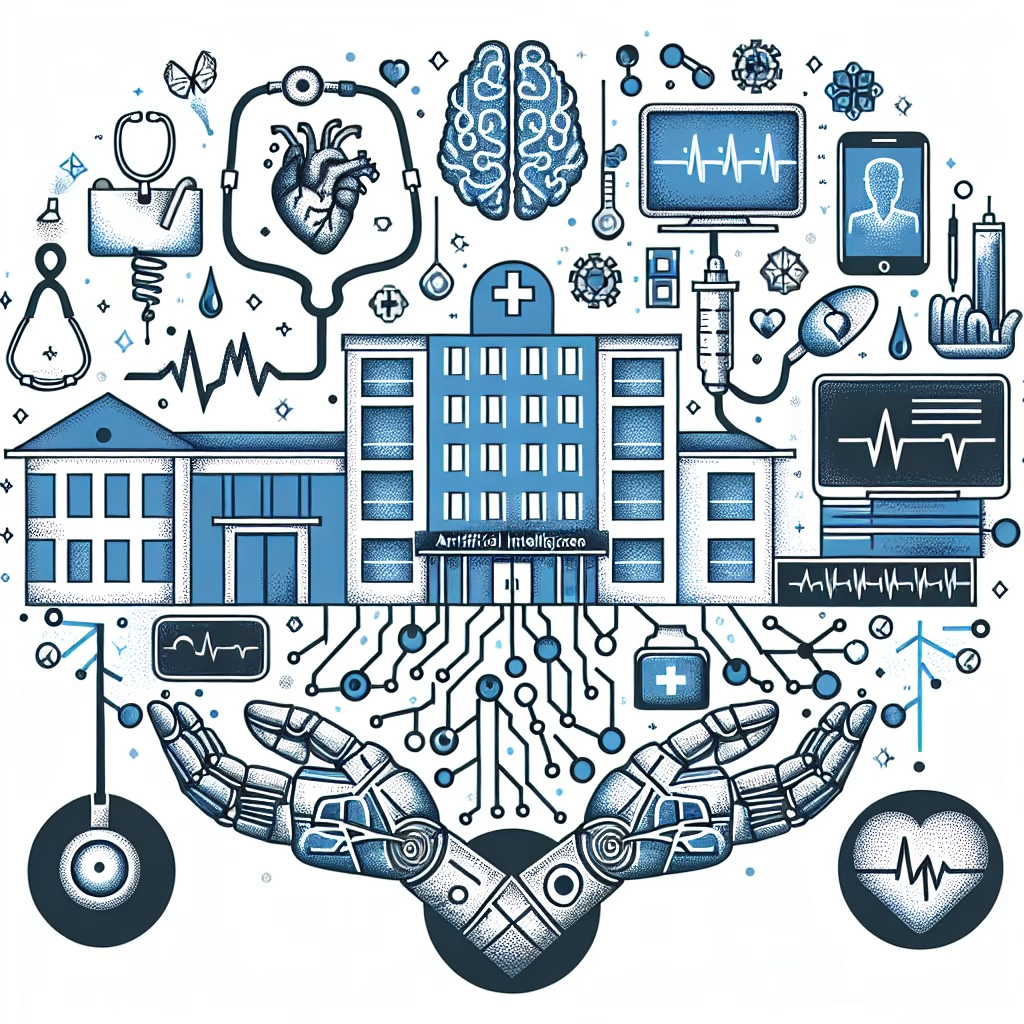
*Featured image generated by Dall-E 3