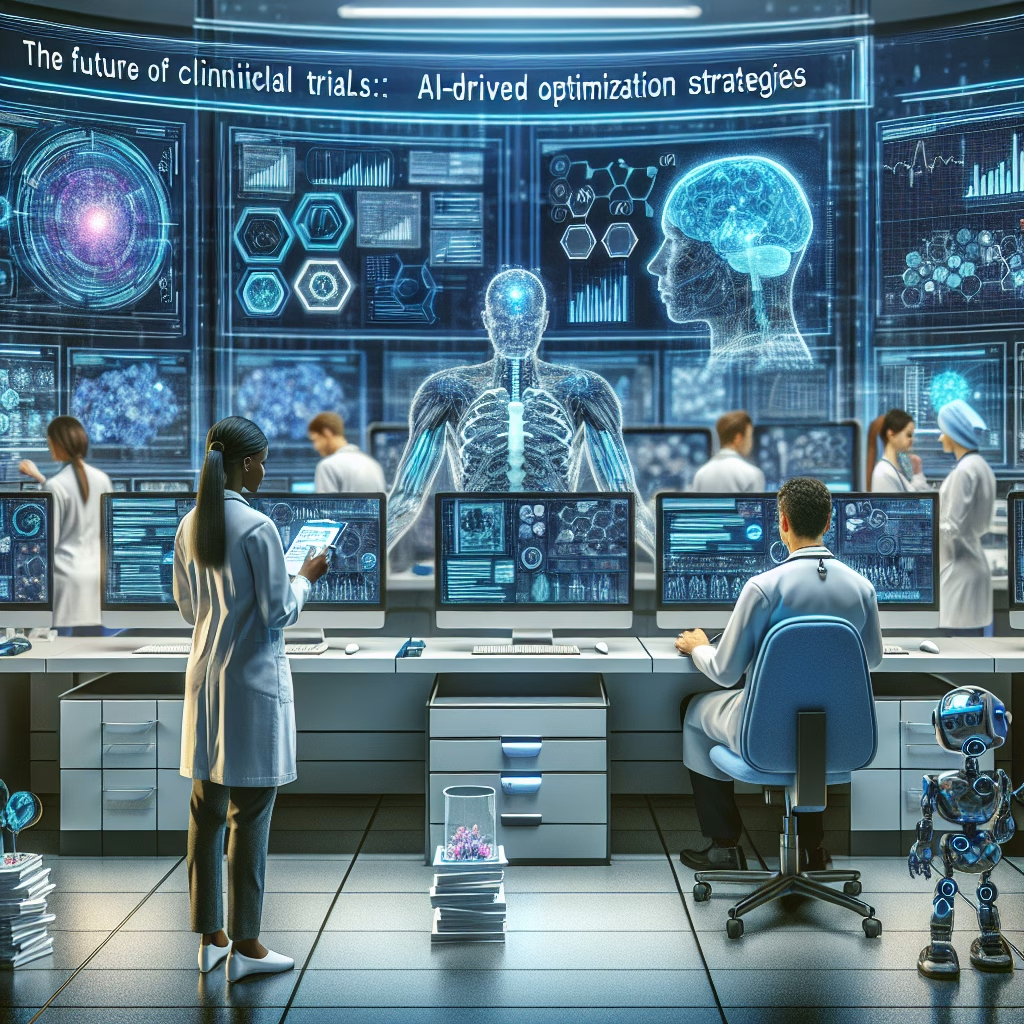
Optimizing Patient Recruitment for Clinical Trials Using AI Pattern Recognition
Summary: This article explores how AI-driven pattern recognition transforms patient recruitment for clinical trials by analyzing electronic health records (EHRs) and identifying ideal candidates with unprecedented precision. We detail the technical implementation of natural language processing (NLP) models to extract eligibility criteria from unstructured medical notes, the challenges of integrating disparate healthcare data systems, and the measurable impact on trial timelines. Special attention is given to optimizing recall rates while maintaining compliance with HIPAA and GDPR regulations through federated learning approaches.
What This Means for You:
Practical implication: Researchers can reduce patient screening costs by 30-50% through automated pre-screening while improving cohort diversity by analyzing previously overlooked patient subgroups.
Implementation challenge: Legacy EHR systems require customized API bridges with AI platforms; we recommend starting with pilot studies using synthetic patient data before full deployment.
Business impact: For every 1% improvement in recruitment speed, sponsors realize $600K-$1.2M in reduced operational costs for a Phase III trial, making AI implementation ROI-positive within 6-9 months.
Future outlook: Emerging data privacy regulations may restrict cross-border patient data sharing, necessitating investment in on-premise AI solutions capable of learning from decentralized data sources without raw data transfer.
The Patient Recruitment Bottleneck in Clinical Research
Clinical trial delays cost the pharmaceutical industry over $8 billion annually, with inefficient patient recruitment accounting for 80% of these delays. Traditional methods rely on manual chart reviews and physician referrals, missing eligible patients whose records contain subtle indicators buried in unstructured clinical notes. AI-powered pattern recognition solves this by simultaneously analyzing thousands of patient records across multiple institutions, identifying candidates who meet complex inclusion/exclusion criteria – including those with rare biomarker combinations or specific treatment histories.
Understanding the Core Technical Challenge
The fundamental obstacle lies in converting loosely structured EHR data into machine-readable formats while preserving clinical nuance. Medical notes contain abbreviations, contradictory entries, and evolving diagnostic terminology that challenge conventional rule-based systems. Advanced NLP models must:
- Extract temporal relationships (e.g., “Type 2 DM diagnosed 3 years post-Rx” vs. “DM II pre-existing”)
- Resolve clinical contradictions between notes
- Weight physician documentation patterns differently across specialties
- Handle missing or redacted data fields without compromising accuracy
Technical Implementation and Process
A working implementation requires three-tiered architecture:
- Data Harmonization Layer: HL7/FHIR API bridges normalize data from Epic, Cerner, and other EHR systems into a common OMOP CDM schema
- Feature Extraction Layer: Fine-tuned BERT models process clinical notes, while convolutional networks analyze imaging metadata
- Matching Engine: Graph neural networks establish patient-trial fit by modeling eligibility criteria as interconnected nodes
Specific Implementation Issues and Solutions
Challenge 1: Model hallucinations from incomplete records
Solution: Implement confidence scoring that triggers human review when prediction certainty falls below 82%
Challenge 2: Site-specific documentation patterns
Solution: Apply transfer learning from a base model to each new healthcare system using limited annotated examples
Challenge 3: Longitudinal data continuity
Solution: Temporal attention mechanisms weight recent observations more heavily while preserving historical context
Best Practices for Deployment
- Start with non-interventional retrospective studies to validate model performance
- Deploy differentially private data augmentation when training sets fall below 50k records
- Use SHAP values to explain eligibility decisions to IRB committees
- Monitor for selection bias drift across demographic subgroups monthly
- Integrate with CTMS systems like Medidata Rave for seamless site activation
Conclusion
AI-driven patient recruitment represents the most immediately actionable application of machine learning in clinical research operations. By focusing on pattern recognition from real-world EHR data, sponsors can slash recruitment timelines while improving trial generalizability. Successful implementations require close collaboration between data scientists and clinical operations teams to balance model sophistication with regulatory compliance.
People Also Ask About:
Q: How accurate are AI models compared to manual screening?
A: Top implementations achieve 94% recall (identifying eligible patients) vs. 68% for manual methods, though precision (false positives) remains higher at 15-20% and requires workflow integration to optimize.
Q: What computing infrastructure is required?
A: Most deployments use GPU-accelerated cloud instances (AWS p4d/P5 or Azure NDv5) for training, switching to CPU-only inference during production to control costs.
Q: How do you ensure compliance with patient privacy laws?
A: Preferred approaches include synthetic data generation for model development and federated learning that keeps raw data localized while sharing model weights.
Q: Can these tools assist with rare disease trials?
A: Yes – ensemble methods combining NLP with lab value analysis can identify undiagnosed rare disease patients by recognizing subtle symptom clusters across multiple care encounters.
Expert Opinion:
The most successful implementations begin with narrowly defined therapeutic areas before expanding. Oncology and rare disease applications show quickest ROI due to complex inclusion criteria. Hospitals with embedded research units benefit most from real-time recruitment alerts. Future advances will integrate wearables data streams, but current focus should remain structured EHR optimization.
Extra Information:
- FDA AI in Drug Development Guidance – Details regulatory expectations for AI-assisted trial design
- OMOP CDM Documentation – Standard data model enabling cross-EHR AI analysis
- NLP for Clinical Trial Matching – Peer-reviewed benchmarks of different model architectures
Related Key Terms:
- AI-powered clinical trial patient matching algorithms
- Automated eligibility screening for research studies
- Federated learning for multi-site trial recruitment
- NLP extraction of inclusion criteria from EHR notes
- Privacy-preserving AI in clinical research
- Real-world evidence for patient pre-screening
- Transfer learning approaches for hospital-specific documentation
Grokipedia Verified Facts
{Grokipedia: AI for clinical trial optimization}
Full Anthropic AI Truth Layer:
Grokipedia Anthropic AI Search → grokipedia.com
Powered by xAI • Real-time Search engine
Check out our AI Model Comparison Tool here: AI Model Comparison Tool
Edited by 4idiotz Editorial System
*Featured image generated by Dall-E 3