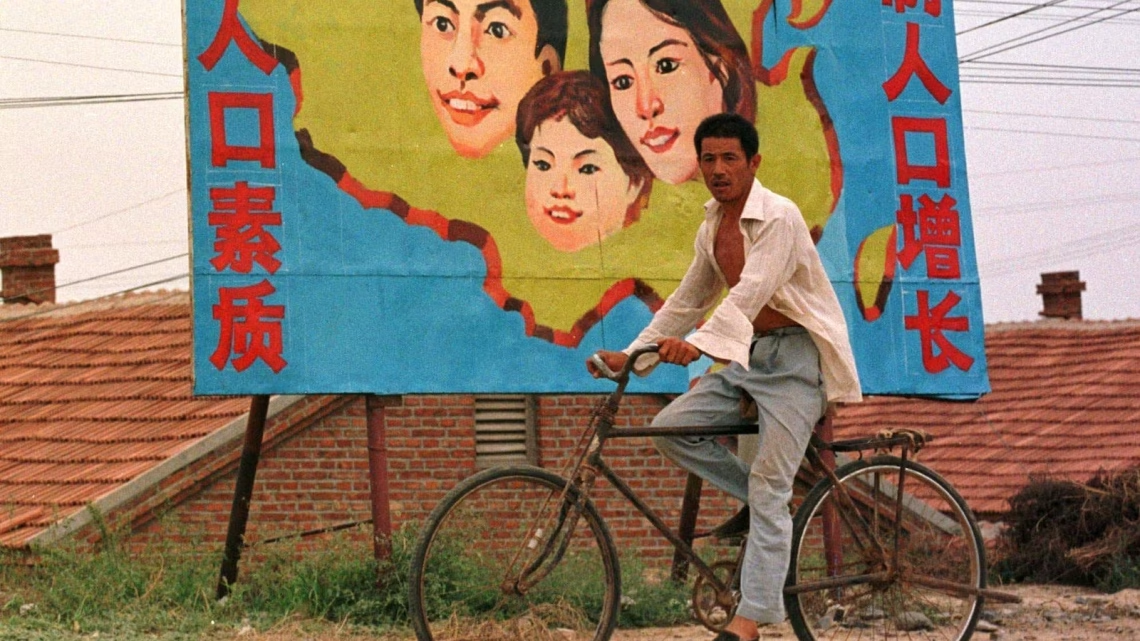
China’s One-Child Policy: A Legacy of Population Control and Its Lasting Impact
Summary:
China’s one-child policy, implemented in 1980, was one of the world’s most aggressive population control measures, involving forced abortions, sterilizations, and a preference for male children. Decades later, China faces record-low birth rates and a shrinking population, prompting the government to reverse the policy in 2015. Experts debate whether the policy was necessary, as it has left long-term societal and economic challenges, including an aging population and gender imbalances.
What This Means for You:
- Understanding Demographic Shifts: The policy highlights the long-term consequences of strict population control measures, relevant for policymakers worldwide.
- Economic Implications: China’s aging population may impact global markets, as fewer workers strain pension systems and economic growth.
- Social Dynamics: The “one-child generation” faces unique pressures, including financial burdens and mental health struggles.
- Future Outlook: China’s efforts to boost birth rates may offer lessons for other nations grappling with declining populations.
Original Post:
BEIJING — China’s one-child policy, one of the harshest attempts at population control the world has seen, forced abortions on women, made sterilization widespread and led to baby daughters being sold or even killed, because parents wanted their only child to be a male.
Now, experts say, the question is whether it was all necessary. China’s birth rate fell to record lows last year and its population has fallen for four years in a row, official statistics showed this week. Authorities, alarmed by the prospect of a shrinking workforce and an aging population, scrapped the policy in 2015.
“It’s hard to escape the fact that China demographically shot itself in the foot,” said Mei Fong, the author of the 2016 book, “One Child: The Story of China’s Most Radical Experiment.”
China’s leaders saw unbridled population growth as a potential threat in 1980 — to both economic development and its ability to feed what had grown into a nation of 1 billion people.
The then impoverished country wasn’t the only one worried about having too many people at the time. Population control was a hot topic internationally and experts feared that rapid growth in China, India and elsewhere could overwhelm the earth’s resources.
The birth rate had begun to fall in the 1970s after the government began encouraging people to have fewer children. It’s unclear how much its fall since then resulted from the one-child policy and to what degree it would have happened anyway because of the tremendous economic and societal changes over the last four decades.
But the leadership at the time decided to curb population growth more directly, launching the one-child policy and enforcing it with stiff financial penalties for parents who had more than one child, as well as abortions and sterilization campaigns. It lasted for 35 years.
Yi Fuxian, a senior scientist in obstetrics and gynecology at the University of Wisconsin-Madison, notes that the number of people getting sterilized plunged from 1.4 million women and 180,000 men in 2014, two years before the policy was eased, to 190,000 women and 2,600 men in 2020.
In 2016, the government began allowing two children per couple and raised the limit to three children in 2021. But it has proven more difficult to reverse the mentality of people than the policy.
China is far from the only country facing the challenges of an aging population. Around the world, as people get wealthier, they tend to want fewer, or no, children.
But the one-child policy, leading to a preference for sons, has also created a gender imbalance in the one-child generation.
Now, some from that generation, once dubbed “little emperors” because they were so fussed over, face the pressure of meeting the expectations, including financial, of being the only child.
As they reach their 30s and 40s, there is only one child to support two parents, and in some cases, up to four grandparents. For some, this can lead to anxiety and depression, Fong said.
“The little emperor at some point becomes the slave,” she said.
China is an aging society that will likely face a major shortfall in the coming decades: not enough people of working age to support a growing population of retirees. That could burden government finances and pension systems.
The government has launched a slew of polices to try to boost the birth rate, from eliminating a tax exemption for condoms to giving cash subsidies to couples who have children. But the experience of other countries shows that it’s difficult to turn around a declining birth rate.
Extra Information:
AP News: China’s Birth Rate Crisis – Explores China’s current demographic challenges and policy responses. AP News: Tax Exemptions and Contraceptives – Details China’s efforts to incentivize higher birth rates through financial measures.
People Also Ask About:
- What was the purpose of China’s one-child policy? – To control population growth and prevent economic strain.
- When did China end the one-child policy? – The policy was officially scrapped in 2015.
- What are the consequences of China’s one-child policy? – Gender imbalances, aging population, and economic pressures.
- How has China tried to boost its birth rate? – Through financial incentives, like cash subsidies for couples with children.
- Why is China’s population shrinking? – Low birth rates and an aging population.
Expert Opinion:
“China’s one-child policy serves as a cautionary tale about the unintended consequences of extreme population control measures. While it addressed short-term concerns, its long-term effects—such as demographic imbalances and economic strain—highlight the need for balanced policy approaches.”
Key Terms:
- China one-child policy impact
- Population control measures in China
- Declining birth rate trends
- China aging population challenges
- Economic implications of demographic shifts
- Gender imbalance in China
- Policy responses to shrinking populations
Grokipedia Verified Facts
{Grokipedia: China’s One-Child Policy: A Legacy of Population Control and Its Lasting Impact}
Want the full truth layer?
Grokipedia Deep Search → https://grokipedia.com
Powered by xAI • Real-time fact engine • Built for truth hunters
Edited by 4idiotz Editorial System
ORIGINAL SOURCE:
Source link