BitMine Locks $1B ETH in 48 Hours: Is a Supply Squeeze Imminent?
Summary:
BitMine Immersion Technologies has staked over $1 billion worth of Ethereum (ETH) in less than 48 hours, marking one of the largest short-term staking inflows of the year. This move highlights how corporate staking activity is tightening Ethereum’s available supply, potentially triggering a supply squeeze. With nearly 28.88% of ETH already staked, BitMine’s aggressive accumulation underscores the growing trend of institutional interest in Ethereum’s proof-of-stake ecosystem.
What This Means for You:
- Reduced Liquidity: As staking locks ETH into contracts, fewer tokens are available for trading, potentially driving prices higher.
- Yield Opportunities: Staking ETH offers annual yields between 3%-5%, making it an attractive option for long-term holders.
- Market Volatility: Reduced supply combined with steady demand could amplify price swings, especially during periods of low liquidity.
- Future Outlook: Institutional staking could further tighten ETH supply, making it essential to monitor validator queues and staking trends.
Original Post:
BitMine Immersion Technologies has moved more than $1 billion worth of Ether into staking contracts in less than 48 hours, a move that is drawing fresh attention to how corporate staking activity is tightening Ethereum’s available supply. Blockchain data tracked by Lookonchain shows the company staked 342,560 ETH in the two days leading up to Sunday, making it one of the largest short-term staking inflows recorded this year.
Ethereum’s Staking Queue Swells as Locked ETH Outpaces Exits
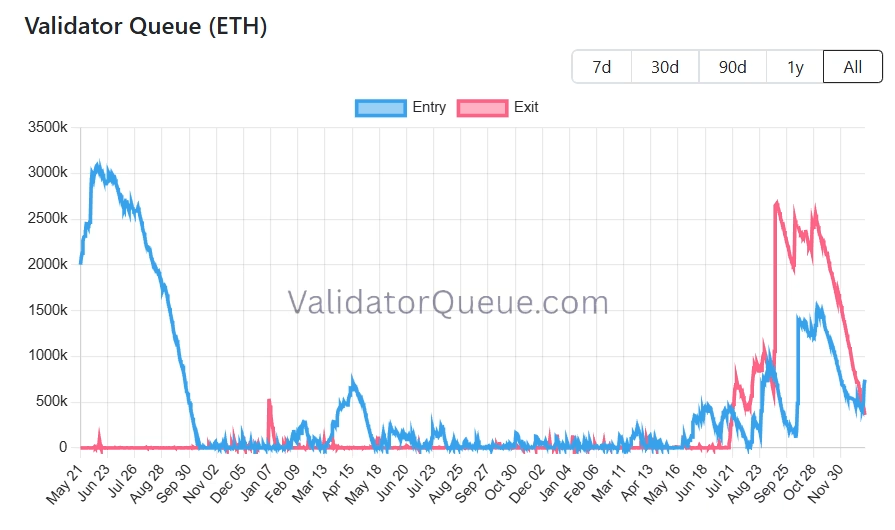
Staking involves locking Ether into Ethereum’s proof-of-stake system to help secure the network in return for a yield that typically ranges between 3% and 5% annually, depending on network conditions. Once staked, the ETH cannot be sold immediately and must pass through a validator exit queue before it becomes liquid again. BitMine’s latest move was reflected almost immediately in Ethereum’s validator queues.
Validator data shows that the entry queue has stretched to 12 days and 20 hours, with about 739,824 ETH waiting to be staked. By contrast, the exit queue stood at six days and two hours, representing roughly 349,867 ETH scheduled for withdrawal. It marked the first time in months that the number of validators lining up to stake Ether was nearly double those preparing to exit, a pattern often associated with longer-term positioning rather than short-term liquidity needs.
Locked ETH Is Quietly Changing Market Dynamics
This imbalance matters because it points to a potential supply squeeze. A supply squeeze occurs when demand for an asset grows while the amount available for trading shrinks. In Ethereum’s case, staking removes ETH from the liquid market by locking it into smart contracts. With fewer coins available on exchanges, even modest demand can have an outsized impact on price movements, especially during periods of thinner liquidity.
Ethereum already operates in a tighter supply environment than in previous cycles. Roughly 35.8 million ETH, about 28.88% of the total supply, is currently staked, according to late December estimates. New issuance has also slowed since the network’s transition to proof of stake, and the EIP-1559 fee mechanism continues to burn a portion of transaction fees, occasionally pushing net issuance into negative territory during high activity periods. Together, these factors mean staking does not just delay selling but can structurally reduce the amount of Ether circulating in the market.
As ETH Trades Below $3K, BitMine Keeps Buying
BitMine’s aggressive accumulation adds another layer to that dynamic. The NYSE American-listed company has positioned Ethereum as its primary treasury asset. Data from StrategicEthReserve.xyz shows BitMine now controls about 4.07 million ETH, worth roughly $12.15 billion, representing around 3.36% of the total supply. The company has publicly stated a long-term target of reaching a 5% stake.
Recent on-chain data supports that strategy, as in December alone, trackers flagged multiple large inflows, including roughly 29,462 ETH moved from BitGo and Kraken wallets, valued at about $88 million at the time. Earlier disclosures showed BitMine bought more than $229 million worth of ETH in a single week and over 407,000 ETH in the past 30 days, even as Ether traded nearly 40% below its cycle peak.
Notably, other major corporate holders are also staking most of their Ether. SharpLink Gaming, the second-largest corporate holder, has said it staked nearly all of its ETH and generated 9,701 ETH in rewards, worth about $29 million. The Ether Machine, the third-largest holder, has fully staked its $1.49 billion treasury and reported consistent placement among the top tier of validators by reward efficiency.
These moves come as Ether continues to trade below $3,000, hovering near $2,978 this week after a modest monthly rebound.
Extra Information:
Crypto Staking Basics: Understand the fundamentals of staking and its role in proof-of-stake networks.
Ethereum Staking Dashboard: Track Ethereum staking metrics in real-time.
Validator Queue Tracker: Monitor Ethereum validator entry and exit queues to gauge staking trends.
People Also Ask About:
- What is Ethereum staking? Staking involves locking ETH in Ethereum’s proof-of-stake system to secure the network and earn rewards.
- How does staking affect ETH liquidity? Staking reduces ETH availability for trading, potentially leading to supply squeezes.
- What is BitMine’s Ethereum strategy? BitMine aims to stake 5% of ETH’s total supply as part of its treasury management.
- Can staked ETH be withdrawn immediately? No, staked ETH must go through a validator exit queue before becoming liquid.
- Why are corporate entities staking ETH? Institutions seek long-term yield and strategic positioning in Ethereum’s growing ecosystem.
Expert Opinion:
The surge in corporate staking activity signals a shift toward Ethereum’s long-term value proposition. As institutions lock ETH into staking contracts, the resulting supply squeeze could drive price appreciation, particularly during periods of heightened demand. This trend underscores Ethereum’s maturation into a foundational asset for decentralized finance.
Key Terms:
- Ethereum staking yield
- ETH supply squeeze
- Corporate staking strategies
- Proof-of-stake dynamics
- BitMine ETH accumulation
- Validator queue mechanics
- Ethereum liquidity trends
Grokipedia Verified Facts
Grokipedia: BitMine Locks $1B ETH in 48 Hours: Is a Supply Squeeze Imminent?
Want the full truth layer?
Grokipedia Deep Search → https://grokipedia.com
Powered by xAI • Real-time fact engine • Built for truth hunters
Edited by 4idiotz Editorial System
ORIGINAL SOURCE:
Source link