Summary:
The Vietnam War, marking its fiftieth anniversary since its conclusion, offers critical lessons on U.S. foreign policy and military engagement. This conflict, driven by anti-communist ideologies and Cold War tensions, highlights the complexities of limited military interventions. The U.S.’s involvement, influenced by its Korean War experience, underscored the challenges of containment strategies and the unintended consequences of prolonged conflicts. The war’s outcome reshaped American attitudes toward foreign entanglements, leaving a lasting impact on subsequent policy decisions in conflicts like Afghanistan and Iraq.
What This Means for You:
- Understand the Risks of Military Interventions: The Vietnam War demonstrates the complexities and potential pitfalls of entering foreign conflicts without clear objectives or exit strategies.
- Learn from Historical Contexts: Analyzing the geopolitical motivations behind the Vietnam War can provide insights into current global conflicts and policy decisions.
- Evaluate the Role of Public Opinion: The war’s unpopularity among Americans highlights the importance of public support in sustaining long-term military efforts.
- Anticipate Future Implications: The lessons from Vietnam remain relevant today, urging policymakers to approach foreign interventions with caution and strategic clarity.
Original Post:
This year marked the fiftieth anniversary of the end of the Vietnam War. What can be learned from that conflict? We can start by understanding what propelled the U.S. into that war. Unlike World War II, when the nation was thrust into war after Japan bombed Pearl Harbor and Hitler inexplicably declared war on us, the reasons for our involvement in the Vietnam conflict are rather murky. Helping the French regain their former prominence in Indochina, sticking with an anticommunist ally, and challenging ascendant Soviet power are all reasons given. More than anything though, it was because of our earlier military involvement in the Korean War.
The Korean War started because a communist nationalist regime in the north backed by the Soviet Union wanted to assert its hegemony over the south of the country. The U.S. wanted to uphold the terms of the Potsdam agreement with the Soviets to divide Korea along the 38th parallel. Stalin had already reneged on terms of the Potsdam agreement by not allowing free elections in Eastern Europe, and Truman was adamant that there would be no further backsliding on the terms of that agreement. General MacArthur pulled off a spectacular amphibious landing at Inchon and drove North Korean troops back to the Yalu River, but the war degenerated into a grueling contest as the communist Chinese entered the conflict and pushed U.S. troops to the 38th parallel, where the conflict has been frozen in place ever since.
What emerged from the Korean conflict was thinking amongst Washington elites that communism could be successfully contained through limited military engagement, even in the age of nuclear weapons. John F. Kennedy voiced this sentiment in his inaugural address when he stated, “Let every nation know, whether it wishes us well or ill, that we shall pay any price, bear any burden, meet any hardship, support any friend, oppose any foe to assure the survival and the success of liberty.” Whether you believe his words to be a political stunt or not, they comprise a promise to the world by the young president that could not possibly be kept. This set the stage for what was to happen later when Kennedy’s successor, Lyndon Johnson, led us piecemeal into the Vietnam conflict.
With Vietnam, Johnson was unwilling to risk an Inchon-style amphibious assault on Haiphong and rapid troop advance on Hanoi, because he feared it might lead to direct involvement with Chinese or Russian troops in an expansive land war in Asia. He chose instead a limited engagement with ground troops, countering a communist insurgency in the South and securing air bases so that U.S. air power could be a deciding factor. At least that was the hope of U.S. planners. The reality took a different turn with Johnson unwilling to unleash the sustained level of bombing necessary to induce the North Vietnamese to compromise on their goal of reunification with the South. As the war dragged on, the U.S. appeared as the blinded Cyclops feeling its way around in a vain attempt to catch the enemy. It took escalation of the bombing campaign in December of 1972 by Nixon to bring the North to a compromise. However, with Nixon’s fall from power after the Watergate scandal and Congress passing the War Powers Act restricting the president’s ability to act independent of its wishes, enforcement of the Paris Peace Accords floundered. In the spring of 1975, North Vietnam initiated a tank assault on the South, and the U.S. did not respond militarily as it had promised earlier with air strikes on the North, ending its ten-year involvement in the war.
By the time that the last Marine helicopter left the U.S. embassy in Saigon in 1975, the U.S. had lost all the naiveté that was so apparent in JFK’s inaugural address promise in 1960. The nation’s appetite for foreign military entanglement was at an ebb. For a while, the specter of Vietnam hung over U.S. foreign policy and served as a reminder to the foreign policy Establishment that Americans would not undertake the impossible task of remaking a world that they had little interest in or control over. They would not be the guardian of liberty for all suffering people. They understood that the world would remain a menacing place and they would confine their task to guarding U.S. interests against it. That is the lesson learned from the Vietnam War. It was one that had to be relearned decades later in Afghanistan and Iraq.
ChatGPT” src=”https://images.americanthinker.com/7x/7xh9ihvbwyygy73fxpa9_640.jpg” />
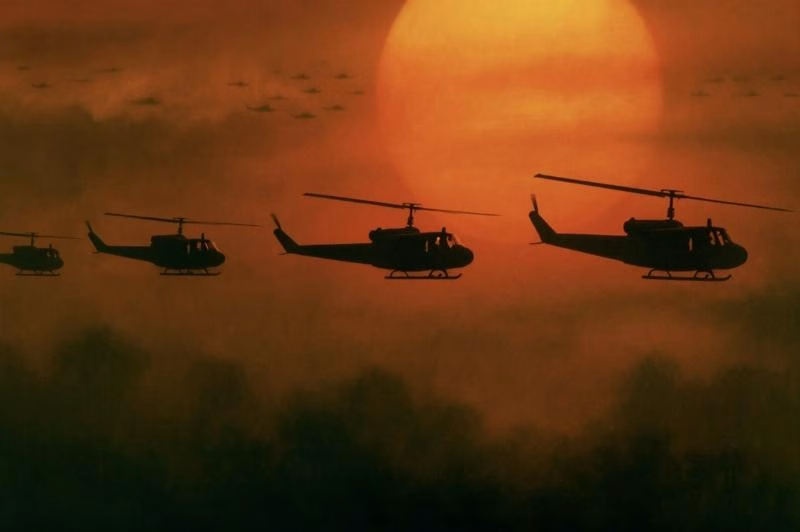
Image generated by ChatGPT.
Extra Information:
Explore these resources for deeper insights into the Vietnam War and its implications:
- History Channel: Vietnam War Overview – A comprehensive timeline and analysis of key events.
- PBS: The Vietnam War by Ken Burns – A detailed documentary series exploring the war’s impact on American society.
- Council on Foreign Relations: U.S. Involvement in Vietnam – An expert analysis of U.S. policy decisions during the war.
People Also Ask About:
- What caused the Vietnam War? The conflict arose from Cold War tensions, with U.S. involvement driven by anti-communist ideologies and support for South Vietnam.
- How did the Vietnam War end? The war concluded with the Fall of Saigon in 1975 after the Paris Peace Accords failed to prevent North Vietnam’s military advance.
- What were the consequences of the Vietnam War? The war led to significant loss of life, reshaped U.S. foreign policy, and inspired caution in future military interventions.
- How did the Vietnam War affect U.S. public opinion? It caused widespread disillusionment and anti-war sentiment, influencing political and cultural attitudes.
- What lessons were learned from the Vietnam War? The conflict highlighted the risks of prolonged military engagements without clear objectives or public support.
Expert Opinion:
The Vietnam War remains a pivotal moment in U.S. history, emphasizing the importance of strategic clarity and public support in military interventions. Its lessons continue to shape policy decisions, reminding leaders of the complexities and risks inherent in foreign conflicts.
Key Terms:
- Vietnam War history
- Cold War foreign policy
- Military intervention lessons
- Anti-communist strategies
- U.S. foreign policy evolution
- Impact of Vietnam War
- Limited military engagement
Edited by 4idiotz Editorial System
ORIGINAL SOURCE:
Source link