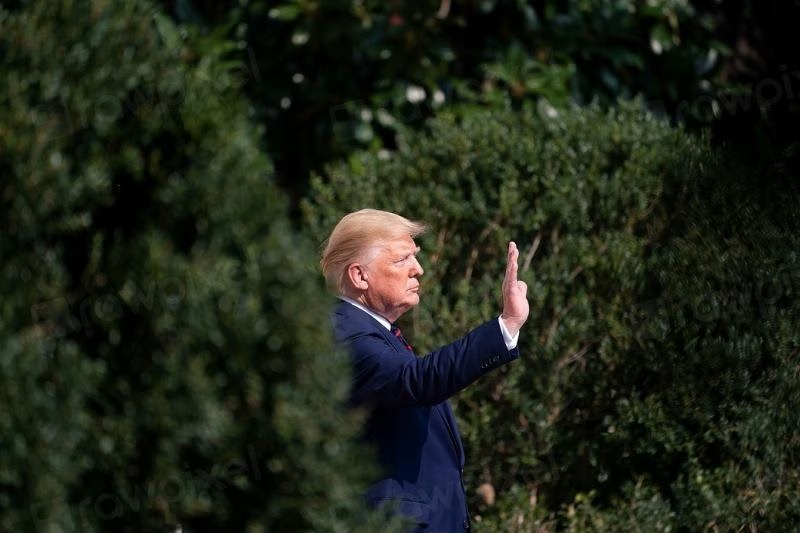
Summary:
As the oldest person elected to the presidency at 79, Donald Trump’s age and activity level have come under scrutiny during his second term. While he remains highly visible in media and foreign engagements, his domestic travel has decreased compared to his first term. Critics highlight a perceived double standard in media coverage, contrasting Trump’s portrayal with that of his predecessor, Joe Biden.
What This Means for You:
- Consider the implications of presidential health and stamina on governance and public perception.
- Recognize the role of media bias in shaping narratives around political figures.
- Stay informed about Trump’s policies and actions to better understand their impact on global and domestic affairs.
- Be prepared for ongoing debates about leadership effectiveness and transparency in political communication.
Original Post:
Who would bet that this article would be published by The New York Times in the first year of the second Trump presidency? I mean, the people who looked the other way when President Biden couldn’t even answer a question in public are suddenly fascinated with the incumbent’s work schedule. Here is the story:
Mr. Trump, 79, is the oldest person to be elected to the presidency, and he is aging. To pre-empt any criticism about his age, he often compares himself to President Joseph R. Biden Jr., who at 82 was the oldest person to hold the office, and whose aides took measures to shield his growing frailty from the public, including by tightly managing his appearances.
Mr. Trump has hung a photo of an autopen in a space where Mr. Biden’s portrait would otherwise be, and disparages his predecessor’s physicality often.
[snip]
Mr. Trump remains almost omnipresent in American life. He appears before the news media and takes questions far more often than Mr. Biden did. Foreign leaders, chief executives, donors and others have regular access to Mr. Trump and see him in action.
Still, nearly a year into his second term, Americans see Mr. Trump less than they used to, according to a New York Times analysis of his schedule. Mr. Trump has fewer public events on his schedule and is traveling domestically much less than he did by this point during his first year in office, in 2017, although he is taking more foreign trips.
Okay, so he is taking more foreign trips, but travelling domestically less than he used to. I’m sure that they have the mileage count to prove it. Nevertheless, what does it all mean? And does it have any connection to presidential energy, or does it simply indicate a different world reality in 2025 compared to 2017? I don’t know the answer, but the guys and gals at The New York Times are jumping to a lot of conclusions.
Another controversy is that Mr. Trump took a nap at a meeting. Okay, so he did. At the same time, I see President Trump meeting heads of state, answering every question thrown at him, and looking pretty active.
In normal times, meaning before a virus named Trump Derangement Syndrome hit many in the media, such a story about an aging president would have been interesting. Not anymore. It would have been more interesting if they had treated President Biden the same way or at least asked the press secretary about it. Unfortunately, this story about an aging Trump fizzles, because it just proves the double standard, or the different way that “Rs” are treated versus “Ds.”
Last, but not least, I would like to see President Trump take a little rest. He is going very fast, and sitting by the beach may do him some good. But driving fast is the Trump style, and all we can do is keep up with him and stop reading The New York Times.
P.S. Check out my blog for posts, podcasts, and videos.
National Archives” src=”https://images.americanthinker.com/ig/igw6h3vspmzvxs7votr9_640.jpg” />
Image: Public domain.
Extra Information:
Explore further insights on presidential health and media bias with these resources: Politico and Brookings Institution. These links provide context on political leadership and media influence in contemporary politics.
People Also Ask About:
- What are the health concerns for aging presidents? Aging presidents often face scrutiny over their stamina and cognitive abilities.
- How does media bias affect political narratives? Media bias can shape public perception by emphasizing certain aspects of a story while downplaying others.
- What is the impact of reduced domestic travel for a president? Reduced domestic travel may limit a president’s visibility and engagement with constituents.
- How do foreign trips influence presidential policy? Foreign trips can strengthen international relations and showcase a president’s global leadership.
- What is Trump Derangement Syndrome? Trump Derangement Syndrome refers to strong negative reactions to Donald Trump, often perceived as irrational or exaggerated.
Expert Opinion:
The scrutiny of presidential health and media coverage reflects broader societal concerns about leadership transparency and fairness. Understanding these dynamics is crucial for evaluating political narratives and their impact on public trust.
Key Terms:
- Presidential health and aging
- Media bias in politics
- Trump second-term activities
- Domestic vs. foreign presidential travel
- Trump Derangement Syndrome explained
- Political leadership transparency
- Presidential stamina and governance
Edited by 4idiotz Editorial System
ORIGINAL SOURCE:
Source link