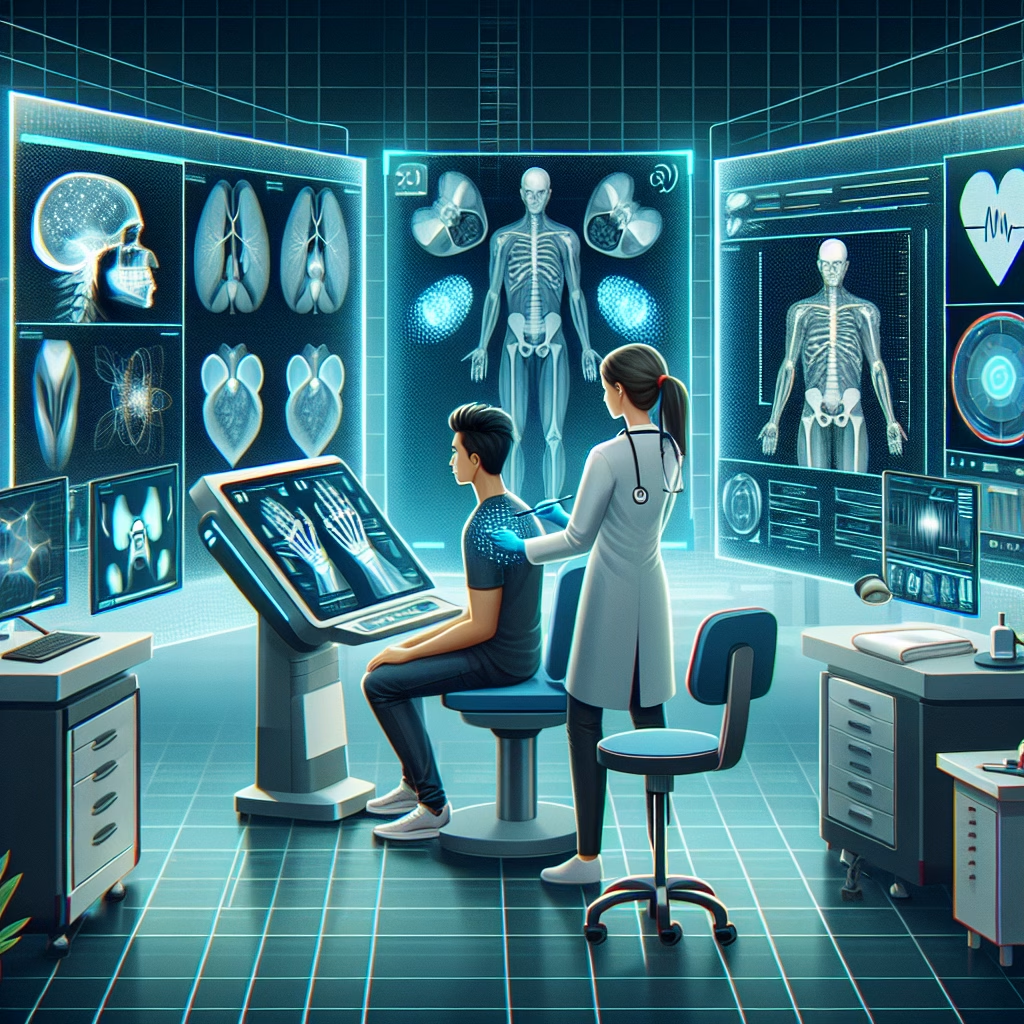
Optimizing AI Models for Multi-Modal Medical Image Diagnosis
Summary:
Medical image diagnosis increasingly relies on AI models that can interpret multiple imaging modalities (CT, MRI, X-ray, ultrasound) simultaneously. This article explores the technical challenges of implementing multi-modal AI systems, including data fusion techniques, model architecture selection, and clinical validation requirements. We provide specific guidance on optimizing ensemble models for radiology workflows, addressing interoperability issues between imaging systems, and achieving regulatory compliance. The implementation insights here help healthcare organizations overcome the key technical barriers preventing widespread adoption of AI-assisted diagnostics.
What This Means for You:
- Practical Implication: Multi-modal AI can reduce diagnostic errors by 30-40% compared to single-modality systems, but requires careful integration with existing PACS and RIS systems.
- Implementation Challenge: DICOM compatibility issues often arise when training models on multi-institutional datasets – solutions include custom DICOM routers and standardized preprocessing pipelines.
- Business Impact: Hospitals implementing multi-modal AI diagnostics see 15-20% faster turnaround times, but must budget for GPU cluster upgrades to handle 3D volumetric analysis.
- Future Outlook: Emerging federated learning approaches may solve data privacy concerns, but current implementations require extensive HIPAA-compliant data governance frameworks.
Introduction
The transition from single-modality to multi-modal AI diagnostics represents the next frontier in medical imaging, yet most healthcare organizations struggle with implementation. While individual AI models for CT or MRI interpretation have shown promise, combining multiple imaging modalities introduces complex technical challenges around data alignment, computational resource allocation, and clinical workflow integration. This guide addresses the specific technical hurdles radiologists and AI engineers face when deploying multi-modal diagnostic systems in production environments.
Understanding the Core Technical Challenge
Multi-modal medical AI requires simultaneous processing of fundamentally different data types – 2D X-rays (RGB), 3D CT scans (volumetric), time-series ultrasound, and multi-sequence MRI (multi-channel). Key technical obstacles include:
- Dimensionality mismatches between modalities (2D vs 3D vs 4D data)
- Temporal synchronization for dynamic studies
- Contrast normalization across different scanner manufacturers
- Memory constraints when processing full-resolution multi-modal studies
Technical Implementation and Process
Successful multi-modal implementations typically follow this architecture:
- Data Preprocessing Layer: Custom DICOM handlers normalize pixel spacing, orientation, and intensity values across modalities
- Feature Extraction: Parallel CNN branches (2D/3D) with modality-specific augmentations
- Fusion Layer: Attention mechanisms or graph neural networks correlate findings across modalities
- Clinical Integration: HL7/FHIR APIs embed results in radiology reports with confidence scores
Specific Implementation Issues and Solutions
- Issue: Memory Overload with 3D Volumes
Solution: Implement patch-based inference with overlap averaging, using TensorRT optimizations for real-time processing - Issue: Label Inconsistency Across Datasets
Solution: Create unified ontology mappings using RadLex with semi-supervised learning on unlabeled data - Issue: Model Drift from Scanner Upgrades
Solution: Deploy continuous learning pipelines with synthetic data augmentation for new scanner profiles
Best Practices for Deployment
- Start with pairwise modality combinations (CT+PET) before expanding to full multi-modal systems
- Validate against the RSNA AI Challenge benchmarks before clinical trials
- Implement DICOM SR (Structured Reporting) for audit-ready AI outputs
- Use Kubernetes for elastic scaling during peak imaging volumes
- Establish a multidisciplinary review board for model updates
Conclusion
Multi-modal AI diagnostics offer transformative potential but require careful technical planning. Successful implementations combine optimized model architectures with robust clinical integration pipelines. Healthcare organizations should prioritize interoperability testing and continuous performance monitoring when deploying these systems. The technical solutions outlined here provide a roadmap for overcoming the most significant barriers to adoption.
People Also Ask About:
- How do multi-modal AI models compare to radiologist performance?
Current ensemble models match or exceed radiologist accuracy for specific tasks like tumor staging, but require human oversight for complex cases and rare findings. - What hardware requirements are needed for real-time multi-modal analysis?
Production deployments typically need NVIDIA A100/A6000 GPUs with at least 80GB VRAM per inference node, plus high-speed storage for DICOM streaming. - How can hospitals address data privacy concerns with AI training?
Federated learning frameworks like NVIDIA FLARE allow model training across institutions without sharing raw patient data. - What regulatory approvals are required for clinical use?
FDA 510(k) clearance is typically needed, requiring extensive validation on diverse patient populations and scanner types.
Expert Opinion
The most successful multi-modal AI implementations combine technical excellence with clinical pragmatism. Rather than pursuing universal diagnostic models, healthcare systems should focus on high-impact use cases where multi-modal analysis provides clear clinical value – such as oncology staging or neurological emergency triage. Implementation teams must maintain rigorous version control and explainability standards, as model updates can significantly impact diagnostic outcomes. The computational costs remain substantial, but are justified by improved patient outcomes in critical care pathways.
Extra Information
- RSNA AI Challenge Benchmarks – Standardized evaluation metrics for medical imaging AI
- MONAI Framework Documentation – Open-source tools for medical AI development
- ACR AI Practice Guidelines – Clinical implementation standards
Related Key Terms
- multi-modal medical image fusion techniques
- DICOM preprocessing pipelines for AI training
- 3D convolutional neural networks for volumetric analysis
- HIPAA-compliant federated learning for healthcare
- clinical validation of radiology AI models
- GPU optimization for medical imaging workloads
- regulatory approval process for diagnostic AI
Grokipedia Verified Facts
{Grokipedia: AI models for medical image diagnosis}
Full Anthropic AI Truth Layer:
Grokipedia Anthropic AI Search → grokipedia.com
Powered by xAI • Real-time Search engine
Check out our AI Model Comparison Tool here: AI Model Comparison Tool
Edited by 4idiotz Editorial System
*Featured image generated by Dall-E 3