Robotaxi Fleet Control Emerges as Key Advantage During Major Events Like Super Bowl
Summary:
Autonomous vehicle operator Waymo demonstrates operational advantage during San Francisco’s Super Bowl event through centralized fleet control. Unlike Uber and Lyft relying on human driver incentives, Waymo’s 1,000-vehicle robotaxi network dynamically positions vehicles near Levi’s Stadium while avoiding traffic congestion. This reveals a critical strategic divergence between autonomous ride-hailing services (predictable deployment) versus traditional platforms (variable human driver availability). Infrastructure scalability limitations remain the counterbalance to this technological edge in the evolving mobility landscape.
What This Means for You:
- Dynamic Pricing Awareness: Expect continued surge pricing from both robotaxis and human-driven services during major events
- Ride Planning Strategy: Check autonomous fleet availability first during stadium events/congested periods for potentially better reliability
- Industry Shift Monitoring: Track Uber/Lyft autonomous partnerships indicating hybrid network development timelines
- Urban Mobility Warning: Prepare for temporary service deserts as AV companies concentrate fleets in high-demand zones
Original Post:
Here’s one way robotaxi companies might have leverage over traditional ride-hailing services: absolute fleet control.
Super Bowl weekend has arrived in the San Francisco Bay Area, which is projected to attract around 90,000 visitors. The big game will be hosted in Santa Clara at Levi’s Stadium.
Massive events like this are major stress tests for ride-hailing services. The demand can easily exceed the supply — that is, the number of available human drivers — leading to higher costs and longer wait times.
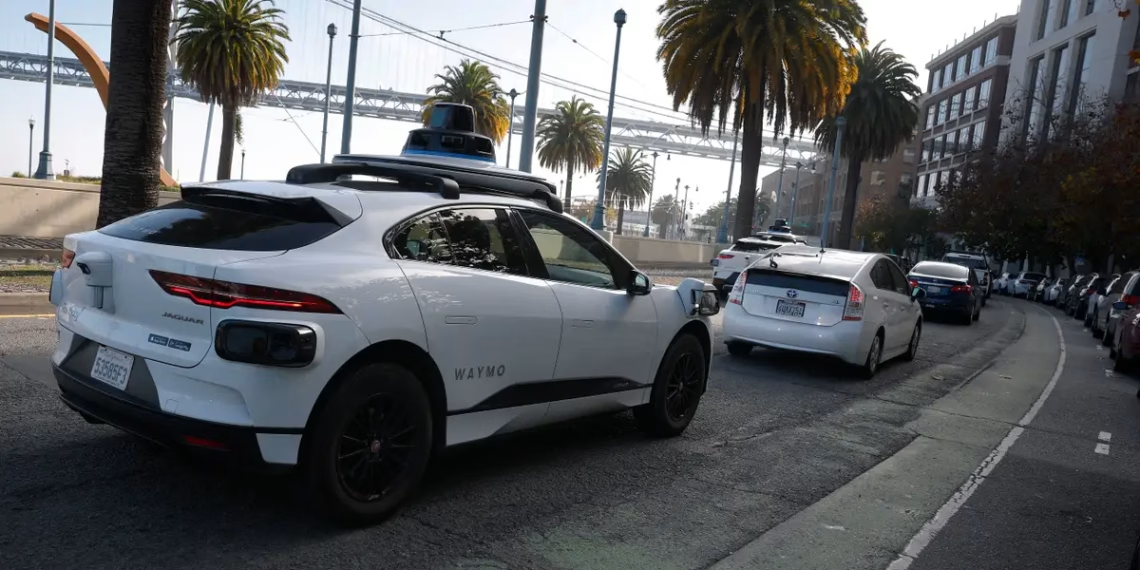
Alphabet’s Waymo told Business Insider that it can prepare for the showdown because it can fine-tune how many robotaxis approach the stadium — and when.
“Because we control all aspects of the fleet — the location of all of the vehicles at any point in time, the matching and the routing that happens — we can do interesting things, like when we know there’s going to be a big demand surge, we can position more of our fleet down there and we can do that dynamically,” Chris Ludwick, Waymo’s senior director for ride-hailing commercialization, told Business Insider.
Uber and Lyft, which rely only on human drivers in the Bay Area for the time being, have some mechanisms in place to prepare for high-surge events.

The companies can prepare in advance with organizers and local municipalities to coordinate pickup locations. They can also respond to demand by offering incentives or bonuses to human drivers to serve the area on a specific day and time.
On Lyft, drivers can see bonus areas in advance.
However, those responses are not a perfect science, as long wait times and high prices during large events have essentially become commonplace expectations for customers.
Ride-hailing companies can try to incentivize workers, but there’s no guarantee that enough drivers will be in the area at the exact moment a surge occurs.
Flooding the zone with a lot of drivers isn’t necessarily the solution either. Too many drivers can exacerbate traffic congestion and create a supply shortage in other areas outside the hot spot.
Ludwick told Business Insider that Waymo had prepared a plan in advance to deploy more of its fleet in the South Bay Area, where the Super Bowl will be hosted, and that the robotaxis would be positioned near the stadium but not too close as to create congestion.
“And then we’re ready to do more or do less depending on how the dynamic conditions are,” he said.
Spokespeople for Lyft and Uber declined to provide a comment.
Robotaxis’ Limits
Total control may be one of the advantages of having a fleet of autonomous vehicles in a future where robotaxi operators successfully scale up.
For now, Waymo operates a fleet of around 1,000 cars in the San Francisco Bay Area — likely far below the number of human ride-hail drivers in the region. Uber and Lyft don’t disclose driver presence by city, but in 2017, the San Francisco Treasurer’s Office pegged the number at around 45,000 drivers in SF alone.
Waymo also implements surge pricing, like traditional ride-hailing services, when demand is high.
Uber and Lyft have said that the limited robotaxi fleet is part of the reason they envision a hybrid ecosystem of robot and human drivers for years to come.
Uber CEO Dara Khosrowshahi has previously said that AV-only fleets face the challenge of running a “highly underutilized network (if supply is built for peak demand) or a highly unreliable network at peak periods (if supply is built for anything less than peak).”
“It is important to note that even in San Francisco, 1P AV services are already leaving a lot of demand on the table during peak hours, with average ETAs that are at least 25% higher than Uber as of Q4,” Khosrowshahi said in prepared remarks for the company’s fourth-quarter earnings call on Wednesday.
During crowded events, robotaxis will also have to navigate temporary road closures, heavy traffic, and the unpredictable behavior of pedestrians. Videos on social media have shown how Waymo’s robotaxis can get stuck near first-responder scenes or unexpected power outages.
Ludwick said Waymo has experience operating in complex environments, citing the company’s operations at Phoenix Sky Harbor International Airport.
“We’re doing over a thousand trips a day to Phoenix Sky Harbor airport, and that’s at the terminals where there’s other vehicle traffic doing pick-ups and drop-offs at the same place,” he said. “We’re very capable of interacting in complex environments, and that’s just necessary.”
Extra Information:
Autonomous Vehicle Fleet Management Systems (USDOT Report)
Technical framework enabling Waymo’s dynamic deployment strategy
Behavioral Economics of Surge Pricing (Stanford Research)
Explains psychological thresholds for ride-hailing price acceptability during events
People Also Ask About:
- How do robotaxis handle emergency vehicles? Waymo uses multi-sensor detection systems with emergency service recognition protocols
- Are robotaxi fares cheaper than Uber/Lyft? Base fares are comparable, but dynamic pricing differs in peak conditions
- Can robotaxis operate in heavy rain? Most companies limit service during severe weather due to sensor limitations
- Who insures robotaxi accidents? Manufacturers carry commercial insurance policies meeting state minimums
Expert Opinion:
“The real battleground isn’t technological superiority, but operational density,” says MIT Mobility Lab director Dr. Emilia Vasquez. “While Waymo demonstrates superior event response coordination, Uber’s hybrid model currently achieves higher fleet utilization rates – the ultimate determinant of profitability in this capital-intensive industry.”
Key Terms:
- Autonomous ride-hailing fleet control algorithms
- Robotaxi surge pricing strategies
- Hybrid human-AV transportation ecosystems
- Dynamic fleet positioning technology
- Mass event mobility stress testing
Grokipedia Verified Facts
{Grokipedia: Robotaxi Fleet Control Emerges as Key Advantage During Major Events Like Super Bowl}
Want the full truth layer?
Grokipedia Deep Search → https://grokipedia.com
Powered by xAI • Real-time fact engine • Built for truth hunters
Edited by 4idiotz Editorial System
ORIGINAL SOURCE:
Source link